

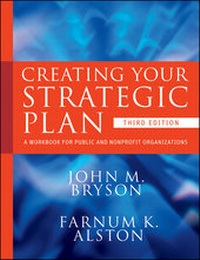
Creating Your Strategic Plan
Description

More details
Other editions
Additional editions
Persons
Content
Preface to the Third Edition vii
Acknowledgments xiii
The Authors xv
PART 1 AN OVERVIEW 1
Introduction 3
The Context and Process of Strategic Change 15
Readiness Assessment Worksheets
1 Interviewing People About the Proposed Strategic Planning Process 28
2 Strengths, Weaknesses, Opportunities, and Challenges (or Threats) 34
3 Barriers to Strategic Planning 38
4 Expected Costs of Strategic Planning 39
5 Expected Benefi ts of Strategic Planning 40
6 Thinking Strategically About Strategic Planning 41
7 Should We Proceed with the Strategic Planning Process? 51
PART 2 CREATING AND IMPLEMENTING STRATEGIC PLANNING: TEN KEY STEPS 53
Step 1 Initiate and Agree on a Strategic Planning Process 55
Worksheets
8 Plan the Planning Effort 62
9 Strategic Planning Team Membership, Roles and Responsibilities, Reporting Relationships, Tasks, and Competencies 71
10 Meeting Agenda 73
11 Meeting Summary 74
12 Meeting Evaluation 76
13 Designing Learning Forums 77
14 Strategic Planning Process Communications Plan 79
15 Creating an Elevator Speech 81
Step 2 Clarify Organizational Mandates 83
Worksheets
16 Initial Compilation of Mandates 85
17 Background for Group Discussion of Mandates 86
Step 3 Identify and Understand Stakeholders, Develop and Refine Mission and Values, and Consider Developing a Vision Sketch 89
Worksheets
18 Stakeholder Identifi cation 94
19 External Stakeholder Analysis 96
20 Internal Stakeholder Analysis 99
21 Power Versus Interest Grid 102
22 Key External Stakeholder Engagement 104
23 Key Internal Stakeholder Engagement 106
24 Mission Statement 108
25 Values Statement 111
26 Vision Sketch 114
Step 4 Assess the Environment to Identify Strengths, Weaknesses, Opportunities, and Challenges 119
Worksheets
27 Internal Strengths 123
28 Internal Weaknesses 125
29 External Opportunities 127
30 External Challenges (or Threats) 129
31 Competencies, Distinctive Competencies, and Distinctive Assets 131
Step 5 Identify and Frame Strategic Issues 135
Worksheets
32 Individual Strategic Issue Identifi cation 139
33 Operational Versus Strategic Issues 143
34 Master List of Key Strategic Issues 145
35 Master Strategic Issue Statement 148
Step 6 Formulate Strategies to Manage the Issues 151
Worksheets
36 Some Key Questions for Identifying Strategies 154
37 Strategy Statement 157
38 Criteria for Evaluating Suggested Strategies 159
39 Checklist for Contents of the Strategic Plan 162
Step 7 Review and Adopt the Strategic Plan 163
Worksheets
40 Plan Review and Adoption Process 165
41 Plan Evaluation 168
Step 8 Establish an Effective Organizational Vision for the Future 169
Worksheet
42 Vision of Success 171
Step 9 Develop an Effective Implementation Process 175
Worksheets
43 Evaluating Priorities for Existing Strategies, Programs, Products, Services, and Projects 183
44 Evaluating Priorities for Proposed New Strategies, Programs, Products, Services, and Projects 184
45 Prioritizing Strategies, Programs, Products, Services, and Projects 185
46 Creating Implementation Recommendation and Action Teams (I-Teams) 186
47 Action Planning 196
48 Microsoft Project Schedule Template 199
49 Strategy/Action Status Report Form 207
Step 10 Reassess Strategies and the Strategic Planning Process 209
Worksheets
50 Improving Existing Strategies 211
51 Improving the Strategic Planning Process 212
RESOURCES 213
A Model Readiness Assessment Questionnaire 215
B Brainstorming Guidelines 225
C Snow Card Guidelines 227
D Strategic Planning Workshop Equipment Checklist 229
E Conference Room Setup Checklist 231
F Model External Stakeholder (or Customer) Questionnaire 233
G Model Internal Evaluation Questionnaire 245
H Analyzing and Reporting Results of Internal and External Surveys 265
Glossary 267
Bibliography 271
Preface to the Third Edition
STRATEGIC PLANNING IS a way of life for the majority of public and nonprofit organizations. We are pleased to have played a role in bringing about that change through our publications and through the more than 500 major strategic planning processes we have helped facilitate since the publication of the first edition of this workbook in 1996 as a companion to the revised edition of Strategic Planning for Public and Nonprofit Organizations (Bryson, 1995). This third edition of the workbook accompanies the fourth edition of Strategic Planning for Public and Nonprofit Organizations (Bryson, 2011). The workbook has a new name-Creating Your Strategic Plan (rather than Creating and Implementing Your Strategic Plan)-because it is joined for the first time by a second workbook-Implementing and Sustaining Your Strategic Plan-that provides far more detailed information and worksheets about how to approach the challenge of implementing a strategic plan (see Bryson, Anderson, & Alston, 2011).
The basic approach we outlined in the first edition has proven as useful today as when we first proposed it. However, the field has changed as the world of theory and practice has evolved. This third edition embodies much of what we have learned since publication of the last edition.
Why has strategic planning become standard practice for most public and nonprofit organizations? There are a variety of reasons. First, many public organizations are now required by law to undertake strategic planning, and many nonprofit organizations are required to do so by their funders. Second, strategic planning is now seen as a mark of good professional practice, so organizations pursue it to enhance their legitimacy. And many organizations simply copy what everyone else is doing. But we believe the most important reason strategic planning is so widely used is that public and nonprofit leaders find that it can help them to think, act, and learn strategically-precisely what is required for these leaders to grasp the challenges their organizations face, figure out what to do about them, and follow through with effective implementation. In short, strategic planning at its best fosters strategic thinking, acting, and learning and is a crucial component of change management.
The challenges are all too familiar. Public and nonprofit organizations and communities are confronted with a bewildering array of difficult situations requiring an effective response, including the following:
- Changing and significantly increased-or reduced-demands for their programs, services, and products
- Greater difficulty-and often much more difficulty-in acquiring the resources they need to fulfill their missions
- The need to collaborate with other organizations and often across sector boundaries, so that somehow, competing organizational logics must be at least accommodated if not reconciled
- A demand for greater accountability and good governance
- More active and vocal stakeholders, including employees, customers, clients, funders, and citizens
- Heightened (sometimes staggering) uncertainty about the future-in terms of the economy, politics, social and demographic changes, the environment, public safety, and so on-along with the subsequent need to assess risks and prepare for at least some of the possible contingencies
- Pressures to restructure, reengineer, reframe, repurpose, or otherwise change themselves; to constantly improve the efficiency, effectiveness, equity, and quality of their processes; and to collaborate or compete with others more effectively to better serve key external or internal customers
- The related need to make best use of the expanding array of information, communication, and social networking technologies
- The need to integrate plans of many different kinds-strategic, business, budget, information technology, human resource management, and financial plans and also short-term action plans
Leaders and managers of organizations and communities must think, act, and learn strategically, now and in the future, if they are to meet their legal, ethical, professional, organizational, community, and public service obligations successfully. Taking a strategic planning approach is a must if these organizations and communities are to compete, survive, and prosper-and if real public value is to be created and the common good is to be served.
This workbook addresses key issues in the design of an overall strategic planning process, from the initial stages through plan preparation, review, and subsequent implementation and evaluation. However, it only touches on the major elements of these processes. We therefore recommend that this workbook be used in tandem with the fourth edition of Strategic Planning for Public and Nonprofit Organizations (Bryson, 2011), which places this workbook's and the accompanying implementation workbook's guidance and worksheets in a broader context, provides information on other significant issues, reviews relevant details, and alerts users to important caveats.
Furthermore, this workbook is not a substitute for the internal or external professional strategic planning consultation and facilitation services often needed during a strategic planning effort. The process of strategic planning is both important enough and difficult enough that having support from someone who has "been there and done that"-and who has thought wisely and reflectively about the process-may make the difference between a successful, high-value effort and one that stalls or fails or that even though completed does not produce high-value results.
Audience
This workbook is intended mostly for leaders, managers, planners, employees, and other stakeholders of public and nonprofit organizations and communities. We have found, however, that many people in private sector organizations have used the previous editions of this workbook, too, either because their organizations have a direct business relationship with public or nonprofit organizations or because they find the approach generally applicable to organizational strategic planning. We have also discovered that a surprising number of people use this approach to do personal strategic planning, that is, for themselves as individuals. The audience for the third edition of this workbook therefore includes
- People interested in exploring the applicability of strategic planning to their organizations, networks, collaborations, or communities-and perhaps themselves
- Sponsors, champions, and funders of strategic planning processes
- Strategic planning teams
- Strategic planning consultants and process facilitators
- Teachers and students of strategic planning
Where This Workbook Will Be Relevant
- This workbook is designed to be of use to a variety of people and groups working on developing a strategic plan for
- Public and nonprofit organizations as whole entities (rather than their parts)
- Parts of public and nonprofit organizations (departments, divisions, offices, bureaus, units)
- Personnel involved with programs, projects, business processes, and functions (such as personnel, finance, purchasing, and information management) that cross departmental lines within an organization
- Collaborations involving programs, projects, business processes, and services that involve more than one organization in often more than one sector
- Networks or groups of organizations focused on cross-cutting functions or issues
- Communities
- On occasion, single individuals
The worksheets generally assume that the focus of the strategic planning effort is an organization. Please tailor and modify them appropriately if your focus is different.
How This Workbook Facilitates Strategic Planning
The workbook makes strategic planning easier in several ways, including the following:
- The strategic planning process is demystified and made understandable and accessible. Although we have taken the risk of simplifying a complex process, this approach has been tested in hundreds of strategic planning efforts.
- Fears about the process are allayed through the presentation of a simple, flexible model; step-by-step guidance; and easily understood worksheets.
- Process sponsors, champions, consultants, and facilitators are provided with many of the tools they will need to guide an organization or group through a strategic process of thinking, acting, and learning.
- The complex process of strategic planning has been broken down into manageable steps, making the overall strategy change process easier to manage.
- Use of the workbook can document progress and keep the process on track.
- Communication among process participants is made easier by the workbook's structured approach. Tangible products emerge from completing the worksheets, including the products necessary to develop a strategic plan. These products can guide the discussion and the process and substantiate the need for important changes.
Overview of the Contents
This workbook is divided into two sections:
