

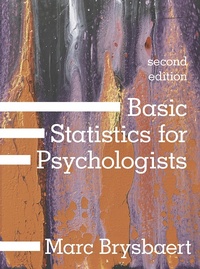
Basic Statistics for Psychologists
2nd Edition
Published on 5. October 2019
560 pages
978-1-350-31248-7 (ISBN)
Description

Written by an experienced teacher of statistics, the new edition of this accessible yet authoritative textbook covers all areas of undergraduate statistics and provides a firm foundation upon which students can build their own knowledge.
Featuring new chapters on Bayesian and multiple regression analysis, this book gives students a working understanding of how to conduct reliable and methodical research using statistics. Brysbaert illustrates the key concepts using examples from psychological research, with clear formulas and explanations for calculations. With helpful chapter-by-chapter guidance for carrying out tests using SPSS, as well as coverage of jamovi and JASP software, this book aims to develop students' confidence in statistical analysis, and to take the fear out of the topic. It offers an easily navigable layout filled with features that help learners to avoid common pitfalls and check their understanding along the way.
This engaging and informative guide is essential reading for undergraduate psychology students taking courses in research methods and statistics.
New to this Edition:
- Chapters on Bayesian analysis, mixed-effects models, and multiple regression analysis
- Coverage of jamovi and JASP, two free statistical packages
Featuring new chapters on Bayesian and multiple regression analysis, this book gives students a working understanding of how to conduct reliable and methodical research using statistics. Brysbaert illustrates the key concepts using examples from psychological research, with clear formulas and explanations for calculations. With helpful chapter-by-chapter guidance for carrying out tests using SPSS, as well as coverage of jamovi and JASP software, this book aims to develop students' confidence in statistical analysis, and to take the fear out of the topic. It offers an easily navigable layout filled with features that help learners to avoid common pitfalls and check their understanding along the way.
This engaging and informative guide is essential reading for undergraduate psychology students taking courses in research methods and statistics.
New to this Edition:
- Chapters on Bayesian analysis, mixed-effects models, and multiple regression analysis
- Coverage of jamovi and JASP, two free statistical packages
More details
Edition
2nd edition
Language
English
Place of publication
London
United Kingdom
Publishing group
Bloomsbury Publishing PLC
Target group
College/higher education
Illustrations
15 bw illus
ISBN-13
978-1-350-31248-7 (9781350312487)
Copyright in bibliographic data and cover images is held by Nielsen Book Services Limited or by the publishers or by their respective licensors: all rights reserved.
Schweitzer Classification
Other editions
Additional editions
Marc Brysbaert
Basic Statistics for Psychologists
Book
10/2019
2nd Edition
Red Globe Press
€57.00
Article not available at the moment
Person
MARC BRYSBAERT is currently Research Professor of Psychology at Ghent University, Belgium. Previously he was Professor of Psychology at Royal Holloway, University of London, where he taught both statistics and research methods. Marc has extensive publishing experience and has written the market-leading book on 'Conceptual and Historical Issues in Psychology', published by Pearson, as well as a Dutch Handbook of Psychology, and more.
Content
1. Using statistics in psychology research
2. Summarising data using the frequency distribution
3. Summarising data using measures of central tendency
4. Summarising data using measures of variability
5. Standardised scores, normal distribution and probability
6. Using the t-test to measure the difference between independent groups
7. Interpreting the results of a statistical test: The traditional approach
8. Interpreting the results of a statistical test: The Bayesian approach
9. Non-parametric tests of difference between independent groups
10. Using the t-test to measure change in related samples
11. Non-parametric tests to measure changes in related samples
12. Improving predictions through the Pearson correlation coefficient
13. Improving predictions through non-parametric tests
14. Using analysis of variance as an extension of t-tests
15. Using analysis of variance for designs with more than one independent variable
16. More than one predictor in correlational studies: Multiple regression
17. More than one observation per condition per participant: Mixed-effects analysis.
2. Summarising data using the frequency distribution
3. Summarising data using measures of central tendency
4. Summarising data using measures of variability
5. Standardised scores, normal distribution and probability
6. Using the t-test to measure the difference between independent groups
7. Interpreting the results of a statistical test: The traditional approach
8. Interpreting the results of a statistical test: The Bayesian approach
9. Non-parametric tests of difference between independent groups
10. Using the t-test to measure change in related samples
11. Non-parametric tests to measure changes in related samples
12. Improving predictions through the Pearson correlation coefficient
13. Improving predictions through non-parametric tests
14. Using analysis of variance as an extension of t-tests
15. Using analysis of variance for designs with more than one independent variable
16. More than one predictor in correlational studies: Multiple regression
17. More than one observation per condition per participant: Mixed-effects analysis.
