

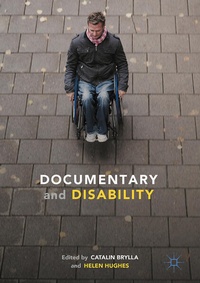
Documentary and Disability
Description

Reviews / Votes
"This book will be indispensable for a wide range of people who are interested in documentary film - films featuring people with impairments, people working within, or interested in Disability Studies, and probably a wide range of artists working in other fields of representation which focus on disabled identities, e.g. performance art. Overall, I would say that it is an accessible book to those who are seeking out creative ideas, and or wrestling with the practicalities of representing disabled people more ethically, especially in the making of documentary film. It has much to offer to people who want an introduction to the subject of documentary and disability, especially those who prefer deeply academic analysis" (Alison Wilde for Disability Arts Online) "This book assembles an international group of scholars and filmmakers to address the significant topic of documentaries about disability. The book uses a wonderfully broad definition of documentary to investigate everything from traditional non-fiction films to YouTube videos to reality television to early 20th century films about sign language. This book truly provides unique and much-needed perspectives about disability representation and identity, as well as film practice, in the documentary world." (Beth Haller, Professor of Journalism/New Media, and Graduate Director, Towson University, USA) "Documentary and Disability celebrates process and spontaneity, inclusion and experimentation. This collection of essays boldly counteracts negative stereotypes and re-appraises a broad range of documentary forms and media, of disabilities and the excessively documented body. In their Introduction, the editors speak to a hope that this anthology become "part of the struggle for a better future"; along with their talented contributors, they have already succeeded." (Nicole Markotic, Professor of English, University of Windsor, Canada; author of Disability in Film and Literature, McFarland & Co.) "A commitment to modes of sustained seeing and testimony makes documentary forms central to any critical engagement with the cultural meanings surrounding 'disability'. The quality and depth of analysis across a range of case studies allow this collection to break new ground in the exploration of documentary-disability relations, in the process illuminating the alternative practices of portrayal which are possible." (John Corner, Visiting Professor in Communication Studies, University of Leeds, UK) "This collection is as fascinating, thought-provoking and indispensable as the genre of documentaries it describes. Accounts from those who have made films, or had films made about them, mingle with the perspectives of disabled and non-disabled viewers and critics. Neither do the editors forget the diversity of impairments and contexts - from art to advocacy to reality TV - which constitute this field. Every disability studies scholar should read this book!" (Tom Shakespeare, Professor of Disability Research, University of East Anglia, UK) "Documentary and Disability is an indispensable book for anyone interested in reading about, writing about, or making a documentary film about disability. It collects a wide group of authors comprised of activists, scholars, and critics. From theory to praxis, covering almost every aspect of disability, the book provides compelling and wide-ranging information and viewpoints. No one should ever think about disability documentaries without reading this book." (Lennard J. Davis, Professor of Disability and Human Development, University of Illinois at Chicago, US) "What a valuable range of perspectives is offered in Documentary and Disability! The editors wisely choose an interdisciplinary approach to a complex, important and sensitive topic. By covering disability on-screen from several points of view, including behind and in front of the camera (the decision-making process of the filmmakers is fascinating), the volume avoids the rhetorical pitfalls of so many studies of disability in the media. With this kind of cultural awareness, it is no wonder that documentary remains the most respectable and respectful of film genres to approach the world of people with disabilities." (Charles A. Riley II, Associate Professor of English, Baruch College, US, Author of Disability and the Media) "The editors aptly construe the combination of disability with documentary not as inevitable but as a nexus bursting with the potential to enact social change. Their lively collection boasts a stellar list of scholars from across global and career maps. These authors exuberantly resist that disability is only either documentable or spectacular. The book's imaginative chapters collectively twist the medical gaze, exposing what is to be celebrated about the creative truths of disabled life." (Sally Chivers, Professor of English, Trent University, Canada)More details
Other editions
Additional editions
Persons
Catalin Brylla is Senior Lecturer in Film at the University of West London, UK.
Helen Hughes is Senior Lecturer in Film Studies at the University of Surrey, UK.
Content
1. Introduction: The Bricolage of Documentary and Disability (Catalin Brylla, Helen Hughes).- 2. Part One: Film Practice - Chapter 2: Not Without Us - Collaborating Across Difference in Documentary Filmmaking (Samuel Avery).- 3. Visual Psychological Anthropology and the Lived Experience of Disability (Annie Tucker, Robert Lemelson).- 4. Valorising Disability on Screen: When did 'Inspirational' Become a Dirty Word? (Veronica Wain).- 5. Spectatorship and Alternative Portrayals of Blindness (Catalin Brylla.- 6. Aberrancy and Autobiographical Documentary (Phoebe Hart).- 7. Part Two: Representation - Chapter 7: Thomas Quasthoff and the Performativity of Disability in Michael Harder's The Dreamer (Anna Drum, Martin Brady).- 8. Rethinking Ability and Disability in the Work of Johan van der Keuken (Hing Tsang).- 9. (Dis)abling the Spectator: Embodying Disability Experience in Animated Documentary (Slava Greenberg).- 10. The Poetics of Touch: Mediating the Reality of Deafblindness in Planetof Snail (Anne-Marie Callus).- 11. Sexual Dissidence and Crip Empowerment in Yes, We Fuck! (Andrea García-Santesmases).- 12. Part Three: Identity, Participation and Exhibition - Chapter 12: Accessing Alternative Ethical Maps of In(ter)depenent Living in Global Disability Documentary (David T. Mitchell, Sharon L. Snyder).- 13. Interface Productions and Disability Programming for Channel 4: 1984 - 1986 (Tony Steyger, Jamie Clarke).- 14. Disability and the Para-TV Communities of Reality Television (Anita Biressi).- 15. Singing Altogether Now: Unsettling Images of Disability and Experimental Filmic Practices (Robert Stock).- 16. To Document is to Preserve: Moving Pictures and Sign Language (Magdalena Zdrodowska).- 17. Documenting Neuropolitics: Cochlear Implant Activation Videos (Beate Ochsner).- 18. On Andrew Kötting's Mapping Perception (Helen Hughes).
