

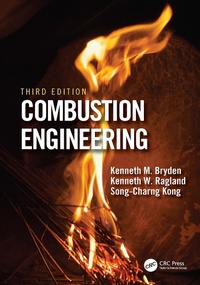
Combustion Engineering
3rd Edition
Published on 26. May 2022
492 pages
978-1-351-66040-2 (ISBN)
Description

Combustion Engineering, Third Edition introduces the analysis, design, and building of combustion energy systems. It discusses current global energy, climate, and air pollution challenges and considers the increasing importance of renewable energy sources, such as biomass fuels.
Mathematical methods are presented, along with qualitative descriptions of their use, which are supported by numerous tables with practical data and formulae, worked examples, chapter-end problems, and updated references. The new edition features new and updated sections on solid biofuels, spark-ignition, compression-ignition, soot and black carbon formation, and current energy policies.
Features include:
Builds a strong foundation for design and engineering of combustion systems.
Provides fully updated coverage of alternative and renewable fuel topics throughout the text.
Features new and updated sections on solid biofuels, spark-ignition, compression-ignition, soot and black carbon formation, and current energy policies.
Includes updated data and formulae, worked examples, and additional chapter-end problems.
Includes a Solutions Manual and figures slides for adopting instructors.
This text is intended for undergraduate and first-year graduate mechanical engineering students taking introductory courses in combustion. Practicing heating engineers, utility engineers, and engineers consulting in energy and environmental areas will find this book a useful reference.
Mathematical methods are presented, along with qualitative descriptions of their use, which are supported by numerous tables with practical data and formulae, worked examples, chapter-end problems, and updated references. The new edition features new and updated sections on solid biofuels, spark-ignition, compression-ignition, soot and black carbon formation, and current energy policies.
Features include:
Builds a strong foundation for design and engineering of combustion systems.
Provides fully updated coverage of alternative and renewable fuel topics throughout the text.
Features new and updated sections on solid biofuels, spark-ignition, compression-ignition, soot and black carbon formation, and current energy policies.
Includes updated data and formulae, worked examples, and additional chapter-end problems.
Includes a Solutions Manual and figures slides for adopting instructors.
This text is intended for undergraduate and first-year graduate mechanical engineering students taking introductory courses in combustion. Practicing heating engineers, utility engineers, and engineers consulting in energy and environmental areas will find this book a useful reference.
More details
Edition
3rd edition
Language
English
Place of publication
London
United Kingdom
Publishing group
Taylor & Francis Ltd
Target group
College/higher education
Professional and scholarly
Product notice
Reflowable
Illustrations
93 Tables, black and white; 53 Line drawings, black and white; 5 Halftones, color; 108 Halftones, black and white; 5 Illustrations, color; 161 Illustrations, black and white
ISBN-13
978-1-351-66040-2 (9781351660402)
Copyright in bibliographic data and cover images is held by Nielsen Book Services Limited or by the publishers or by their respective licensors: all rights reserved.
Schweitzer Classification
Other editions
Additional editions
Kenneth Bryden | Kenneth W. Ragland | Song-Charng Kong
Combustion Engineering
Book
05/2025
3rd Edition
CRC Press
€111.40
Shipment within 10-20 days
Kenneth Bryden | Kenneth W. Ragland | Song-Charng Kong
Combustion Engineering
Book
05/2022
3rd Edition
CRC Press
€243.00
Shipment within 10-20 days
Persons
Dr. Kenneth "Mark" Bryden joined the faculty of the Mechanical Engineering Department at Iowa State University in 1998 after receiving his doctoral degree in mechanical engineering from the University of Wisconsin-Madison. Prior to his studies at the University of Wisconsin-Madison, he worked fourteen years in a wide range of engineering positions at Westinghouse Electric Corporation. This included eight years in power plant operations and six years in power plant engineering, more than ten of these years were in engineering management. Mark has an active research and teaching program in the areas of energy, combustion, and appropriate technology. He is particularly interested in biomass combustion and small cookstoves for the developing world. He is founder and past president of Engineers for Technical and Humanitarian Opportunities for Service (ETHOS) and is the program director for the Simulation, Modeling and Decision Science Program at the U.S. Department of Energy's Ames Laboratory. He teaches classes in combustion, sustainability, energy systems, and design for the developing world. He is the recipient of numerous teaching and research awards, including the ASME Melville Medal and three R&D 100 awards. He is the co-founder and board chair of two successful startups based on his research.
Dr. Kenneth Ragland is an emeritus professor of mechanical engineering at the University of Wisconsin-Madison. Throughout his career, he taught courses in thermodynamics, fluid dynamics, combustion, and air pollution control. His early research was on solid fuel ram jet combustion, and gaseous and heterogeneous detonations. His research at UW-Madison focused on solid fuel combustion of coal and biomass as single particles, combustion in shallow and deep fixed beds, fluidized bed combustion, and combustion emissions. He served as chair of the Department of Mechanical Engineering from July 1995 until his retirement in July 1999. In retirement, his research has focused on the development of systems for planting, harvesting, and combusting biomass crops for energy. Currently, he is the vice president of Energy Performance Systems, Inc.
Dr. Song-Charng Kong is a professor of mechanical engineering at Iowa State University. He teaches courses related to thermal sciences, including thermodynamics, heat transfer, combustion, and internal combustion engine. His research is focused on multiphase, chemically reacting flows in the areas of internal combustion engine and biorenewable energy. His research includes both experimental diagnostics and numerical modeling. The common goal is to increase the energy efficiency and enable the use of biorenewable energy. He is the Associate Editor of Journal of Engineering for Gas Turbines and Power, Editorial Board Member of International Journal of Engine Research, and the Director of Bioenergy Systems Analysis Program of Bioeconomy Institute at Iowa State University. Currently, Dr. Kong also serves as Program Director of the Combustion and Fire Systems Program at the National Science Foundation.
Dr. Kenneth Ragland is an emeritus professor of mechanical engineering at the University of Wisconsin-Madison. Throughout his career, he taught courses in thermodynamics, fluid dynamics, combustion, and air pollution control. His early research was on solid fuel ram jet combustion, and gaseous and heterogeneous detonations. His research at UW-Madison focused on solid fuel combustion of coal and biomass as single particles, combustion in shallow and deep fixed beds, fluidized bed combustion, and combustion emissions. He served as chair of the Department of Mechanical Engineering from July 1995 until his retirement in July 1999. In retirement, his research has focused on the development of systems for planting, harvesting, and combusting biomass crops for energy. Currently, he is the vice president of Energy Performance Systems, Inc.
Dr. Song-Charng Kong is a professor of mechanical engineering at Iowa State University. He teaches courses related to thermal sciences, including thermodynamics, heat transfer, combustion, and internal combustion engine. His research is focused on multiphase, chemically reacting flows in the areas of internal combustion engine and biorenewable energy. His research includes both experimental diagnostics and numerical modeling. The common goal is to increase the energy efficiency and enable the use of biorenewable energy. He is the Associate Editor of Journal of Engineering for Gas Turbines and Power, Editorial Board Member of International Journal of Engine Research, and the Director of Bioenergy Systems Analysis Program of Bioeconomy Institute at Iowa State University. Currently, Dr. Kong also serves as Program Director of the Combustion and Fire Systems Program at the National Science Foundation.
Content
Preface. 1. Introduction to Combustion Engineering. Part I. Basic Concepts. 2. Fuels. 3. Thermodynamics of Combustion. 4. Chemical Kinetics of Combustion. Part II. Combustion of Gaseous and Vaporized Fuels. 5. Flames. 6. Gas-Fired Furnaces and Boilers. 7. Spark-Ignition Engine combustion. 8. Detonation of Gaseous Mixtures. Part III. Combustion of Liquid Fuels. 9. Spray Formation and Droplet Behavior. 10. Oil-Fired Furnace Combustion. 11. Gas Turbine Spray Combustion. 12. Compression-Ignition Engine Combustion. 13. Detonation of Liquid and Gaseous Mixtures. Part IV. Combustion of Solid Fuels. 14. Solid Fuel Combustion Mechanisms. 15. Fixed Bed Combustion. 16. Suspension Burning. 17. Fluidized Bed Combustion. Appendix A. Properties of Fuels. Appendix B. Properties of Air (at 1 atm). Appendix C. Thermodynamic Properties of Combustion Products. Appendix D. Historical Perspective on Combustion Technology. Index.
