

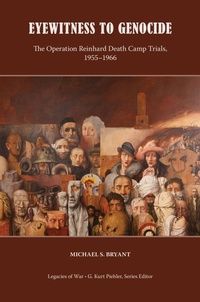
Eyewitness to Genocide
Description

Winner of the Book of the Year Award from the American National Chapter of the Association Internationale de Droit Penal.
One of the deadliest phases of the Holocaust, the Nazi regime's "Operation Reinhard" produced three major death camps-Belzec, Treblinka, and Sobibor-which claimed the lives of 1.8 million Jews. In the 1960s, a small measure of justice came for those victims when a score of defendants who had been officers and guards at the camps were convicted of war crimes in West German courts. The conviction rates varied, however. While all but one of fourteen Treblinka defendants were convicted, half of the twelve Sobibor defendants escaped punishment, and only one of eight Belzec defendants was convicted. Also, despite the enormity of the crimes, the sentences were light in many cases, amounting to only a few years in prison.
In this meticulous history of the Operation Reinhard trials, Michael S. Bryant examines a disturbing question: Did compromised jurists engineer acquittals or lenient punishments for proven killers? Drawing on rarely studied archival sources, Bryant concludes that the trial judges acted in good faith within the bounds of West German law. The key to successful prosecutions was eyewitness testimony. At Belzec, the near-total efficiency of the Nazi death machine meant that only one survivor could be found to testify. At Treblinka and Sobibor, however, prisoner revolts had resulted in a number of survivors who could give firsthand accounts of specific atrocities and identify participants. The courts, Bryant finds, treated these witnesses with respect and even made allowances for conflicting testimony. And when handing down sentences, the judges acted in accordance with strict legal definitions of perpetration, complicity, and action under duress.
Yet, despite these findings, Bryant also shows that West German legal culture was hardly blameless during the postwar era. Though ready to convict the mostly working-class personnel of the death camps, the Federal Republic followed policies that insulated the judicial elite from accountability for its own role in the Final Solution. While trial records show that the "bias" of West German jurists was neither direct nor personal, the structure of the system ensured that lawyers and judges themselves avoided judgment.
More details
Other editions
Additional editions
Person
Michael S. Bryant is professor of history and legal studies at Bryant University. He is the author of Confronting the "Good Death": Nazi Euthanasia on Trial, 1945-1953, A World History of War Crimes, and Nazi Crimes and Their Punishment. Bryant specializes in the impact of the Holocaust on the law, human rights, German criminal law, and international humanitiarian law.
Content
- Intro
- Contents
- Foreword - G. Kurt Piehler, Series Editor
- Preface
- Acknowledgments
- Introduction
- 1. A Subject for Jurisprudence: From the Ulm Einsatzgruppen Trial to the Creation of the Ludwigsburg Central Office, 1956-1960
- 2. The Queen of the Dead: The Investigation and Trial of the Belzec Death Camp
- 3. Who Killed the Jews? The Treblinka Investigation and Trial
- 4. Murdering Star: The Sobibor Investigation and Trial
- 5. Handy-Dandy Justice: Nazi Crimes and the Self-Absolution of the West German Judiciary
- Conclusion
- Appendices
- Chronology
- Notes
- Glossary
- Bibliography
- Index
