

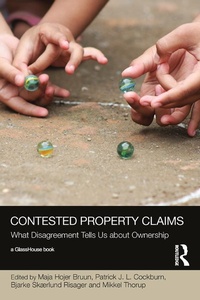
Contested Property Claims
What Disagreement Tells Us About Ownership
1st Edition
Published on 1. December 2017
250 pages
978-1-351-36210-8 (ISBN)
Description

Property relations are such a common feature of social life that the complexity of the web of laws, practices, and ideas that allow a property regime to function smoothly are often forgotten. But we are quickly reminded of this complexity when conflict over property erupts. When social actors confront a property regime - for example by squatting - they enact what can be called 'contested property claims'. As this book demonstrates, these confrontations raise crucial issues of social justice and show the ways in which property conflicts often reflect wider social conflicts. Through a series of case studies from across the globe, this multidisciplinary anthology brings together works from anthropologists, legal scholars, and geographers, who show how exploring contested property claims offers a privileged window onto how property regimes function, as well as an illustration of the many ways that the institution of property shapes power relationships today.
More details
Series
Edition
1. Auflage
Language
English
Place of publication
London
United Kingdom
Publishing group
Taylor & Francis Ltd
Target group
College/higher education
Illustrations
15 s/w Abbildungen
15 Illustrations, black and white
File size
4,60 MB
ISBN-13
978-1-351-36210-8 (9781351362108)
Copyright in bibliographic data and cover images is held by Nielsen Book Services Limited or by the publishers or by their respective licensors: all rights reserved.
Schweitzer Classification
Other editions
Additional editions
Maja Hojer Bruun | Patrick Joseph Cockburn | Bjarke Skaerlund Risager
Contested Property Claims
What Disagreement Tells Us About Ownership
Book
03/2019
1st Edition
Routledge
€68.40
Shipment within 15-20 days
Maja Hojer Bruun | Patrick Joseph Cockburn | Bjarke Skaerlund Risager
Contested Property Claims
What Disagreement Tells Us About Ownership
Book
12/2017
1st Edition
Routledge
€231.80
Shipment within 10-20 days
Persons
Maja Hojer Bruun is Associate Professor of Anthropology at the Department of Learning and Philosophy, Aalborg University, Denmark. Her work in the Contested Property Claims research group focuses on urban commons and how ownership is practiced in everyday life through relations of care, stewardship, belonging, and identification.
Patrick J. L. Cockburn is Assistant Professor at the Department of Philosophy and History of Ideas, Aarhus University, Denmark, and post-doctoral researcher with the Contested Property Claims research group (funded by the Carlsberg Foundation and the Danish Council for Independent Research). He works on the political philosophy of economic practices and institutions and is the author of the forthcoming book The Politics of Dependence: Economic Parasites and Vulnerable Lives (Palgrave Macmillan).
Bjarke Skaerlund Risager is a PhD Fellow in the Department of Philosophy and History of Ideas, Aarhus University, Denmark. Part of the Contested Property Claims research group, he writes about social movements and activism from an interdisciplinary perspective. His research has been published in Globalizations, International Journal of Sociology and Social Policy, Interface: A Journal For and About Social Movements, and elsewhere; it can be followed on au.academia.edu/BjarkeRisager.
Mikkel Thorup is Professor with Special Responsibilities at the section for intellectual history at the Institute of Culture and Society, University of Aarhus, Denmark. His main interests concern the history of political and economic thought, and he directed the research project of Contested Property Claims behind this book. Recent books include Pro Bono? (Zero Books 2014), The Total Enemy (Wipf & Stock 2015), and the edited volume Intellectual History of Economic Normativities (Palgrave, 2016).
Patrick J. L. Cockburn is Assistant Professor at the Department of Philosophy and History of Ideas, Aarhus University, Denmark, and post-doctoral researcher with the Contested Property Claims research group (funded by the Carlsberg Foundation and the Danish Council for Independent Research). He works on the political philosophy of economic practices and institutions and is the author of the forthcoming book The Politics of Dependence: Economic Parasites and Vulnerable Lives (Palgrave Macmillan).
Bjarke Skaerlund Risager is a PhD Fellow in the Department of Philosophy and History of Ideas, Aarhus University, Denmark. Part of the Contested Property Claims research group, he writes about social movements and activism from an interdisciplinary perspective. His research has been published in Globalizations, International Journal of Sociology and Social Policy, Interface: A Journal For and About Social Movements, and elsewhere; it can be followed on au.academia.edu/BjarkeRisager.
Mikkel Thorup is Professor with Special Responsibilities at the section for intellectual history at the Institute of Culture and Society, University of Aarhus, Denmark. His main interests concern the history of political and economic thought, and he directed the research project of Contested Property Claims behind this book. Recent books include Pro Bono? (Zero Books 2014), The Total Enemy (Wipf & Stock 2015), and the edited volume Intellectual History of Economic Normativities (Palgrave, 2016).
Content
List of contributors
Preface
Foreword: how property matters
NICHOLAS BLOMLEY
Introduction: disagreement as a window onto property
PATRICK J. L. COCKBURN, MAJA HOJER BRUUN, BJARKE SKAERLUND RISAGER, AND MIKKEL THORUP
PART 1
Squatting and eviction
1 The right to the city and its limits: contested property claims, urban exceptionality, and the fight for relational space in Glasgow's Commonwealth Games 2014
NEIL GRAY AND LIBBY PORTER
2 Possession through dispossession: in quest of property and social mobility in urban Brazil
MARIE KOLLING
3 The politics of legal technicalities: an inquiry into the demolition of a Roma EU-migrant settlement in Malmoe, Sweden
MARIA PERSDOTTER
4 Urban emptiness, ghost owners and squatters' challenges to private property
MIGUEL A. MARTINEZ
Intermezzos
5 Landed (Freeman's Wood): an exploration of landownership through contemporary art
JOHN ANGUS AND STOREY G2
6 In the time of Trump: housing, whiteness, and abolition
MANISSA M. MAHARAWAL AND ERIN MCELROY
PART 2
Land rights and conflicting laws
7 The work of ownership: shaping contestation in Ontario's aggregate extraction disputes
ESTAIR VAN WAGNER
8 Climate adaptation on the Australian east coast
TAYANAH O'DONNELL
9 Property as a technique of jurisdiction: traplines and tenure
SHIRI PASTERNAK
10 Decolonizing neoliberalism? First Nations reserves, private property rights, and the legislation of Indigenous dispossession in Canada
MICHAEL FABRIS (KREBS)
11 Contesting claims to gardens and land: gendered practice in post-war northern Uganda
JULAINA A. OBIKA, BEN ADOL OTTO, SULAYMAN MPISI BABIIHA, AND MICHAEL WHYTE
Afterword: prophecies on property's probability: climate change and smart contracts in the Anthropocene
BILL MAURER
Index
Preface
Foreword: how property matters
NICHOLAS BLOMLEY
Introduction: disagreement as a window onto property
PATRICK J. L. COCKBURN, MAJA HOJER BRUUN, BJARKE SKAERLUND RISAGER, AND MIKKEL THORUP
PART 1
Squatting and eviction
1 The right to the city and its limits: contested property claims, urban exceptionality, and the fight for relational space in Glasgow's Commonwealth Games 2014
NEIL GRAY AND LIBBY PORTER
2 Possession through dispossession: in quest of property and social mobility in urban Brazil
MARIE KOLLING
3 The politics of legal technicalities: an inquiry into the demolition of a Roma EU-migrant settlement in Malmoe, Sweden
MARIA PERSDOTTER
4 Urban emptiness, ghost owners and squatters' challenges to private property
MIGUEL A. MARTINEZ
Intermezzos
5 Landed (Freeman's Wood): an exploration of landownership through contemporary art
JOHN ANGUS AND STOREY G2
6 In the time of Trump: housing, whiteness, and abolition
MANISSA M. MAHARAWAL AND ERIN MCELROY
PART 2
Land rights and conflicting laws
7 The work of ownership: shaping contestation in Ontario's aggregate extraction disputes
ESTAIR VAN WAGNER
8 Climate adaptation on the Australian east coast
TAYANAH O'DONNELL
9 Property as a technique of jurisdiction: traplines and tenure
SHIRI PASTERNAK
10 Decolonizing neoliberalism? First Nations reserves, private property rights, and the legislation of Indigenous dispossession in Canada
MICHAEL FABRIS (KREBS)
11 Contesting claims to gardens and land: gendered practice in post-war northern Uganda
JULAINA A. OBIKA, BEN ADOL OTTO, SULAYMAN MPISI BABIIHA, AND MICHAEL WHYTE
Afterword: prophecies on property's probability: climate change and smart contracts in the Anthropocene
BILL MAURER
Index
