

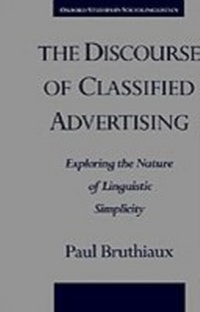
The Discourse of Classified Advertising
Exploring the Nature of Linguistic Simplicity
1st Edition
Published on 11. July 1996
225 pages
978-0-19-535660-1 (ISBN)
Description

Linguists who have studied simplified varieties of a given language, such as pidgins or the language of care-givers, have tended to explain similarities in their structure by the fact that they use the same mechanisms of simplification. Bruthiaux tests this idea by looking at the structure of classified ads in American English, using a body of 800 ads from four categories: automobile sales, apartments for rent, help wanted, and personal ads.
Bruthiaux's thesis is that strict, uniform constraints on space should result in uniformly simple texts, no matter which category they are in, and that any variation would be due to the particular needs of each category. To prove this he describes the linguistic structure of classified ads, and shows that they are characterized by a minimal degree of morphosyntactic elaboration. He then examines aspects of their conventions to highlight the role of pre-patterned and prefabricated segments whose collocational rigidity may force the inclusion of otherwise dispensable items. He finds that there is indeed significant variation across ad categories in terms of morphosyntactic elaboration, and concludes that this is due to a greater or lesser need to be explicit, as well as a greater or lesser anticipation of interaction. Finally, he examines the implications of these findings for the study of linguistic simplification and register variation.
More details
Other editions
Additional editions
Book
10/1996
Oxford University Press Inc
€215.10
Shipment within 15-20 days
Content
- Intro
- Contents
- 1 Theoretical issues
- Linguistic simplicity and register variation
- Linguistic simplicity and linguistic theory
- Linguistic simplicity and the parameters of discourse
- Linguistic simplicity and innateness
- Register studies, linguistic simplicity, and classified ads register
- Aims and structure of the book
- 2 Situating the corpus
- The language of advertising and classified ads register
- Source and nature of the corpus
- Representativeness of the corpus
- 3 Syntactic elaboration
- Characteristics of syntactic elaboration in classified ads register
- Definite articles
- Indefinite articles
- Pronouns
- Do auxiliaries
- Modals
- Negatives
- Be copulas
- Prepositions
- Relativization
- Lexical compounds
- Coordination
- Subordination
- Adjectival and nominal chains
- Economy language and ambiguity
- Classified ads register and syntactic elaboration
- Summary
- 4 Conventionalization
- Idiomatic sequences
- Collocation
- Lexical collocation
- Structural collocation
- Conventionalization and discourse structure
- Auto ads
- Apartment ads
- Job ads
- Personal ads
- Summary
- 5 Functional variation
- Cross-category analysis of features
- Definite articles
- Indefinite articles
- First and second person pronouns
- Relative pronouns
- Be copulas
- Prepositions
- Patterns of distribution
- Functional analysis
- Definite articles
- Indefinite articles
- First and second person pronouns
- Relative pronouns
- Be copulas
- Prepositions
- Discussion and implications
- 6 Classified advertising in its linguistic context
- Toward a multifunctional model of linguistic simplicity
- Description
- Processing
- Linguistic simplicity and grammatical theory
- Suggestions for further research
- Appendix A: Summary of features of linguistic simplification
- Appendix B: Corpus selection criteria
- Appendix C: Glossary of abbreviations
- A
- B
- C
- D
- E
- F
- G
- H
- I
- K
- L
- M
- N
- O
- P
- R
- S
- T
- U
- V
- W
- X
- Y
- Appendix D: Test of editorial interference in Recycler ads
- Notes
- References
- Index
- A
- B
- C
- D
- E
- F
- G
- H
- I
- J
- L
- M
- N
- P
- R
- S
- T
- V
- W
