

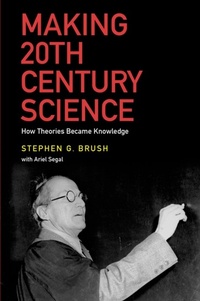
Making 20th Century Science
How Theories Became Knowledge
1st Edition
Published on 13. April 2015
978-0-19-026694-3 (ISBN)
Description

Historically, the scientific method has been said to require proposing a theory, making a prediction of something not already known, testing the prediction, and giving up the theory (or substantially changing it) if it fails the test. A theory that leads to several successful predictions is more likely to be accepted than one that only explains what is already known but not understood. This process is widely treated as the conventional method of achieving scientific progress, and was used throughout the twentieth century as the standard route to discovery and experimentation.
But does science really work this way? In Making 20th Century Science, Stephen G. Brush discusses this question, as it relates to the development of science throughout the last century. Answering this question requires both a philosophically and historically scientific approach, and Brush blends the two in order to take a close look at how scientific methodology has developed. Several cases from the history of modern physical and biological science are examined, including Mendeleev's Periodic Law, Kekule's structure for benzene, the light-quantum hypothesis, quantum mechanics, chromosome theory, and natural selection. In general it is found that theories are accepted for a combination of successful predictions and better explanations of old facts.
Making 20th Century Science is a large-scale historical look at the implementation of the scientific method, and how scientific theories come to be accepted.
More details
Other editions
Additional editions
Book
05/2015
Oxford University Press Inc
€83.20
Shipment within 15-20 days
Content
Illustrations
Preface
PART ONE: THE RECEPTION AND EVALUATION OF THEORIES IN THE SCIENCES
Chapter 1. Who Needs "The Scientific Method"?
1.1. The Rings of Uranus
1.2. Maxwell and Popper
1.3. What is a "Prediction"? A Mercurial Definition
1.4. Hierarchy and Demarcation
1.5. What's Wrong with Quantum Mechanics?
1.6. Was Chemistry (1865-1980) more scientific than Physics?
1.7. Scientific Chemists: Benzene and Molecular Orbitals
1.8. The Unscientific (but very successful) method of Dirac and Einstein: Can We Trust Experiments to Test Theories?
1.9. Why was Bibhas De's paper rejected by Icarus?
1.10. The Plurality of Scientific Methods
Chapter 2. Reception Studies by Historians of Science
2.1. What is "Reception"?
2.2. The Copernican Heliocentric System
2.3. Newton's Universal Gravity
2.4. Darwin's Theory of Evolution by Natural Selection
2.5. Bohr Model of the Atom
2.6. Conclusions and Generalizations
Chapter 3. The Role of Prediction-Testing in the Evaluation of Theories: A Controversy in the Philosophy of Science
3.1. Introduction
3.2. Novelty in the Philosophy of Science
3.3. What is a Prediction? (Revisited)
3.4. Does Novelty Make a Difference?
3.5. Evidence from case histories
3.6. Are Theorists less trustworthy than Observers?
3.7. The Fallacy of Falsifiability: Even the Supreme Court was Fooled
3.8. Conclusions
Chapter 4. The Rise and Fall of Social Constructionism 1975-2000
4.1. The Problem of defining "Science and Technology Studies"
4.2. The Rise of Social Constructionism
4.3. The Fall of Social Constructionism
4.4. Post Mortem
4.5. Consequences for "Science Studies"
PART TWO: ATOMS, MOLECULES, AND PARTICLES
Chapter 5. Mendeleev's Periodic Law
5.1. Mendeleev and the Periodic Law
5.2. Novel Predictions
5.3. Mendeleev's Predictions
5.4. Reception by Whom?
5.5. Tests of Mendeleev's Predictions
5.6. Before the Discovery of Gallium
5.7. The Impact of Gallium and Scandium
5.8. The Limited Value of Novel Predictions
5.9. Implications of the Law
5.10 Conclusions
Chapter 6. The Benzene Problem 1865-1930
6.1. Kekulé's Theory
6.2. The first Tests of Kekulé's Theory
6.3. Alternative Hypotheses
6.4. Reception of Benzene Theories 1866-1880
6.5. New Experiments, New Theories 1881-1900
6.6. The Failure of Aromatic Empiricism 1901-1930
Chapter 7. The Light Quantum Hypothesis
7.1. Black-Body Radiation
7.2. Planck's Theory
7.3. Formulation of the Light-Quantum Hypothesis
7.4. The Wave Theory of Light
7.5. Einstein's "Heuristic Viewpoint"
7.6. What did Millikan Prove?
7.7. The Compton Effect
7.8. Reception of Neo-Newtonian Optics before 1923
7.9. The Impact of Compton's Discovery
7.10. Rupp's Fraudulent Experiments
7.11. Conclusions
Chapter 8. Quantum Mechanics
8.1. The Bohr Model
8.2. The Wave Nature of Matter
8.3. Schrödinger's Wave Mechanics
8.4. The Exclusion Principle, Spin, and the Electronic Structure of Atoms
8.5. Bose-Einstein Statistics
8.6. Fermi-Dirac Statistics
8.7. Initial Reception of Quantum Mechanics
8.8. The Community is Converted
8.9. Novel Predictions of Quantum Mechanics
8.10. The Helium Atom
8.11. Reasons for accepting Quantum Mechanics after 1928
Chapter 9. New Particles
9.1. Dirac's Prediction and Anderson's Discovery of the Positron
9.2. The Reception of Dirac's Theory
9.3. The Transformation of Dirac's Theory
9.4. Yukawa's Theory of Nuclear Forces
9.5. Discovery of the Muon and Reception of Yukawa's Theory
9.6. The Transformation of the Yukon
9.7. Conclusions
Chapter 10. Benzene and Molecular Orbitals 1931-1980
10.1. Resonance, Mesomerism, and the Mule 1931-1945
10.2. Reception of Quantum Theories of Benzene 1932-1940
10.3. Chemical Proof of Kekulé's Theory
10.4. Anti-Resonance and the Rhinoceros
10.5. The Shift to Molecular Orbitals after 1950
10.6. Aromaticity
10.7. The Revival of Predictive Chemistry
10.8. Reception of Molecular Orbital Theory by Organic Chemists
10.9. Adoption of MO in Textbooks
10.10. A 1996 Survey
10.11. Conclusions
PART THREE: SPACE AND TIME
Chapter 11. Relativity
11.1. The Special Theory of Relativity
11.2. General Theory of Relativity
11.3. Empirical Predictions and Explanations
11.4. Social-Psychological Factors
11.5. Aesthetic-Mathematical Factors
11.6. Early Reception of Relativity
11.7. Do Scientists Give Extra Credit for Novelty? The Case of Gravitational Light Bending
11.8. Are Theorists less Trustworthy than Observers?
11.9. Mathematical/Aesthertic Reasons for Accepting Relativity
11.10. Social-Psychological Reasons for Accepting Relativity
11.11. A Statistical Summary of Comparative Reception
11.12. Conclusions
Chapter 12. Big Bang Cosmology
12.1. The Expanding Universe is Proposed
12.2. The Age of the Earth
12.3. The Context for the Debate: Four "New Sciences" and One Shared Memory
12.4. Cosmology Constrained by Terrestrial Time
12.5. Hubble Doubts the Expanding Universe
12.6. A Radical Solution: Steady-State Cosmology
12.7. Astronomy Blinks: Slowing the Expansion
12.8. Lemaître's Primeval Atom and Gamow's Big Bang
12.9. Arguments for Steady State Weaken
12.10. The Temperature of Space
12.11. Discovery of the Cosmic Microwave Background
12.12. Impact of the Discovery on Cosmologists
12.13. Credit for the Prediction
12.14. Conclusions
PART FOUR: HEREDITY AND EVOLUTION
Chapter 13. Morgan's Chromosome Theory
13.1. Introduction
13.2. Is Biology like (Hypothetico-Deductive) Physics?
13.3. Precursors
13.4. Morgan's Theory
13.5. The Problem of Universality
13.6. Morgan's Theory in Research Journals
13.7. Important Early Supporters
13.8. Bateson and the Morgan Theory in Britain
13.9. The Problem of Universality Revisited
13.10. Books and Review Articles on Genetics, Evolution and Cytology
13.11. Biology Textbooks
13.12. Age Distribution of Supporters and Opponents
13.13. Conclusions
Chapter 14. The Revival of Natural Selection 1930-1970
14.1. Introduction
14.2. Fisher: A new Language for Evolutionary Research
14.3. Wright: Random Genetic Drift, A Concept Out of Control
14.4. Haldane: A Mathematical-Philosophical Biologist Weighs in
14.5. Early Reception of the Theory
14.6. Dobzhansky: The Faraday of Biology?
14.7. Evidence for Natural Selection, before 1941
14.8. Huxley: A New Synthesis is Proclaimed
14.9. Mayr: Systematics and the Founder Principle
14.10. Simpson: No Straight and Narrow Path for Paleontology
14.11. Stebbins: Plants are also Selected
14.12. Chromosome Inversions in Drosophila
14.13. Ford: Unlucky Blood Groups
14.14. Resistance to Antibiotics
14.15. Two "Great Debates": Snails and Tiger Moths
14.16. Selection and/or Drift? The Changing Views of Dobzhansky and Wright
14.17. The Views of other Founders and Leaders
14.18. The Peppered Moth
14.20. Results of a Survey of Biological Publications
14.19. The Triumph of Natural Selection?
14.21. Is Evolutionary Theory Scientific?
14.22. Context and Conclusions
PART FIVE: CONCLUSIONS
Chapter 5. Which Works Faster: Prediction or Explanation?
5.1. Comparison of Cases Presented in this Book
5.2. From Princip to Principe
5.3. Can Explanation be Better than Prediction?
5.4. Special Theory of Relativity: Explaining "Nothing"
5.5. The Old Quantum theory: Many Things are Predicted, but Few are Explained
5.6. Quantum Mechanics: Many Things are Explained, Predictions are Confirmed too late
5.7. Millikan's Walk
Notes for Part One
Notes for Part Two
Notes for Part Three
Notes for Part Four
Notes for Part Five
Selected Bibliography: Includes works cited more than once in a chapter
Index
