

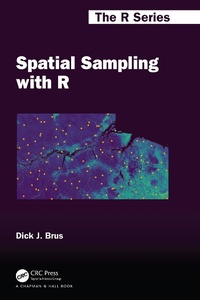
Spatial Sampling with R
1st Edition
Published on 26. September 2022
548 pages
978-1-000-60005-6 (ISBN)
Description

Scientific research often starts with data collection. However, many researchers pay insufficient attention to this first step in their research. The author, researcher at Wageningen University and Research, often had to conclude that the data collected by fellow researchers were suboptimal, or in some cases even unsuitable for their aim. One reason is that sampling is frequently overlooked in statistics courses. Another reason is the lack of practical textbooks on sampling. Numerous books have been published on the statistical analysis and modelling of data using R, but to date no book has been published in this series on how these data can best be collected. This book fills this gap. Spatial Sampling with R presents an overview of sampling designs for spatial sample survey and monitoring. It shows how to implement the sampling designs and how to estimate (sub)population- and space-time parameters in R.
Key features
Describes classical, basic sampling designs for spatial survey, as well as recently developed, advanced sampling designs and estimators
Presents probability sampling designs for estimating parameters for a (sub)population, as well as non-probability sampling designs for mapping
Gives comprehensive overview of model-assisted estimators
Covers Bayesian approach to sampling design
Illustrates sampling designs with surveys of soil organic carbon, above-ground biomass, air temperature, opium poppy
Explains integration of wall-to-wall data sets (e.g. remote sensing images) and sample data
Data and R code available on github
Exercises added making the book suitable as a textbook for students
The target group of this book are researchers and practitioners of sample surveys, as well as students in environmental, ecological, agricultural science or any other science in which knowledge about a population of interest is collected through spatial sampling. This book helps to implement proper sampling designs, tailored to their problems at hand, so that valuable data are collected that can be used to answer the research questions.
Key features
Describes classical, basic sampling designs for spatial survey, as well as recently developed, advanced sampling designs and estimators
Presents probability sampling designs for estimating parameters for a (sub)population, as well as non-probability sampling designs for mapping
Gives comprehensive overview of model-assisted estimators
Covers Bayesian approach to sampling design
Illustrates sampling designs with surveys of soil organic carbon, above-ground biomass, air temperature, opium poppy
Explains integration of wall-to-wall data sets (e.g. remote sensing images) and sample data
Data and R code available on github
Exercises added making the book suitable as a textbook for students
The target group of this book are researchers and practitioners of sample surveys, as well as students in environmental, ecological, agricultural science or any other science in which knowledge about a population of interest is collected through spatial sampling. This book helps to implement proper sampling designs, tailored to their problems at hand, so that valuable data are collected that can be used to answer the research questions.
Reviews / Votes
"What makes this book different is the level of detail at which sensitive issues on spatial sampling designs provided by the specialized literature are discussed and the strong way in which the author constructs his arguments. Dick J. Brus proposes a valuable book, equally complex and accessible, a practical grounded resource for researchers, master and doctoral students interested in spatial sampling problems, sampling designs, and subsequent inferences."~Anca Vitcu, ISCB Book Reviews
"The theory is accessible and well presented. The book is rich in examples based on real applications, and when discussing implementation, guidelines on which methods could be more suited in terms of computing time are presented, which can be useful. Additionally, exercises are provided at the end of sections and of chapters, together with solutions at the end of the book, which could be helpful if the book were used as textbook. We think the strength of the book is surely the software implementation part: accessible R code is
provided to replicate the examples, the scripts are freely available on GitHub, and, more importantly, the code is well explained, and functions and packages are described."~Francesco Pantalone & Roberto Benedetti (11 Nov 2024), The American Statistician
More details
Series
Edition
1. Auflage
Language
English
Place of publication
London
United Kingdom
Publishing group
Taylor & Francis Ltd
Target group
College/higher education
Product notice
Reflowable
Illustrations
34 Tables, color; 154 Line drawings, color; 26 Halftones, color; 180 Illustrations, color
ISBN-13
978-1-000-60005-6 (9781000600056)
Copyright in bibliographic data and cover images is held by Nielsen Book Services Limited or by the publishers or by their respective licensors: all rights reserved.
Schweitzer Classification
Other editions
Additional editions
Dick J. Brus
Spatial Sampling with R
Book
approx. 07/2026
1st Edition
Taylor & Francis
€84.36
Not yet published
Dick J. Brus
Spatial Sampling with R
Book
09/2022
1st Edition
Chapman & Hall/CRC
€242.70
Shipment within 10-20 days
Person
Dick J. Brus worked as a researcher and statistics teacher at the Wageningen University and Research (Netherlands) for 38 years. His main fields of interest are sampling theory and geostatistics. He has gathered rich research experience in developing and applying statistical methods for natural resources inventory and monitoring. In 2015, he was appointed Adjunct Professor at Nanjing Normal University, Nanjing, China. He has published about 100 papers in peer-reviewed, international journals. He is second co-author of the book 'Sampling for Natural Resource Monitoring', published in 2006 by Springer. This book is widely acclaimed in soil, earth, environmental, agricultural and statistical science. Since January 1, 2022 he is retired and lives a joyful life in the countryside, where he grows vegetables in the garden, goes on cycling tours and sings in a choir. Every now and then, during rainy days, he works as a private contractor for the sole proprietorship Spatial Sampling registered with the Chamber of Commerce in the Netherlands.
Content
1 Introduction 2 Introduction to probability sampling 3 Simple random sampling 4 Stratified simple random sampling 5 Systematic random sampling 6 Cluster random sampling 7 Two-stage cluster random sampling 8 Sampling with probabilities proportional to size 9 Balanced and well-spread sampling 10 Model-assisted estimation 11 Two-phase random sampling 12 Computing the required sample size 13 Model-based optimisation of probability sampling designs 14 Sampling for estimating parameters of (small) domains 15 Repeated sample surveys for monitoring population parameters 16 Introduction to sampling for mapping 17 Regular grid and spatial coverage sampling 18 Covariate space coverage sampling 19 Conditioned Latin hypercube sampling 20 Spatial response surface sampling 21 Introduction to kriging 22 Model-based optimisation of the grid spacing 23 Model-based optimisation of the sampling pattern 24 Sampling for estimating the semivariogram 25 Sampling for validation of maps 26 Design-based, model-based, and model-assisted approach for sampling and inference
