

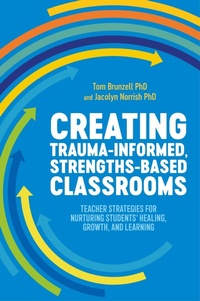
Creating Trauma-Informed, Strengths-Based Classrooms
Teacher Strategies for Nurturing Students' Healing, Growth, and Learning
Published on 21. May 2021
272 pages
978-1-78775-375-4 (ISBN)
Description

With accessible strategies grounded in trauma-informed education and positive psychology, this book equips teachers to support all students, particularly the most vulnerable. It will help them to build their resilience, increase their motivation and engagement, and fulfil their full learning potential within the classroom.
Trauma-informed, strengths-based classrooms are built upon three core aims: to support children to build their self-regulatory capacities, to build a sense of relatedness and belonging at school, and to integrate wellbeing principles that nurture growth and identify strengths. Taking conventional approaches to trauma one step further, teachers may create a classroom environment which helps students to meet their own needs in a healthy way and progress academically.
Based on the successful Berry Street education strategies pioneered by the authors, this book also includes comprehensive case studies, learning points and opportunities for self-reflection, fully supporting teachers to implement these strategies within the classroom.
Trauma-informed, strengths-based classrooms are built upon three core aims: to support children to build their self-regulatory capacities, to build a sense of relatedness and belonging at school, and to integrate wellbeing principles that nurture growth and identify strengths. Taking conventional approaches to trauma one step further, teachers may create a classroom environment which helps students to meet their own needs in a healthy way and progress academically.
Based on the successful Berry Street education strategies pioneered by the authors, this book also includes comprehensive case studies, learning points and opportunities for self-reflection, fully supporting teachers to implement these strategies within the classroom.
More details
Edition
Digital original
Language
English
Place of publication
London
United Kingdom
Target group
Professional and scholarly
Edition type
Digital original
ISBN-13
978-1-78775-375-4 (9781787753754)
Copyright in bibliographic data and cover images is held by Nielsen Book Services Limited or by the publishers or by their respective licensors: all rights reserved.
Schweitzer Classification
Other editions
Additional editions
Tom Brunzell | Jacolyn Norrish
Creating Trauma-Informed, Strengths-Based Classrooms
Teacher Strategies for Nurturing Students' Healing, Growth, and Learning
Book
05/2021
Jessica Kingsley Publishers
€32.50
Shipment within 15-20 days
Persons
Tom Brunzell and Jacolyn Norrish
Content
- Intro
- Creating Trauma-Informed, Strengths-Based Classrooms
- Cover
- Of related interest
- Title page
- Copyright
- Contents
- Acknowledgments
- Authors' Note
- A note about privacy
- A note on pronouns
- Preface
- 1. Introducing Trauma-Informed, Strengths-Based Classrooms
- Purpose of this book
- This book is for you
- What is trauma?
- The impact of trauma
- The healing power of the classroom
- The cycle of trauma
- Ready to focus
- Introducing trauma-informed classrooms
- Healing dysregulated stress responses
- Support students' attachments
- What do we mean by strengths-based?
- Introducing positive psychology
- Our developmental approach
- A focus on strategies
- An invitation
- 2. Understanding the Effects of Childhood Stress and Trauma in the Classroom
- Understanding stress and trauma
- Survival strategies
- Adverse childhood experiences
- Understanding stress
- Stress at school
- Enduring stress
- The window of tolerance
- The developing brain
- Neurodevelopment and learning
- Unpredictability = Risk
- Unmet needs
- Revisiting Kain, Rhiana, and Cassie
- Summary and conclusions
- Self-reflection checklist
- 3. A Developmentally Informed Approach to Learning
- A proactive and pre-emptive approach
- Trauma-informed, strengths-based classrooms
- Introducing Body
- Introducing Relationship
- Introducing Stamina
- Introducing Engagement
- Introducing Character
- Trauma-informed, strengths-based approach
- Levels of intervention
- Embedding the strategies
- Creating a shared language
- Consistent and firm expectations
- Rhythm and repetition
- Teacher observation and feedback
- Revisiting Jalen
- A long-term investment
- Self-reflection checklist
- 4. Body
- Introducing Body
- Bottom-up regulation
- Top-down regulation
- De-escalation
- Stress and de-escalation
- Stress and the body
- Mindfulness
- Present, centered, and ready to learn
- Learning to breathe
- Self-regulation
- Co-regulation
- Decision fatigue and ego depletion
- Ready to Learn Scale
- Ready to Learn Plans
- Teachers' self-regulation
- The triage conversation
- Revisiting Dev
- Some concluding thoughts
- Self-reflection checklist
- 5. Relationship
- Beyond student interests
- The importance of student-teacher relationships
- Attachment theory
- Attachment and co-regulation
- Neuroception and polyvagal theory
- Neuroception in the classroom
- Unconditional positive regard
- Pathways to unconditional positive regard
- Power within relationships
- Bucket and dipper theory
- The triage conversation
- Revisiting Sasha
- Some concluding thoughts
- Self-reflection checklist
- 6. Stamina
- Building stamina in the classroom: A set of top-down strategies
- The experience of learning
- Micro-moments of expansion
- Window of tolerance
- Understanding stamina
- Growth mindset
- Shifting mindsets
- Supporting growth mindsets
- Self-reflection for growth mindsets
- Person and process praise and feedback
- Emotional intelligence
- Building emotional intelligence
- Emotional intelligence through savoring
- Building savoring capacity
- Resilience
- Resilient self-talk
- Introducing mindhooks
- Stamina for independent learning
- Stamina graphs
- Stamina thermometers
- the triage conversation
- Revisiting Talia
- Some concluding thoughts
- Self-reflection checklist
- 7. Engagement
- Student engagement
- Uncovering our students' true motivations to change
- The Decisional Balance Framework
- Flow theory
- Applying flow theory to the classroom
- The importance of goals
- Flow Checklist
- The transformative power of positive emotions
- Broaden-and-build theory
- Positive primers
- The triage conversation
- Revisiting Riley
- Some concluding thoughts
- Self-reflection checklist
- 8. Character
- Starting with strengths
- Developing character
- A focus on strengths
- The VIA framework of strengths
- Building understanding of character strengths
- Signature strengths
- Identifying signature strengths
- Spotting students' strengths
- Using character strengths
- Strengths in balance
- Strengths-based questioning
- Gratitude
- Hope
- Developing waypower and willpower
- the triage conversation
- Revisiting Zane
- Some concluding thoughts
- Self-reflection checklist
- 9. Moving Forward
- A developmental journey
- From bottom-up to top-down
- bottom-up and Top-down integration
- Limitations of this book
- Involving parents, carers, and families
- School-community partnerships
- Special educational needs
- Culturally responsive pedagogy
- A simplification of science
- Biases in the research
- Future directions for the field
- Future directions for you
- Returning to values
- Finishing with gratitude
- References
- Subject Index
- Author Index
