

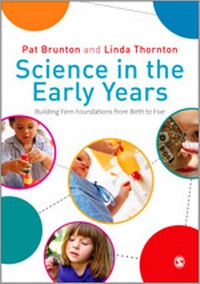
Science in the Early Years
Building Firm Foundations from Birth to Five
1st Edition
Published on 13. November 2009
200 pages
978-1-4462-0353-8 (ISBN)
Description

Giving early years practitioners and students the confidence to effectively support scientific exploration and investigation with young children, this book explains the science behind young children's knowledge and understanding of the world.
Linking theory to good early years practice, the emphasis throughout the book is on recognizing young children as competent, creative thinkers and building on their ideas. The reader is encouraged to think carefully about the role of the adult in supporting child-initiated learning and discovery by providing open ended resources, asking productive questions and observing carefully.
The authors provide essential background information for all the key areas of scientific knowledge supported by practical ideas suitable for babies, toddlers and children aged 3 to 5 years. For each of these ideas, practice and theory are linked by highlighting the skills, attitudes and dispositions to observe and the questions to ask to challenge young children's thinking and plan for the next stages in their learning.
Chapters cover:
- the place of science in early years curricula in the UK
- the processes of science and the role of the adult in supporting young children's scientific learning
- using open ended resources to create a science-rich environment
- essential background knowledge, covering all areas of early years science
- ideas to use as starting points for exploration and investigation, indoors and outdoors
- pointers for observational assessment and planning
- suppliers of resources and equipment
By making clear links to practice, and providing ideas to use with babies and toddlers as well as with 3-5 year old children, this book enables the reader to fully exploit the potential for exploration and investigation in any early years setting.
Pat Brunton and Linda Thornton are both Education Consultants based in Cheltenham. They run their own training and consultancy company alc associates, and edit Early Years Update.
Linking theory to good early years practice, the emphasis throughout the book is on recognizing young children as competent, creative thinkers and building on their ideas. The reader is encouraged to think carefully about the role of the adult in supporting child-initiated learning and discovery by providing open ended resources, asking productive questions and observing carefully.
The authors provide essential background information for all the key areas of scientific knowledge supported by practical ideas suitable for babies, toddlers and children aged 3 to 5 years. For each of these ideas, practice and theory are linked by highlighting the skills, attitudes and dispositions to observe and the questions to ask to challenge young children's thinking and plan for the next stages in their learning.
Chapters cover:
- the place of science in early years curricula in the UK
- the processes of science and the role of the adult in supporting young children's scientific learning
- using open ended resources to create a science-rich environment
- essential background knowledge, covering all areas of early years science
- ideas to use as starting points for exploration and investigation, indoors and outdoors
- pointers for observational assessment and planning
- suppliers of resources and equipment
By making clear links to practice, and providing ideas to use with babies and toddlers as well as with 3-5 year old children, this book enables the reader to fully exploit the potential for exploration and investigation in any early years setting.
Pat Brunton and Linda Thornton are both Education Consultants based in Cheltenham. They run their own training and consultancy company alc associates, and edit Early Years Update.
Reviews / Votes
'I would thoroughly recommend this book to anyone wanting to get the most out of the opportunities for learning about science that seem to be all around us in our settings' - Early Years Update'[This book] provides a thorough background, putting together relevant knowledge and understanding, key information and practical support, coupled with innovative ideas' - Early Years Educator
'This book is aimed at teachers, trainee teachers and other early years practitioners, providing a thorough background of the science taught for children aged from birth to five. It puts together relevant knowledge and understanding, key information and practical support along with innovative ideas on current thinking in the early years setting. In two easily accessible parts, the book firstly provides guidance on creating a science-rich environment whilst considering the child as a creative thinker; secondly it gives support for practitioners in the scientific concepts needed to deliver science to young children successfully. A very readable and essential book for anyone working in the early years' - Louise Nelson, Senior Lecturer, Initial Teacher Education, Primary Science, Leeds Metropolitan University
All prices
More details
Language
English
Place of publication
London
United Kingdom
Target group
College/higher education
ISBN-13
978-1-4462-0353-8 (9781446203538)
Copyright in bibliographic data and cover images is held by Nielsen Book Services Limited or by the publishers or by their respective licensors: all rights reserved.
Schweitzer Classification
Other editions
Additional editions
Pat Brunton | Linda C. Thornton
Science in the Early Years
Building Firm Foundations from Birth to Five
Book
11/2009
1st Edition
SAGE Publications Ltd
€202.38
Shipment within 15-20 days
Pat Brunton | Linda C. Thornton
Science in the Early Years
Building Firm Foundations from Birth to Five
Book
11/2009
1st Edition
SAGE Publications Ltd
€83.00
Shipment within 15-20 days
Persons
Pat Brunton is a research scientist by training, with a postgraduate degree in virology. She has extensive experience of the early years field and provides training for a wide variety of audiences including school governors, teachers, early years and childcare practitioners and children's centre professionals. She is a director of alc associates, an early years training and consultancy company, and is the author of a range of publications.
Pat provides keynote presentations and workshops at conferences and consultancy and training for local authorities, schools and early years settings across the UK.
Pat provides keynote presentations and workshops at conferences and consultancy and training for local authorities, schools and early years settings across the UK.
Content
PART ONE
Supporting Young Children's Scientific Learning
Creating a Science Rich Environment
PART TWO
Introduction to Part 2
Living Things
Habitats and Sustainability
The Structure of the Human Body and Healthy Living
Materials
Forces
Air and Water
Magnets and Magnetism
Electricity
Sound
Light, Colour and Shadow
The Earth
Supporting Young Children's Scientific Learning
Creating a Science Rich Environment
PART TWO
Introduction to Part 2
Living Things
Habitats and Sustainability
The Structure of the Human Body and Healthy Living
Materials
Forces
Air and Water
Magnets and Magnetism
Electricity
Sound
Light, Colour and Shadow
The Earth
