

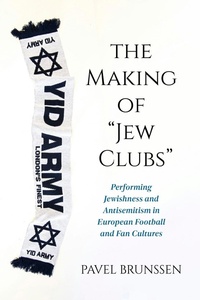
The Making of "Jew Clubs"
Description

Why do non-Jewish football fans chant "Yid Army" or wave "Super Jews" banners-especially in support of clubs that are not Jewish? The Making of "Jew Clubs" explores how four major European football clubs-FC Bayern Munich, FK Austria Vienna, Ajax Amsterdam, and Tottenham Hotspur-came to be seen as "Jew Clubs," even though they have never officially identified as Jewish.
In this transnational study, Pavel Brunssen traces how both Jewish and non-Jewish actors perform Jewishness, antisemitism, and philosemitism within European football cultures over the 20th and 21st centuries. Drawing on a wide array of primary sources-from fan chants and matchday rituals to media portrayals and club histories-the book reveals how football stadiums have become unexpected stages for negotiating memory, identity, and historical trauma.
Offering a new approach to Holocaust memory, sports history, and Jewish studies, The Making of "Jew Clubs" shows how football cultures reflect and reshape Europe's conflicted relationship with its Jewish past.
More details
Other editions
Additional editions
Person
Pavel Brunssen is a Research Associate and Alfred Landecker Lecturer at the Research Center on Antigypsyism at Heidelberg University. He is author of Antisemitsmus in Fußball-Fankulturen; editor, with Stefanie Schüler-Springorum, of Football and Discrimination: Antisemitism and Beyond; and editor of Antigypsyism and Film: Antiziganismus und Film.
Content
Preface and Acknowledgments
Introduction
1. FC Bayern Munich: The "Jew Club" as Memory Culture
2. FK Austria Vienna: The "Jew Club" as Cultural Code
3. Ajax Amsterdam: The "Jew Club" as Fan Performance
4. Tottenham Hotspur: Problematizing the "Jew Club"
Conclusion
Afterword: The "Jew Clubs" after October 7
Appendix: Archives, Monuments, and Museums
Notes
Bibliography
Index
