

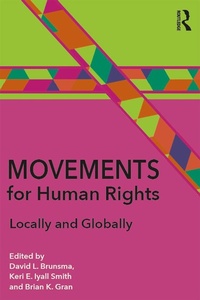
Movements for Human Rights
Locally and Globally
Published on 7. September 2016
190 pages
978-1-315-51184-9 (ISBN)
Description

How do people work together to advance human rights? Do people form groups to prevent human rights from being enforced? Why? In what ways do circumstances matter to the work of individuals collectively working to shape human rights practices?
Human society is made of individuals within contexts-tectonic plates not of the earth's crust but of groups and individuals who scrape and shift as we bump along, competing for scarce resources and getting along. These movements, large and small, are the products of actions individuals take in communities, within families and legal structures. These individuals are able to live longer, yet continue to remain vulnerable to dangers arising from the environment, substances, struggles for power, and a failure to understand that in most ways we are the same as our neighbors.
Yet it is because we live together in layers of diverse communities that we want our ability to speak to be unhindered by others, use spirituality to help us understand ourselves and others, possess a space and objects that are ours alone, and join with groups that share our values and interests, including circumstances where we do not know who our fellow neighbor is. For this reason sociologists have identified the importance of movements and change in human societies. When we collaborate in groups, individuals can change the contours of their daily lives.
Within this book you will find the building blocks for human rights in our communities. To understand why sometimes we enjoy human rights and other times we experience vulnerability and risk, sociologists seek to understand the individual within her context. Bringing together prominent sociologists to grapple with these questions, Movements for Human Rights: Locally and Globally, offers insights into the ways that people move for (and against) human rights.
Human society is made of individuals within contexts-tectonic plates not of the earth's crust but of groups and individuals who scrape and shift as we bump along, competing for scarce resources and getting along. These movements, large and small, are the products of actions individuals take in communities, within families and legal structures. These individuals are able to live longer, yet continue to remain vulnerable to dangers arising from the environment, substances, struggles for power, and a failure to understand that in most ways we are the same as our neighbors.
Yet it is because we live together in layers of diverse communities that we want our ability to speak to be unhindered by others, use spirituality to help us understand ourselves and others, possess a space and objects that are ours alone, and join with groups that share our values and interests, including circumstances where we do not know who our fellow neighbor is. For this reason sociologists have identified the importance of movements and change in human societies. When we collaborate in groups, individuals can change the contours of their daily lives.
Within this book you will find the building blocks for human rights in our communities. To understand why sometimes we enjoy human rights and other times we experience vulnerability and risk, sociologists seek to understand the individual within her context. Bringing together prominent sociologists to grapple with these questions, Movements for Human Rights: Locally and Globally, offers insights into the ways that people move for (and against) human rights.
More details
Language
English
Place of publication
London
United Kingdom
Publishing group
Taylor & Francis Ltd
Target group
College/higher education
Illustrations
1 s/w Abbildung, 1 s/w Tabelle, 1 s/w Zeichnung
1 Tables, black and white; 1 Line drawings, black and white; 1 Illustrations, black and white
File size
2,40 MB
ISBN-13
978-1-315-51184-9 (9781315511849)
Copyright in bibliographic data and cover images is held by Nielsen Book Services Limited or by the publishers or by their respective licensors: all rights reserved.
Schweitzer Classification
Other editions
Additional editions
Book
09/2016
1st Edition
Routledge
€59.90
Shipment within 10-20 days
Book
08/2016
1st Edition
Routledge
€241.50
Shipment within 10-20 days
Persons
David L. Brunsma is Professor of Sociology at Virginia Tech. His areas of research include sociologies of human rights and human rights sociologies, racial identity and racism, cognitive sociology and epistemologies, and multiraciality and whiteness. Keri E. Iyall Smith's research explores the intersections between human rights doctrine, the state, and indigenous peoples in the context of a globalizing society. She has published articles on hybridity and world society, human rights, indigenous peoples, and teaching sociology. Hybrid Identities: Theoretical and Empirical Examinations (with Patricia Leavy, 2008). She is Assistant Professor of Sociology at Suffolk University in Boston, Massachusetts. Brian K. Gran is a former lawyer whose sociological research focuses on human rights and institutions that support and hinder their enforcement, with a particular interest in whether law can intervene in private spheres of the ISA Thematic Group on Human Rights and Global Justice (TG03). For his research on independent children's rights institutions, he was a visiting fellow of the Fulbright grant to research and teach at the School of Law at Reykjavik University in Iceland.
Content
Introduction
1 Community and Urban Sociology
Kenneth Neubeck
2 Peace, War, and Social Conflict
Nader Saiedi
3 Environment and Technology
Francis O. Adeola and J. Steven Picou
4 Population
Jenniffer Santos-Hernandez
5 Collective Behavior and Social Movements
Lyndi Hewitt
6 Alcohol, Drugs, and Tobacco
Jennifer Bronson
7 Rationality and Society
Valeska P. Korff, Mimi Zou, Tom Zwart, and Rafael Wittek
8 International Migration
Tanya Golash-Boza
9 Labor and Labor Movements
Hector L. Delgado
10 Evolution, Biology, and Sociology
Rosemary L. Hopcroft
Discussion Questions
List of Acronyms
Bibliography
About the Editors
1 Community and Urban Sociology
Kenneth Neubeck
2 Peace, War, and Social Conflict
Nader Saiedi
3 Environment and Technology
Francis O. Adeola and J. Steven Picou
4 Population
Jenniffer Santos-Hernandez
5 Collective Behavior and Social Movements
Lyndi Hewitt
6 Alcohol, Drugs, and Tobacco
Jennifer Bronson
7 Rationality and Society
Valeska P. Korff, Mimi Zou, Tom Zwart, and Rafael Wittek
8 International Migration
Tanya Golash-Boza
9 Labor and Labor Movements
Hector L. Delgado
10 Evolution, Biology, and Sociology
Rosemary L. Hopcroft
Discussion Questions
List of Acronyms
Bibliography
About the Editors
