

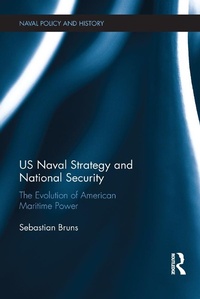
US Naval Strategy and National Security
The Evolution of American Maritime Power
Published on 22. September 2017
288 pages
978-1-317-22969-8 (ISBN)
Description

This book examines US naval strategy and the role of American seapower over three decades, from the late 20th century to the early 21st century.
This study uses the concept of seapower as a framework to explain the military and political application of sea power and naval force for the United States of America. It addresses the context in which strategy, and in particular US naval strategy and naval power, evolves and how US naval strategy was developed and framed in the international and national security contexts. It explains what drove and what constrained US naval strategy and examines selected instances where American sea power was directed in support of US defense and security policy ends - and whether that could be tied to what a given strategy proposed. The work utilizes naval capstone documents in the framework of broader maritime conceptual and geopolitical thinking, and discusses whether these documents had lasting influences in the strategic mind-set, the force structure, and other areas of American sea power. Overall, this work provides a deeper understanding of the crafting of US naval strategy since the final decade of the Cold War, its contextual and structural framework setting, and its application. To that end, the work bridges the gap between the thinking of American naval officers and planners on the one hand and academic analyses of Navy strategy on the other hand. It also presents the trends in the use of naval force for foreign policy objectives and into strategy-making in the American policy context.
This book will be of much interest to students of naval power, maritime strategy, US national security and international relations in general.
This study uses the concept of seapower as a framework to explain the military and political application of sea power and naval force for the United States of America. It addresses the context in which strategy, and in particular US naval strategy and naval power, evolves and how US naval strategy was developed and framed in the international and national security contexts. It explains what drove and what constrained US naval strategy and examines selected instances where American sea power was directed in support of US defense and security policy ends - and whether that could be tied to what a given strategy proposed. The work utilizes naval capstone documents in the framework of broader maritime conceptual and geopolitical thinking, and discusses whether these documents had lasting influences in the strategic mind-set, the force structure, and other areas of American sea power. Overall, this work provides a deeper understanding of the crafting of US naval strategy since the final decade of the Cold War, its contextual and structural framework setting, and its application. To that end, the work bridges the gap between the thinking of American naval officers and planners on the one hand and academic analyses of Navy strategy on the other hand. It also presents the trends in the use of naval force for foreign policy objectives and into strategy-making in the American policy context.
This book will be of much interest to students of naval power, maritime strategy, US national security and international relations in general.
Reviews / Votes
'This book is a most welcome addition to the library of understanding that surrounds strategy and seapower. Its academic credentials are robust and its observations and deductions, I found, most helpful.' -- Clive Johnstone, Commander, NATO Maritime Command, Northwood'Current trends of American 'rebalancing' from Europe and the Middle East into the Asia-Pacific, with the simultaneous challenge of conventional Western military and in particular naval capabilities under pressure, could all too easily lure the strategically untrained mind to return to Halford Mackinder's heartland theory to try to grasp the fate of European security. This would deliberately omit the importance of American seapower. In fact, the relationship between American national security and the use of its Navy as a foreign policy tool and a geostrategic instrument has too often negated by academics, policy-makers, and even the military. This timely book offers a thorough investigation of the basic principles of American national security, naval strategy, the trajectory of U.S. maritime power since the 1980s. It shows how US Navy strategy and its fleet evolved, and where and when it was used in support of larger national (and in some cases international) security ends.' -- Wolfgang Peischel, Brigadier General, Austrian Armed Forces
More details
Series
Language
English
Place of publication
London
United Kingdom
Publishing group
Taylor & Francis Ltd
Target group
College/higher education
Professional and scholarly
Illustrations
25 s/w Tabellen
16 Tables, black and white; 13 Line drawings, black and white
File size
3,01 MB
ISBN-13
978-1-317-22969-8 (9781317229698)
Copyright in bibliographic data and cover images is held by Nielsen Book Services Limited or by the publishers or by their respective licensors: all rights reserved.
Schweitzer Classification
Other editions
Additional editions

Book
12/2019
1st Edition
Routledge
€65.60
Shipment within 15-20 days
Book
09/2017
1st Edition
Routledge
€231.20
Shipment within 10-20 days
Person
Sebastian Bruns heads the Center for Maritime Strategy & Security (CMSS) at the Institute for Security Policy, University of Kiel (ISPK). He is co-editor of the Routledge Handbook of Naval Strategy and Security (Routledge, 2016).
Content
1. Introduction: Seapower, Strategy, and the Particulars of the Maritime Operating Environment 2. Strategy: Its setting 3. Prelude: 1945-1980, a "naval baisse"? 4. A "Naval Renaissance" through "The Maritime Strategy" (1981-1989) 5. Managing Strategic Change and Embracing a New World Order (1989-2001) 6. A Sea Power Rationale for the 21st Century (2001-2008) 7. Sea Change: American National Security and U.S. Seapower in an Increasingly Chaotic World (2009-2016) 8. Conclusion
