

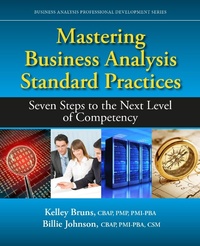
Mastering Business Analysis Standard Practices
Seven Steps to the Next Level of Competency
Published on 15. May 2019
401 pages
978-1-60427-805-7 (ISBN)
Description

This volume presents all the standard practices for performing business analysis work across seven steps, five perspectives, and 74 techniques. It will help business analysts at all levels further develop their skills to master the next level of competency in business analysis needed to advance their careers. It will help readers comprehend the BA role, responsibilities, and deliverables that ensure business analysis success.
More details
Other editions
Additional editions
Kelley Bruns | Billie Johnson
Mastering Business Analysis Standard Practices
Seven Steps to the Next Level of Competency
Book
03/2019
J Ross Publishing
€89.44
Shipment within 10-20 days
Content
- Front Cover
- Title Page
- Copyright
- Contents
- Preface
- Acknowledgments
- About the Authors
- WAVT
- CHAPTER 1-Introduction
- What Is Business Analysis?
- Who Does Business Analysis?
- What Qualities Do BAs Possess?
- Organizational Structures and the BA
- BA Career Progression
- Becoming a Trusted Advisor
- Business Analysis Competencies
- Core Concept Model
- Underlying BA Competencies and Skills
- Business Analysis Perspectives
- The BI Perspective
- The BPM Perspective
- The IT Perspective
- The Business Architecture Perspective
- The Agile Perspective
- Key Business Analysis Terms, Concepts, and Definitions
- What Is a Requirement Versus Design Versus Business Analysis Information?
- What Is a Project Versus Program Versus Initiative Versus Operation?
- What Is a System Versus a Solution Versus a Process Versus an Application Versus a Software System?
- What Are Stakeholders Versus Actors Versus Users?
- What Are Enterprise Environmental Factors Versus Organizational Process Assets?
- Business Analysis Center of Excellence and Business Analysis Community of Practice
- Hone Your Business Analysis Information Elaboration Techniques
- Business Analysis Journey Map
- Summary of Key Points
- Chapter References
- CHAPTER 2-Step 1: Understand Your Stakeholders
- Types of Stakeholders
- Domain Stakeholders
- Solution Stakeholders
- Business Analysts and Project Managers
- Product Owners and Scrum Masters/Agile Project Managers
- Develop Stakeholder Profiles
- Understand Stakeholder Motivations
- Understand Stakeholder Differences
- Understand Stakeholder Attitudes
- Understand Stakeholder Influence
- Understand Stakeholder Success Criteria
- Understand How Stakeholders Can Be Engaged
- Balance Your Stakeholders' Needs
- Understand the Political Environment
- Define Strategy for Navigating the Organizational Environment
- Trust: It's the Game Changer
- Detecting Mistrust or Distrust
- Understand the Impact of Trust on Your Business Analysis Work
- Ongoing Stakeholder Analysis
- Techniques
- Capability Framework
- Organizational Modeling (Organizational Charts)
- Stakeholder List, Map, or Personas
- Summary of Key Points
- Chapter References
- CHAPTER 3-Step 2: Understand the Business Context
- Understand the Enterprise Architectural Direction
- Organizational Structure
- Organizational Culture and Style
- Organizational Communication
- Organizational Systems
- Organizational Readiness
- EA Components
- Understand the Organization's Business Drivers
- Frequently Identified Business Drivers
- Customer Satisfaction/Customer Impact Business Driver
- Currency Business Driver
- Compliance Business Driver
- Market Position Business Driver
- Needs Analysis/Needs Assessment Business Driver
- Situation Statement
- Feasibility Analysis
- Cost-Benefit Analysis
- Understand the Business Case
- Techniques
- Balanced Scorecard (BSC)
- Benchmarking and Market Analysis
- Business Capability Analysis
- Business Model Canvas
- Business Motivation Model (BMM)
- Business Value Definition
- Decision Analysis
- Document Analysis
- Financial Analysis/Valuation Techniques
- Interviews
- Project Portfolio Analysis
- Root Cause Analysis (RCA)
- Roadmap
- SWOT Analysis
- Summary of Key Points
- Chapter References
- CHAPTER 4-Step 3: Plan the Business Analysis Work
- Iterative Nature of Elicitation, Collaboration, and Analysis
- Where to Begin Planning
- Plan the Business Analysis Work Activities
- Elicitation and Collaboration
- Scope Analysis
- Solution Requirements Analysis and Design Definition
- Solution Evaluation
- Scope Management
- Justify the Business Analysis Effort
- Business Analysis Assessment
- Techniques
- Estimation
- Risk Analysis and Management
- Summary of Key Points
- Chapter References
- CHAPTER 5-Step 4: Set Initiative Scope
- What Is Scope?
- Focus on Why First, before What
- Develop Success Measures
- Now What?-Chunkify the Initiative
- At the Highest Level What
- The Mid-Level What
- Solution Stakeholder Impact and Scope Definition
- Gain Consensus on Scope Definition
- Techniques
- Brainstorming
- Business Process Architecture
- Business Value Modeling
- Collaborative Games
- Concept Modeling
- Customer Journey Map
- Focus Groups
- Functional Decomposition
- Gap Analysis
- Glossary
- House of Quality and Voice of Customer
- Input, Guide, Output, Enablers (IGOE)
- Kaizen Event
- Kano Analysis
- Mind Mapping
- Process Analysis
- Purpose Alignment Model
- Scope Modeling
- Story Mapping
- Survey or Questionnaire
- Planning and Facilitated Workshops
- Summary of Key Points
- Chapter References
- CHAPTER 6-Step 5: Develop Solution Requirements and Design Definition
- Decompose Scope Definition into Effective Solution Requirements
- Elicitation
- Collaboration
- Analysis
- Consensus
- Decompose Solution Requirements into Effective Design Definition
- Doneness: How Do I Know When I'm Done?
- Techniques
- Acceptance and Evaluation Criteria
- Business Rules Analysis
- Data Mining
- Data Modeling
- Data Dictionary
- Data Flow Diagrams
- Sequence Diagrams
- State Modeling (State Table/State Diagram)
- Interface Analysis
- Lightweight Documentation
- Nonfunctional Requirements Analysis
- Observation
- Process Modeling
- Prototyping (Storyboarding, Wireframes)
- Real Options
- Roles and Permissions Matrix
- Story Elaboration
- Use Cases and Scenarios
- User Stories
- Summary of Key Points
- Chapter References
- CHAPTER 7-Step 6: Scope Management
- Verify Requirements
- Peer Reviews
- Inspections
- Validate Requirements
- Recommend Solution(s)
- Monitor Requirements and Design Definition
- Tracing Requirements and Designs
- Maintaining Requirements and Designs
- Prioritizing Requirements and Designs
- Monitoring Requirements and Designs
- Scope Change
- Techniques
- Backlog Management
- Change Control Board
- Impact Analysis
- Item Tracking/Issue Log
- Prioritization
- RCMS and VCS
- Reviews
- Traceability Matrix
- Summary of Key Points
- Chapter References
- CHAPTER 8-Step 7: Evaluate the Solution
- Evaluate Proposed Solutions
- Recommend Actions to Increase Solution Value
- Support Implementation SMEs
- Support Testers
- Assess Organizational Readiness
- Develop Transition Requirements
- Measure Solution Success
- Analyze Performance Measures
- Collect Measures
- Analyze and Communicate Measures
- Techniques
- Definition of Done (DoD)
- Failure Mode and Effect Analysis (FMEA)
- Theory of Constraints (TOC) Thinking Processes
- Specification by Example
- Lessons Learned/Retrospective
- Metrics and Key Performance Indicators (KPIs)
- Product Portfolio Matrix
- Relative Estimation
- Vendor Assessment
- Summary of Key Points
- Chapter References
- Glossary
- Index
