

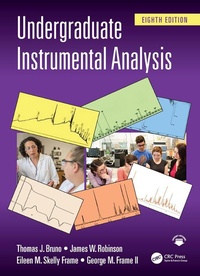
Undergraduate Instrumental Analysis
8th Edition
Published on 31. July 2023
1026 pages
978-1-000-84579-2 (ISBN)
Description

Analytical instrumentation is crucial to research in molecular biology, medicine, geology, food science, materials science, forensics, and many other fields. Undergraduate Instrumental Analysis, 8th Edition, provides the reader with an understanding of all major instrumental analyses, and is unique in that it starts with the fundamental principles, and then develops the level of sophistication that is needed to make each method a workable tool for the student. Each chapter includes a discussion of the fundamental principles underlying each technique, detailed descriptions of the instrumentation, and a large number of applications. Each chapter includes an updated bibliography and problems, and most chapters have suggested experiments appropriate to the technique.
This edition has been completely updated, revised, and expanded. The order of presentation has been changed from the 7th edition in that after the introduction to spectroscopy, UV-Vis is discussed. This order is more in keeping with the preference of most instructors. Naturally, once the fundamentals are introduced, instructors are free to change the order of presentation. Mathematics beyond algebra is kept to a minimum, but for the interested student, in this edition we provide an expanded discussion of measurement uncertainty that uses elementary calculus (although a formula approach can be used with no loss of context). Unique among all instrumental analysis texts we explicitly discuss safety, up front in Chapter 2. The presentation intentionally avoids a finger-wagging, thou-shalt-not approach in favor of a how-to discussion of good laboratory and industrial practice. It is focused on hazards (and remedies) that might be encountered in the use of instrumentation. Among the new topics introduced in this edition are:
* Photoacoustic spectroscopy.
* Cryogenic NMR probes and actively shielded magnets.
* The nature of mixtures (in the context of separations).
* Troubleshooting and leaks in high vacuum systems such as mass spectrometers.
* Instrumentation laboratory safety.
* Standard reference materials and standard reference data.
In addition, the authors have included many instrument manufacturer's websites, which contain extensive resources. We have also included many government websites and a discussion of resources available from National Measurement Laboratories in all industrialized countries. Students are introduced to standard methods and protocols developed by regulatory agencies and consensus standards organizations in this context as well.
This edition has been completely updated, revised, and expanded. The order of presentation has been changed from the 7th edition in that after the introduction to spectroscopy, UV-Vis is discussed. This order is more in keeping with the preference of most instructors. Naturally, once the fundamentals are introduced, instructors are free to change the order of presentation. Mathematics beyond algebra is kept to a minimum, but for the interested student, in this edition we provide an expanded discussion of measurement uncertainty that uses elementary calculus (although a formula approach can be used with no loss of context). Unique among all instrumental analysis texts we explicitly discuss safety, up front in Chapter 2. The presentation intentionally avoids a finger-wagging, thou-shalt-not approach in favor of a how-to discussion of good laboratory and industrial practice. It is focused on hazards (and remedies) that might be encountered in the use of instrumentation. Among the new topics introduced in this edition are:
* Photoacoustic spectroscopy.
* Cryogenic NMR probes and actively shielded magnets.
* The nature of mixtures (in the context of separations).
* Troubleshooting and leaks in high vacuum systems such as mass spectrometers.
* Instrumentation laboratory safety.
* Standard reference materials and standard reference data.
In addition, the authors have included many instrument manufacturer's websites, which contain extensive resources. We have also included many government websites and a discussion of resources available from National Measurement Laboratories in all industrialized countries. Students are introduced to standard methods and protocols developed by regulatory agencies and consensus standards organizations in this context as well.
More details
Edition
8th edition
Language
English
Place of publication
London
United Kingdom
Publishing group
Taylor & Francis Ltd
Target group
College/higher education
Product notice
Reflowable
Illustrations
165 Tables, black and white; 2 Line drawings, color; 634 Line drawings, black and white; 12 Halftones, color; 152 Halftones, black and white; 140 Illustrations, color; 786 Illustrations, black and white
ISBN-13
978-1-000-84579-2 (9781000845792)
Copyright in bibliographic data and cover images is held by Nielsen Book Services Limited or by the publishers or by their respective licensors: all rights reserved.
Schweitzer Classification
Other editions
Additional editions
Thomas J. Bruno | James W. Robinson | George M. Frame II
Undergraduate Instrumental Analysis
Book
approx. 07/2026
8th Edition
CRC Press
€66.00
Not yet published

Thomas J. Bruno | James W. Robinson | George M. Frame II
Undergraduate Instrumental Analysis
Book
07/2023
8th Edition
CRC Press
€161.50
Shipment within 10-20 days
Persons
Thomas J. Bruno was group leader in the Applied Chemicals and Materials Division at NIST, Boulder, Colorado before retiring in 2019. He received his B.S. in chemistry from Polytechnic Institute of Brooklyn, and his M.S. and Ph.D. in physical chemistry from Georgetown University. He has published over 270 research papers, 8 books, and has been awarded 10 patents. He serves as associate editor of the CRC Handbook of Chemistry and Physics, and associate editor for Fuel Processing Technology.
The late James W. Robinson earned his BS (Hons), PhD, and DSc from the University of Birmingham, England. A fellow of the Royal Society of Chemistry, he was author of 250 research papers, book chapters, and several books. He was editor in chief of Spectroscopy Letters and the Journal of Environmental Science and Health (both Marcel Dekker, Inc.); executive editor of Handbook of Spectroscopy Vol. 1 (1974), Vol. 2 (1974), Vol. 3 (1981); and Practical Handbook of Spectroscopy (1991) (all CRC Press). Professor Emeritus James W. Robinson passed away in November, 2018, at 95 years of age.
The late Eileen M. Skelly Frame was the first woman commissioned from the Drexel University Army ROTC program, graduating summa cum laude in chemistry. She served as Medical Service Corps officer in the U.S. Army from 1975 to 1986, rising to the rank of Captain. She received her doctorate in 1982, and became the first female chemistry professor at the U.S. Military Academy at West Point. She was adjunct professor, Department of Chemistry and Chemical Biology, Rensselaer Polytechnic Institute (RPI), Troy, NY, and head of Full Spectrum Analytical Consultants. Dr. Skelly Frame passed away in January of 2020.
George M. Frame II earned his AB in chemistry from Harvard College, Cambridge, Massachusetts, and his PhD in analytical chemistry from Rutgers University, New Brunswick, New Jersey. He is a retired scientific director, Chemical Biomonitoring Section of the Wadsworth Laboratory, New York State Department of Health, Albany. He has a wide range of experience in analytical chemistry and has worked at the GE Corporate R&D Center (now GE Global Research), Pfizer Central Research, the US Coast Guard R&D Center, the Maine Medical Center, and in the US Air Force Biomedical Sciences Corps.
The late James W. Robinson earned his BS (Hons), PhD, and DSc from the University of Birmingham, England. A fellow of the Royal Society of Chemistry, he was author of 250 research papers, book chapters, and several books. He was editor in chief of Spectroscopy Letters and the Journal of Environmental Science and Health (both Marcel Dekker, Inc.); executive editor of Handbook of Spectroscopy Vol. 1 (1974), Vol. 2 (1974), Vol. 3 (1981); and Practical Handbook of Spectroscopy (1991) (all CRC Press). Professor Emeritus James W. Robinson passed away in November, 2018, at 95 years of age.
The late Eileen M. Skelly Frame was the first woman commissioned from the Drexel University Army ROTC program, graduating summa cum laude in chemistry. She served as Medical Service Corps officer in the U.S. Army from 1975 to 1986, rising to the rank of Captain. She received her doctorate in 1982, and became the first female chemistry professor at the U.S. Military Academy at West Point. She was adjunct professor, Department of Chemistry and Chemical Biology, Rensselaer Polytechnic Institute (RPI), Troy, NY, and head of Full Spectrum Analytical Consultants. Dr. Skelly Frame passed away in January of 2020.
George M. Frame II earned his AB in chemistry from Harvard College, Cambridge, Massachusetts, and his PhD in analytical chemistry from Rutgers University, New Brunswick, New Jersey. He is a retired scientific director, Chemical Biomonitoring Section of the Wadsworth Laboratory, New York State Department of Health, Albany. He has a wide range of experience in analytical chemistry and has worked at the GE Corporate R&D Center (now GE Global Research), Pfizer Central Research, the US Coast Guard R&D Center, the Maine Medical Center, and in the US Air Force Biomedical Sciences Corps.
Content
1.Concepts of Instrumental Analytical Chemistry. 2.Safety in the Instrumentation Laboratory.3. Introduction to Spectroscopy. 4. Visible and Ultraviolet Molecular Spectroscopy. 5. Infrared, Near-Infrared, Raman, and Photoacoustic Spectroscopy. 6. Magnetic Resonance Spectroscopy. 7. Atomic Absorption Spectrometry. 8. Atomic Emission Spectroscopy. 9. X-Ray Spectroscopy. 10. Mass Spectrometry I: Principles and Instrumentation. 11. Mass Spectrometry II: Spectral Interpretation and Applications. 12. Principles of Chromatography. 13. Gas Chromatography. 14. Chromatography with Liquid (and Fluid) Mobile Phases. 15. Electroanalytical Chemistry. 16. Surface Analysis.17. Thermal Analysis.
