

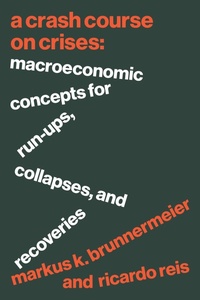
A Crash Course on Crises
Description

An incisive overview of the macroeconomics of financial crises-essential reading for students and policy experts alike With alarming frequency, modern economies go through macro-financial crashes that arise from the financial sector and spread to the broader economy, inflicting deep and prolonged recessions. A Crash Course on Crises brings together the latest cutting-edge economic research to identify the seeds of these crashes, reveal their triggers and consequences, and explain what policymakers can do about them. Each of the book's ten self-contained chapters introduces readers to a key economic force and provides case studies that illustrate how that force was dominant. Markus Brunnermeier and Ricardo Reis show how the run-up phase of a crisis often occurs in ways that are preventable but that may go unnoticed and discuss how debt contracts, banks, and a search for safety can act as triggers and amplifiers that drive the economy to crash. Brunnermeier and Reis then explain how monetary, fiscal, and exchange-rate policies can respond to crises and prevent them from becoming persistent. With case studies ranging from Chile in the 1970s to the COVID-19 pandemic, A Crash Course on Crises synthesizes a vast literature into ten simple, accessible ideas and illuminates these concepts using novel diagrams and a clear analytical framework.
More details
Other editions
Additional editions
Persons
Content
- Cover
- Contents
- 1. Introduction
- 1.1 Crashes
- 1.2 Organization of the Book
- 1.3 Uses of the Book
- 1.4 Acknowledgments
- Part I. Growing Fragilities: The Run-up to Crises
- 2. Bubbles and Beliefs
- 2.1 A Model of Bubbles with a Keynesian Beauty Contest
- 2.2 The Japanese Bubble of the Mid-1980s
- 2.3 The Internet Bubble of 1998-2000
- 3. Capital Inflows and Their (Mis)allocation
- 3.1 A Model of Misallocation
- 3.2 The Seeds of the Euro Crisis: Portugal's Twenty-First Century Slump
- 3.3 Chile's 1970s Liberalization and 1982 Crash
- 4. Banks and Their Cousins
- 4.1 Modern and Shadow Banks
- 4.2 U.S. Subprime Mortgages and Securitization
- 4.3 The Spanish Credit Boom of the 2000s
- Part II. Crashes: Triggers and Amplifiers
- 5. Systemic Risk, Amplification, and Contagion
- 5.1 Strategic Complementarities, Amplification, Multiplicity
- 5.2 Systemic Risk in the Irish Banking Sector in the 2000s
- 5.3 The Emerging Markets' Storm of 1997-98
- 6. Solvency and Liquidity
- 6.1 Debt and the Challenging Illiquidity-Insolvency Distinction
- 6.2 The Run on the German Banking System in 1931
- 6.3 The Greek Sovereign Debt Crisis of 2010-12 and the IMF
- 7. The Nexus between the Private and Public Sectors
- 7.1 The Diabolic/Doom Loop
- 7.2 European Banks and Their Sovereigns in 2007-10
- 7.3 Argentina's 2001-02 Crisis
- 8. The Flight to Safety
- 8.1 Safe Assets
- 8.2 Borrowing Costs in the Euro Area: The 2010-12 Crisis
- 8.3 The Pandemic Flight to Safety of 2020
- Part III. Policies and Recoveries
- 9. Exchange Rate Policies and the Speed of Recoveries
- 9.1 A Model of Exchange Rates and Recovery
- 9.2 The Mexican Tequila Crisis of 1994-95
- 9.3 The Lasting Stagnation from the 2008 Global Financial Crisis
- 10. The New Conventional Monetary Policy
- 10.1 Reserve Satiation and Quantitative Easing
- 10.2 The Bank of Japan's Innovations since 1998
- 10.3 The Euro Area Yield Curve during Crisis
- 11. Fiscal Policy and the Real Interest Rates
- 11.1 Savings and Investment, Revisited
- 11.2 The Rise of Savings during the 2020 Pandemic
- 11.3 The End of the U.S. Great Depression
- Part IV. Parting Words
- 12. Conclusion
- Bibliography
- Index
