

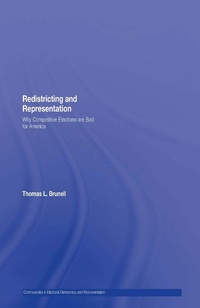
Redistricting and Representation
Why Competitive Elections are Bad for America
Published on 2. April 2010
160 pages
978-1-135-92521-5 (ISBN)
Description

Pundits have observed that if so many incumbents are returned to Congress to each election by such wide margins, perhaps we should look for ways to increase competitiveness - a centerpiece to the American way of life - through redistricting. Do competitive elections increase voter satisfaction? How does voting for a losing candidate affect voters' attitudes toward government? The not-so-surprising conclusion is that losing voters are less satisfied with Congress and their Representative, but the implications for the way in which we draw congressional and state legislative districts are less straightforward.
Redistricting and Representation argues that competition in general elections is not the sine qua non of healthy democracy, and that it in fact contributes to the low levels of approval of Congress and its members. Brunell makes the case for a radical departure from traditional approaches to redistricting - arguing that we need to "pack" districts with as many like-minded partisans as possible, maximizing the number of winning voters, not losers.
Redistricting and Representation argues that competition in general elections is not the sine qua non of healthy democracy, and that it in fact contributes to the low levels of approval of Congress and its members. Brunell makes the case for a radical departure from traditional approaches to redistricting - arguing that we need to "pack" districts with as many like-minded partisans as possible, maximizing the number of winning voters, not losers.
Reviews / Votes
"In this book Professor Brunell provocatively challenges conventional thinking about representation and political satisfaction. He convincingly argues that electoral competition is not, nor perhaps should it be, the hallmark of democracy."--J. Dennis Hastert (IL-14), Speaker of the United States House of Representatives (1999-2007)
"An unusual thesis, well argued. You may not change your mind, but this book will make you rethink the importance of competitive elections."
--Richard G. Niemi, University of Rochester
"Until this book, just about the only people who thought that political competition wasn't desirable were the incumbent politicians whose preference was to hold their present seats in perpetuity. Tom Brunell's intriguing-and highly controversial-claim is that the absence of competition brought about by the creation of demographically and politically homogeneous districts is actually a very good thing. Brunell shows that voter satisfaction goes up in homogenous districts where winners win by large margins-because most voters in the district are then satisfied with the outcome. In contrast, in competitive seats, a large number of voters are always disappointed, sometimes bitterly so. He also shows that the representative's task of effectively representing the district is made much easier when the district is not divided into two opposing camps of near equal size. And, he argues that the creation of homogenous districts can serve as a tool to assure political fairness and minimize the effects of political gerrymandering. This fascinating, well researched and entertainingly written book is a must read for anybody interested in politics and the concept of political representation."
--Bernard Grofman, University of California, Irvine
"Brunell challenges the widely held assumption that the best electoral districts are competitive districts. Taking a utilitarian view of elections, he argues that the practice of packing like-minded voters into homogeneous districts actually maximizes voter satisfaction. In a refreshing alternative to many of the recent analyses of congressional redistricting, Brunell takes our focus back to basic principles and reassures us that the current system is not so bad after all."
--Barry C. Burden, University of Wisconsin-Madison
"Redistricting and Representation is interesting, well organized, and easily accessible to the reader. Most refreshingly and importantly, it has a provocative and original argument.
--David Lublin, American University
"Thomas Brunell takes on the conventional wisdom in his accessible, concise, and thought-provoking book...The book sets out to challenge a dearly held belief among democratic theorists, political scientists, and most anyone concerned with the democratic health of the American system. In making this argument, the book also serves as a good primer on the redistricting process by highlighting and discussing the traditional principles and how they interact with fostering (non)competitive elections."
--Jonathan Winburn, University of Mississippi
"Thomas Brunell has written a very thought-provoking book challenging the conventional wisdom that electoral competition is good. Indeed, this notion is so broadly accepted that most people have probably never seriously considered the argument against competition. Brunell's fine book forces us to reconsider those long-held views."
--David T. Canon, University of Wisconsin-Madision, Political Science Quarterly, Summer 2009
More details
Series
Language
English
Place of publication
London
United Kingdom
Publishing group
Taylor & Francis Ltd
Target group
College/higher education
Illustrations
8 s/w Tabellen, 11 s/w Photographien bzw. Rasterbilder, 8 s/w Zeichnungen
8 Tables, black and white; 8 Line drawings, black and white; 11 Halftones, black and white
File size
3,09 MB
ISBN-13
978-1-135-92521-5 (9781135925215)
Copyright in bibliographic data and cover images is held by Nielsen Book Services Limited or by the publishers or by their respective licensors: all rights reserved.
Schweitzer Classification
Other editions
Additional editions
Book
02/2008
1st Edition
Routledge
€273.30
Shipment within 15-20 days
Book
02/2008
1st Edition
Routledge
€64.70
Shipment within 15-20 days
Person
Thomas L. Brunell is associate professor of political science at The University of Texas at Dallas.
Content
1. Introduction 2. Theories of Democracy and Representation 3. Voters Prefer to Win Elections 4. Modern Redistricting Principles 5. Beneficial Effects of Packed Districts 6. Addressing Critiques of Packed Districts 7. Conclusion
