

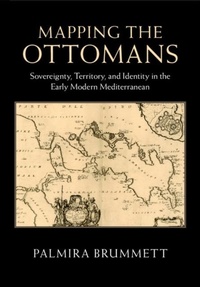
Mapping the Ottomans
Sovereignty, Territory, and Identity in the Early Modern Mediterranean
Published on 29. April 2015
978-1-316-31027-4 (ISBN)
Description

Simple paradigms of Muslim-Christian confrontation and the rise of Europe in the seventeenth century do not suffice to explain the ways in which European mapping envisioned the 'Turks' in image and narrative. Rather, maps, travel accounts, compendia of knowledge, and other texts created a picture of the Ottoman Empire through a complex layering of history, ethnography, and eyewitness testimony, which juxtaposed current events to classical and biblical history; counted space in terms of peoples, routes, and fortresses; and used the land and seascapes of the map to assert ownership, declare victory, and embody imperial power's reach. Enriched throughout by examples of Ottoman self-mapping, this book examines how Ottomans and their empire were mapped in the narrative and visual imagination of early modern Europe's Christian kingdoms. The maps serve as centerpieces for discussions of early modern space, time, borders, stages of travel, information flows, invocations of authority, and cross-cultural relations.
Reviews / Votes
'In this well-documented and richly illustrated narrative, Palmira Brummett envisions the European obsession with the Turk as an imagined space serving as a canvas for the sacred, warlike and quotidian impressions of historians and travelers alike. Tracing the accumulation of a remarkable body of information, Brummett describes the production of a chain of authorities, ancient and contemporary, in the cultural construction of pre-1800 Europe.' Virginia Aksan, McMaster University, Ontario 'Mapping the Ottomans is the triumphant conclusion of Palmira Brummett's innovative work on the early modern Ottoman Empire over more than three decades. I have no doubt that as both a model of scholarship and a passionately engaged critique of many of the west's assumptions about early Islamic empires, Brummett's book will come to redefine the next generation's approach to the study of the Ottomans. Anyone interested in our current geopolitical dilemmas should read it.' Jerry Brotton, Queen Mary, University of London, author of A History of the World in Twelve Maps 'Moving beyond the simple cataloguing of European images of the Ottoman other that has characterized previous scholarship, Palmira Brummett shows the nuanced and diverse range of European responses to the Ottomans, as well as illustrating Ottoman self-mapping practices and the ways in which both emerged from a set of shared precedents and fit into a common early modern cartographic culture. Mapping the Ottomans is an essential addition to the rich body of literature on early modern maps, as well as to our growing understanding of the complex and interconnected character of early modern European and the Mediterranean worlds.' Eric Dursteler, Brigham Young University 'This lavishly illustrated volume opens up the world of European perceptions, portrayal and cultural imagination of the Ottomans. Breaking away from the religious divide and military enemy motifs, Palmira Brummett presents a much more realistic and complex vision of osmosis, permeability, and shared societies in a book which is a true pleasure to read.' Kate Fleet, Director of the Skilliter Centre for Ottoman Studies and Fellow of Newnham College, University of Cambridge 'Palmira Brummett's nuanced account goes well beyond cartography to provide a rich history of how Western Europe viewed Ottoman space. This illuminating study demonstrates how texts and maps together shaped an imaginary of the borderlines between Asia and Europe, Islam, and Christianity. Brummett's focus on perceptions of space renders the maps she discusses as richly layered and interconnected objects, fully embedded in broader rhetorical, iconographic, and historiographic traditions.' Barbara Fuchs, University of California, Los Angeles 'In this comprehensive study of written and pictorial descriptions of the Ottoman state and its borderlands, Palmira Brummett gathers several of the most important strands of recent scholarship on the early modern world. This authoritative book is characterized by increasing recognition of the enmeshment of material and intellectual cultures in Christian and Muslim lands, reconfiguration of knowledge of the 'east' that eschews the stultifying rubric of orientalism, and reliance on maps as historical archives and powerful metaphors for picturing spaces and their inhabitants.' Sean Roberts, American Historical ReviewMore details
Language
English
Place of publication
Cambridge
United Kingdom
Publishing group
Cambridge University Press
Target group
Professional and scholarly
College/higher education
Illustrations
17 Plates, color; 1 Maps; 95 Halftones, unspecified; 95 Halftones, black and white
File size
98,14 MB
ISBN-13
978-1-316-31027-4 (9781316310274)
Copyright in bibliographic data and cover images is held by Nielsen Book Services Limited or by the publishers or by their respective licensors: all rights reserved.
Schweitzer Classification
Other editions
Additional editions
Palmira Brummett
Mapping the Ottomans
Sovereignty, Territory, and Identity in the Early Modern Mediterranean
Book
05/2015
Cambridge University Press
€53.50
Shipment within 15-20 days
Person
Palmira Brummett is Professor Emerita of History at the University of Tennessee, where she was Distinguished Professor of Humanities, and Visiting Professor of History at Brown University. Her publications include Ottoman Seapower and Levantine Diplomacy in the Age of Discovery (1994); Image and Imperialism in the Ottoman Revolutionary Press, 1908-1911 (2000); The 'Book' of Travels: Genre, Ethnology and Pilgrimage, 1250-1700 (2009), for which she was the editor and a contributor; and Civilizations Past and Present (2000-5), for which she was the coauthor of multiple editions. She has also written numerous articles on Ottoman, Mediterranean, and world history. She has been the recipient of NEH and ACLS fellowships, a Phi Beta Kappa Faculty Award for Scholarly Achievement, and a Bunting Fellowship at Radcliff University.
Content
1. Introduction: mapping empire and 'Turks' on the map; 2. Reading and placing the 'Turk'; 3. Borders: the edge of Europe, the ends of empire, and the redemption of Christendom; 4. Sovereign space: the fortress as marker of possession; 5. Heads and skins: mapping the fallen Turk; 6. From Venice and Vienna to Istanbul: the travel space between Christendom and Islam; 7. Authority, travel, and the map; 8. Afterword: mapping the fault lines of empire and nation.
