

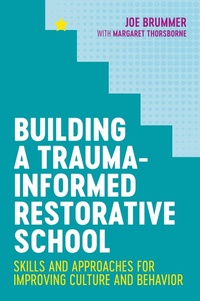
Building a Trauma-Informed Restorative School
Skills and Approaches for Improving Culture and Behavior
Published on 21. December 2020
240 pages
978-1-78775-268-9 (ISBN)
Description

Covering both theory and practice, this betselling guide provides educators with everything you need to know about developing restorative and trauma-informed practices within your setting.
Part 1 addresses the theory and philosophy of restorative approaches, and of trauma-informed and trauma-sensitive schools. Part 2 outlines the five restorative skills (mindfulness, honest expression, empathy, the art of asking questions and the art of requests). It shows you what these look like in practice - including using circles, respect agreements and restorative dialogue - and how to implement them. Every strategy is clearly explained and adapted to be appropriate for children and adults who have experienced trauma.
Designed to be adapted for different school settings and their particular challenges, this groundbreaking guide provides you with a trusted roadmap for successfully introducing restorative trauma-informed practice.
Part 1 addresses the theory and philosophy of restorative approaches, and of trauma-informed and trauma-sensitive schools. Part 2 outlines the five restorative skills (mindfulness, honest expression, empathy, the art of asking questions and the art of requests). It shows you what these look like in practice - including using circles, respect agreements and restorative dialogue - and how to implement them. Every strategy is clearly explained and adapted to be appropriate for children and adults who have experienced trauma.
Designed to be adapted for different school settings and their particular challenges, this groundbreaking guide provides you with a trusted roadmap for successfully introducing restorative trauma-informed practice.
More details
Edition
Digital original
Language
English
Place of publication
London
United Kingdom
Target group
Primary & secondary/elementary & high school
Edition type
Digital original
File size
1,20 MB
ISBN-13
978-1-78775-268-9 (9781787752689)
Copyright in bibliographic data and cover images is held by Nielsen Book Services Limited or by the publishers or by their respective licensors: all rights reserved.
Schweitzer Classification
Other editions
Additional editions
Joe Brummer | Margaret Thorsborne
Building a Trauma-Informed Restorative School
Skills and Approaches for Improving Culture and Behavior
Book
12/2020
Jessica Kingsley Publishers
€35.00
Shipment within 15-20 days
Persons
Joe Brummer has been the victim of two separate violent anti-gay related hate crimes and what began as a personal healing response to the trauma he has transformed into professional involvement in the field of community and restorative justice. Since 2006, Joe has actively been working with schools and NGOs in multiple states to share Nonviolent Communication, implement peer mediation programs, and school-wide restorative practices. In 2017, he completed a six-year term on the board of directors for the National Association for Community Mediation where he helped lead the overhaul of employee review strategies to be more restorative. He presented on Conflict and Peace Building in 2012 and 2013 for the Annual International Leadership Training Programme: A Global Intergenerational Forum sponsored by the United Nations Education, Scientific, and Cultural Organization (UNESCO) Chair & Institute of Comparative Human Rights at the University of Connecticut. Joe has been an invited presenter on trauma-informed restorative practices at the last three Annual Creating Trauma-Sensitive Schools Conferences hosted by the Trauma and Attachment Network. From 2010 until 2014, Joe was the associate director of a community mediation center in Connecticut where he provided school-based mediation programs, mediation for the Juvenile Review Boards, oversaw adolescent and adult criminal mediation/dialogue programs that involved victim/offender and offender/offender dialogues, and provided training in Nonviolent Communication, trauma-informed schools, and restorative justice. Since 2015, he has worked as an independent consultant to schools and school districts developing trauma-informed approaches to restorative practice in multiple locations throughout the United States.
Content
- Intro
- Building Atrauma-Informed Restorative School
- Cover
- Of related interest
- Title page
- Copyright
- Contents
- Foreword by Judy Atkinson
- Acknowledgments
- Preface
- Introduction
- Section summaries
- Section 1: The Foundations, Principles, and a New Understanding of Behavior
- 1. A New Lens on Behavior
- Introduction
- Punishment as violence
- Rewards
- In the service of meeting needs
- The Relationship Matrix
- Conventional versus restorative thinking
- 2. Trauma and the Art of Connection
- Empathy
- The brain is a house!
- Trauma
- Toxic stress
- What are ACEs?
- Trauma-informed schools
- Emotion is contagious
- Universal precautions
- Strategies for connection
- 3. The Four Elements of a Restorative School Climate and Culture
- Restorative language
- Demands
- Community-building
- Repairing relationships
- Rebuilding community
- Section 2: The Five Skills of Restorative
- 4. The Five Skills of Restorative
- 5. Mindfulness
- Developing a pause button
- How mindfulness supports the success of P.A2.I.R
- Modeling mindfulness
- Formal versus informal mindfulness practice
- Informal practice in restorative skills
- Trauma-sensitive mindfulness
- 6. Empathy
- Fix-it
- Competition/defensiveness
- Empathic listening
- 7. Honest Expression
- Affective statements
- How honest expression works
- 8. The Art of Asking Questions
- Open versus closed questions/statements
- Restorative questions
- Talking circle questions and prompts to dialogue
- 9. The Art of Requests
- Action plans
- Section 3: Restorative in Action
- 10. Restorative in Practice
- A brief background to restorative practices
- Student involvement
- Formal conferencing
- What practice and when?
- Training in practices
- 11. Restorative Language
- Nonverbal communication
- 12. Respect Agreements
- How to use the respect agreement
- Creating respect agreements
- Variations on the lesson plan
- 13. Collaborative and Proactive Solutions
- Plan A: An imposed solution
- Plan C: Prioritizing
- Plan B: Solving problems collaboratively and proactively
- 14. Using Circles
- The basics elements of the circle process
- Stages/structure of a circle
- Planning for a circle
- Phases of a harm-, conflict-, or incident-focused circle
- Facilitating a harm circle
- Using academic-focused circles
- Gratitude and celebration circles
- Facilitating a formal conference
- Troubleshooting circle
- 15. Regulation Spaces
- Section 4: Implementation
- 16. Implementation
- The power of our stories: The importance of narrative
- My journey into trauma-informed Restorative Justice in schools
- The lessons learned
- The Six Sources of Influence
- Creating the three-year plan
- Conclusion
- References
- Appendix
- Index
