

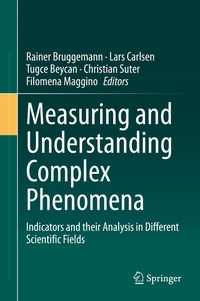
Measuring and Understanding Complex Phenomena
Description

Indicators are more and more applied to describe and analyze complex systems. Typical examples: Innovation potential of nations, child-well being, Environmental health, poverty, chemical pollution, corruption of nations. The task is: How can a system of indicators be defined in order to fulfill the above expectations. One possibility is the application of the mathematical theory of partial order, especially when the indicator system shall be used for ranking purposes.
More details
Other editions
Additional editions
Persons
Rainer Bruggemann studied chemistry with a focus on theoretical and mathematical concepts. He was working at several research institutes and was teaching mathematical modelling in Environmental Chemistry at several universities. His interest also focuses on indicators and their analysis.
Lars Carlsen has more than 35 years of experience in R&D, technical support and training activities within the environmental field. His current research interests include areas like sustainable development, model tools, such as structure-activity relationships and ranking techniques as decision support tools and development and application of multi-criteria data analysis tools within environmental - and social science.
Tugce Beycan is currently finalizing her dissertation on multidimensional poverty in upper-middle-income countries at the department of sociology of University of Neuchâtel. She formerly worked at IPEC and department of statistics of ILO. Her research interests are poverty, quality of life, social bonds, capabilities, and child labour.
Christian Suter is Professor at the Department of Sociology of the University of Neuchâtel, Switzerland. His research has focused on social and economic inequalities, social indicators and quality of life, as well as on globalization and world society.
Filomena Maggino is Professor of Social Statistics at the Sapienza University of Rome. President and co-founder of the Italian Association for Quality-of-Life Studies (AIQUAV). Editor-in-Chief of Social Indicators Research journal (Springer) and Encyclopedia of Quality-of-Life and Well-being Research (Springer). She is one of the main worldwide experts in the field of indicators construction, analysis and synthesis and wellbeing and quality of life research. Advisor of several governmental organizations and member of institutional ad-hoc committees.
