
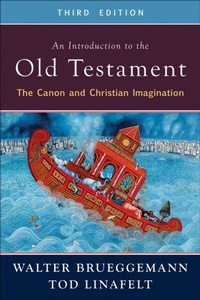
An Introduction to the Old Testament, Third Edition
Description
Alles über E-Books | Antworten auf Fragen rund um E-Books, Kopierschutz und Dateiformate finden Sie in unserem Info- & Hilfebereich.
In this updated edition of the popular textbook An Introduction to the Old Testament, Walter Brueggemann and Tod Linafelt introduce the reader to the broad theological scope of the Old Testament, treating some of the most important issues and methods in contemporary biblical interpretation. This clearly written textbook focuses on the literature of the Old Testament as it grew out of religious, political, and ideological contexts over many centuries in Israel's history. Covering every book in the Old Testament (arranged in canonical order), the authors demonstrate the development of theological concepts in biblical writings from the Torah through postexilic Judaism.
Incorporating the most current scholarship, this new edition also includes concrete tips for doing close readings of the Old Testament text, and a chapter on ways to read Scripture and respond in light of pressing contemporary issues, such as economic inequality, racial and gender justice, and environmental degradation. This introduction invites readers to engage in the construction of meaning as they venture into these timeless texts.
All prices
More details
Other editions
Additional editions

Persons
Walter Brueggemann is William Marcellus McPheeters Professor Emeritus of Old Testament at Columbia Theological Seminary. An ordained minister in the United Church of Christ, he is the author of dozens of books, including Sabbath as Resistance: Saying No to the Culture of Now, Interrupting Silence: God's Command to Speak Out, and Truth and Hope: Essays for a Perilous Age.
Content
- Intro
- Half Title
- Title Page
- Copyright
- Contents
- Preface to the Third Edition
- Preface to the Second Edition
- Preface to the First Edition
- Introductory Materials
- 1. Imaginative Remembering: The Theological Witness of the Old Testament
- 2. Narrative and Poetry: The Literary Art of the Old Testament
- Part I: The Torah
- 3. Introduction to the Torah
- 4. Genesis 1-11: Cosmic Miracles in Contradiction
- 5. Genesis 12-50: The Ancestors
- 6. The Book of Exodus
- 7. The Book of Leviticus
- 8. The Book of Numbers
- 9. The Book of Deuteronomy
- 10. Reprise on the Torah
- Part II: The Prophets
- 11. Introduction to the Prophets
- 12. The Book of Joshua
- 13. The Book of Judges
- 14. The Books of 1 and 2 Samuel
- 15. The Books of 1 and 2 Kings
- 16. The Book of Isaiah
- 17. The Book of Jeremiah
- 18. The Book of Ezekiel
- 19. The Minor Prophets (1)
- 20. The Minor Prophets (2)
- 21. Reprise on the Prophets
- Part III: The Writings
- 22. Introduction to the Writings
- 23. The Book of Psalms
- 24. The Book of Job
- 25. The Book of Proverbs
- 26. The Five Scrolls
- 27. The Book of Daniel
- 28. The Books of Ezra and Nehemiah
- 29. The Books of 1 and 2 Chronicles
- 30. Reprise on the Writings
- Concluding Reflections
- 31. The Hiddenness of God and the Complexities of Interpretation
- 32. Getting the Most from the Bible
- 33. The Bible and the Contemporary World
- Bibliography
- Index of Scripture
- Index of Names
- Index of Subjects

System requirements
File format: ePUB
Copy protection: Adobe-DRM (Digital Rights Management)
System requirements:
- Computer (Windows; MacOS X; Linux): Install the free reader Adobe Digital Editions prior to download (see eBook Help).
- Tablet/smartphone (Android; iOS): Install the free app Adobe Digital Editions or the app PocketBook before downloading (see eBook Help).
- E-reader: Bookeen, Kobo, Pocketbook, Sony, Tolino and many more (not Kindle).
The file format ePub works well for novels and non-fiction books – i.e., „flowing” text without complex layout. On an e-reader or smartphone, line and page breaks automatically adjust to fit the small displays.
This eBook uses Adobe-DRM, a „hard” copy protection. If the necessary requirements are not met, unfortunately you will not be able to open the eBook. You will therefore need to prepare your reading hardware before downloading.
Please note: We strongly recommend that you authorise using your personal Adobe ID after installation of any reading software.
For more information, see our ebook Help page.
File format: PDF
Copy-Protection: Adobe-DRM (Digital Rights Management)
System requirements:
- Computer (Windows; MacOS X; Linux): Install the free reader Adobe Digital Editions prior to download (see eBook Help).
- Tablet/smartphone (Android; iOS): Install the free app Adobe Digital Editions or the app PocketBook before downloading (see eBook Help).
- E-reader: Bookeen, Kobo, Pocketbook, Sony, Tolino and many more (only limited: Kindle).
The file format PDF always displays a book page identically on any hardware. This makes PDF suitable for complex layouts such as those used in textbooks and reference books (images, tables, columns, footnotes). Unfortunately, on the small screens of e-readers or smartphones, PDFs are rather annoying, requiring too much scrolling.
This eBook uses Adobe-DRM, a „hard” copy protection. If the necessary requirements are not met, unfortunately you will not be able to open the eBook. You will therefore need to prepare your reading hardware before downloading.
Please note: We strongly recommend that you authorise using your personal Adobe ID after installation of any reading software.
For more information, see our eBook Help page.
File format: ePUB
Copy protection: Watermark-DRM (Digital Rights Management)
System requirements:
- Computer (Windows; MacOS X; Linux): Use a reading software that can process the file format ePUB: e.g., Adobe Digital Editions or FBReader – both free (see eBook Help).
- Tablet/Smartphone (Android; iOS): Before downloading, install the free app Adobe Digital Editions (see eBook Help).
- E-reader: Bookeen, Kobo, Pocketbook, Sony, Tolino and many more (not Kindle).
The file format ePUB works well for novels and non-fiction books – i.e., „flowing” text without complex layout. On an e-reader or smartphone, line and page breaks automatically adjust to fit the small displays.
This eBook uses Watermark-DRM, a „soft” copy protection. This means that there are no technical restrictions to prevent illegal distribution. However, there is a personalised watermark embedded in the eBook that can be used to identify the purchaser of the eBook in the event of misuse and to provide evidence for legal purposes.
For more information, see our eBook Help page.
