

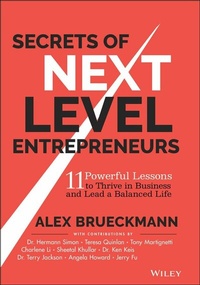
Secrets of Next-Level Entrepreneurs
Description

In Secrets of Next Level Entrepreneurs: 11 Powerful Lessons To Thrive in Business and Lead a Balanced Life, business strategist Alex Brueckmann presents a collection of practical and insightful resources that walk you through how to grow a profitable business while maintaining a healthy and fulfilling life. You'll learn to run your company while, at the same time, contributing to and improving a community and world we all want to live in.
In the book, industry leaders offer hyper-specific and actionable advice about issues that dominate the thoughts of every business leader and owner at one point or another, from how to implement environmentally and socially sustainable practices to building high-performance workplace cultures and setting optimal pricing strategies in environments of high inflation.
You'll also find:
* Frequently overlooked perspectives and unfamiliar topics that hold huge value for courageous readers with open minds
* Strategies for prioritizing self-care while running your business, ensuring you don't neglect yourself while you're taking care of everyone else
* A philosophy that emphasizes the creation of sustainable, profitable businesses that contribute to the health of their founders, employees, stakeholders, and communities
A singular and powerful collection of resources for entrepreneurs, founders, managers, executives, board members, and other business leaders, Secrets of Next Level Entrepreneurs will also earn a place on the bookshelves of coaches, consultants, and other professionals who serve business leaders.
More details
Other editions
Additional editions
Person
He partners with leaders in corporate, not-for-profit, and the public sector to help create business clarity and strategic direction. He has over two decades of
experience as a strategic facilitator for business owners and corporate leaders.
Content
Theme I Three Essential Hard Skills Every Business Leader Should Master 1
Chapter 1 Creating a Winning Business Strategy--It's Easier Said Than Done 5
Chapter 2 The Smartest Way to Boost Profits Is Clever Pricing 25
Chapter 3 Creating Value and a Sustainable Impact for Your Business 43
Theme II How Businesses Shape Impactful Cultures Through Leadership 63
Chapter 4 Mastering Disruption and the Future of Work 67
Chapter 5 Six Components to Build a HighPerformance Culture 87
Chapter 6 Creating an Impact Culture 105
Chapter 7 How to Make Conflict Resolution Easier and More Productive 125
Theme III Self-Care: The Secret Sauce for Leading a Fulfilling Life and Successful Business 145
Chapter 8 Self-Leadership and Leading in Challenging Times 149
Chapter 9 Creating a Balanced Life That You Love 163
Chapter 10 Whole Person Self-Awareness: The Key to Transformation 183
Chapter 11 Four Powerful Mindset Shifts to Help You Conquer Love, Overcome Death, and Succeed in Business 205
Notes 219
Acknowledgments 223
About the Author 225
CHAPTER 1
Creating a Winning Business Strategy-It's Easier Said Than Done
Alex Brueckmann
If you ask three business owners "what is strategy?" you will likely receive three different definitions. Their answers might range from "a plan on how we create value" or "our priorities for the next few years" to "an approach to winning against competitors" and "a framework used to make decisions." There is nothing wrong with these answers. As a matter of fact, if you research a definition of the term strategy, you will find suggestions that match these ideas to a large degree. So, which definition is the most accurate? Which approach should be used for your business?
I would accept any definition of strategy as long as it captures some of these ideas if used consistently in your business. This can prevent businesses from running into major issues with severe consequences. The term strategy is highly versatile in all aspects of life, from the world of sports to business and beyond. It does not come as a surprise that many find it difficult to make sense of it.
This chapter will focus on strategy using examples of go-to-market strategies for start-ups and competitive strategies for corporations. I will define what strategy is, describe the characteristics and importance of an impactful strategy, and examine the ethics of strategy.
What Is a Strategy Anyway?
The first matter to take care of is to define the term itself. For start-ups and entrepreneurs, the term strategy is closely associated with go-to-market strategy: how they plan to penetrate a specific market with a new product, technology, or service offering. Serial entrepreneur Richard Branson, the founder of Virgin Group, is quoted to have said, "And in the end, you just got to say, 'Screw it, just do it' and get on and try it."1 Now, Branson certainly made some significant business decisions in his life, and some questionable ones as well. Having learned from observing Branson, let me suggest that a 'screw it, just do it' attitude is the opposite of having a strategy at play. You might want to approach your business with a more focused approach.
FIGURE 1.1 The Entrepreneurial Strategy Compass, adapted from Joshua Gans, et al.2
A simple way to develop a straightforward strategy is to start with the Entrepreneurial Strategy Compass. It describes four types of strategies that help founders and entrepreneurs make educated, rather than impulsive, go-to-market decisions.
How would these strategic go-to-market options look in operation for a real business? To understand further, I've come up with a not-so-hypothetical scenario. Let's assume you are an aspiring entrepreneur living in Bellevue, Washington, USA. It is 1994, your name is Jeffrey, and you want to launch a business based on your best idea: selling books online. You examine the following strategic options to consider your ideal strategy to enter the market:
- Option 1: Disruption-you pick one product category, books, and move fast. You compete against giant book retailers and take them by surprise. They don't take you seriously at first; however, your mission is to change that.
- Option 2: Architectural-you create and control a new platform and allow retailers to sell their products via Amazon.
- Option 3: Value Chain-you partner with publishing houses, helping them circumvent retailers as gatekeepers and use Amazon as the key to a profitable business-to-consumer (B2C) business.
- Option 4: Intellectual Property-you help large retailers modernize their sales channels and build a white-label online bookstore.
Strategic Specificity Matters More Than You Might Think
It seems that Jeff Bezos maneuvered his strategic options wisely. Now, Amazon can hardly be described as a start-up anymore, but rather a significant corporate player. In the corporate world, the term strategy describes an organization's business or competitive strategy. There are many examples of how the term lacks specificity-and the potential issues that arise. Let me share two particularly notable examples, which are publicly accessible on the respective company websites of Porsche and Boeing.
Example 1: Porsche-2025 Strategy
"The company's main objective is to achieve value-generating growth. Only by achieving such growth can we make sustainable investments in innovative technologies, new products, and, most importantly, in our team here at Porsche. With this approach, we are already on our way toward rethinking sporty mobility. We want to excite customers with our products and services. We also aim to consolidate our reputation as an excellent employer and business partner that fulfills its social and environmental responsibilities. And the return needs to be sufficient too."
Porsche's strategy consists of four key pillars:
- Excellent employer and business partner
- Inspiring customers with a unique product and brand experience
- Excellent profitability with a return on sales of more than 15 percent
- Innovation and sustainable business practices.3
The pillars are specific, immediately showing an understanding of their intentions and direction. Porsche's four pillars are linked to each other; they also are mutually beneficial and could not stand on their own. No pillar is self-sustaining, and each point contributes to the main objective of value-generating growth. Also, the pillars align with their company: anyone reading them can quickly develop a clear understanding of any of them.
This is a solid explanation of Porsche's main priorities and focus. It consists of concise sentences, is clearly structured, and contains a timeframe with ways to measure their success. Let's be clear: this strategy description is better than many other examples of company business strategies.
Example 2: Boeing-2025 Strategy
"Enterprise Strategy:
- Operate as One Boeing
- Build Strength on Strength
- Sharpen and Accelerate to Win
2025 Goals:
- Market Leadership
- Top-quartile Performance and Returns
- Growth Fueled by Productivity
- Design, Manufacturing, Services Excellence
- Accelerated Innovation
- Global Scale and Depth
- Best Team, Talent and Leaders
- Top Corporate Citizen"4
Let's briefly examine the Boeing strategy. It does not consist of proper sentences and lists three brief bullet points, followed by eight goals for 2025. This hardly qualifies as a strategy. It's a nondescript list rather than a description anyone can read and comprehend. The three main bullet points couldn't be more generic and resemble internal corporate marketing jargon.
The parts that could be measurable are unspecific. For example, it's unclear what they mean by "Top-quartile," as it could refer to Fortune 500 companies, airplane producers, the aviation industry, or any number of things. The content and direction of the three strategic themes leave maximum room for interpretation, as they are nonspecific and very short. In addition, it is unclear how Boeing's themes and goals are related.
Since the 1970s, Boeing's business strategies have resulted in a creeping loss of market share to its primary rival, Airbus. In the 2000s, Boeing failed to develop more fuel-efficient passenger planes. It became a major problem when their competitor Airbus, introduced the A320neo, which became a best-seller. Boeing didn't have a comparable aircraft ready to compete. Due to the time and cost involved in designing a new plane from scratch, Boeing decided to update their existing 737 model with larger and more fuel-efficient engines and related design additions, sold as the 737 MAX. An upgrade.
In October 2018, and again in March 2019, two 737 MAX aircraft crashed, with 346 casualties. The fallout for Boeing was significant. The 737 MAX models lost their clearance and were grounded. A United States Federal Aviation Agency investigation revealed that design flaws concealed by Boeing caused the disasters. As a result, the company lost the trust of regulators and the public. The total direct costs of the 737 MAX groundings are an estimated US$20 billion, and indirect costs are over US$60 billion. This excludes the US$2.5 billion settlement Boeing paid after being charged with fraud to avoid criminal prosecution.5 While I'm not suggesting that it was only because of their strategy-culture and leadership appear to have played a role as well-Boeing paid a high toll for their mistakes.
I chose to examine Boeing's and Porsche's public plans to illustrate how vastly different strategies can look, and how various companies communicate their strategies to the public. I'm sure internally, both companies adopt a more succinct and focused version of their strategies. However, this is what Boeing and Porsche are publicly declaring and sharing as their strategy.
Other companies publish strategies that are looser vision statements, aspirations, or missions, which hardly qualify as...
