

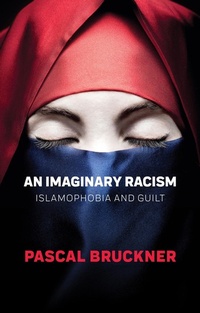
An Imaginary Racism
Description

There are already more than enough forms of racism; there is no need to imagine more. While all violence directed against Muslims is to be strongly condemned and punished, defining these acts as 'Islamophobic' rather than criminal does more to damage Islam and weaken the position of Muslims than to strengthen them.
More details
Other editions
Additional editions

Person
Content
Introduction: A Semantic Revolution
Part I The Fabrication of a Crime of Opinion
1. The Disappearance of Race, the Proliferation of Racists
2. A Weapon of Mass Intimidation
3. The Miracle of Transubstantiation
Part II The Left Suffering from Denial
4. Islamo-Leftism, or the Conjunction of Resentments
5. An Unnatural Marriage
6. The Victim's Guilt, the Murderer's Innocence
Part III Are Muslims the Equivalent of Jews?
7. From the Principle of Equivalence to the Principle of Substitution
8. Exterminations Galore
9. The Jew, An Accursed White
10. A Semantic Racket
Part IV Are We Guilty of Existing?
11. The Criminalization of Reticence
12. Minorities, Protection or Prison?
13. The Racism of the Anti-Racists
14. Should the West be De-Colonized?
Part V What is God's Future?
15. Is the War on Terror a Sham?
16. Resistance or Penitence
17. Western Values are not Negotiable
8. Weary of God
19. The Grandeur and the Tragedy of Tolerance
Epilogue: On History as a Warning
Notes
1
The Disappearance of Race, the Proliferation of Racists
Écr.l'inf., abbreviation of 'Écrasons l'infâme' (i.e., 'let us crush obscurantism and superstition'): Voltaire's signature at the end of his letters.
On 16 May 2013, the French parliament, acting on a proposal made by the Front de gauche, decided to eliminate the notion of 'race' from legislation, 'in order to move our society forward on the ideological and pedagogical level, even though we are all convinced that this symbolic gesture will not suffice to do away with racism' (François Ascensi).1 During his campaign, the presidential candidate (François Hollande) had in fact supported this move, in order to cut the ground from under 'all the nauseating theories'. The delegate who presented the proposal, Alfred Marie-Jeanne,2 emphasized that the word 'race' is an 'aberrant concept'. Having served as the basis for the worst excesses, 'it has no place in our juridical order'. Already taboo in common discourse, the term has more or less fallen into disuse, except in far-right homilies and in rap songs. The initiative is revelatory of our desire to resolve problems by nullifying them. If there are no longer any races, then the word 'racism' ought to disappear. There are no longer any races except the proliferating race of racists, who are proliferating like vermin in need of re-education. To eliminate these differences, we have to stress one difference that cannot be overcome, that of the racist, who is cast out into the absolute otherness of the barbarian. Thus all we have to do is cut out the tumour, eradicate the accursed word, and everything will be fine.
The approval of this law occurred in the context of a new wave of hostile acts among citizens of various groups, and thus of a tendency the inverse of that proclaimed by the elites. In the schools, in the street, in the media, and in song lyrics, the fine drama of unanimity disintegrated into insults, fights, and diverse abusive epithets such as 'feujs' (Jews), 'rebeus' (Arabs), 'gaulois' (Gauls), 'céfrans' (French), 'noiches' (Asians), and many more. The hymn sung to happy coexistence corresponds to the image of a fragmented humanity. We have never shouted so much at people in the name of their origins, their beliefs, or the colour of their skin. In a movement already noted by those most lucid observers, Paul Yonnet and Pierre-André Taguieff, anti-racism never ceases to racialize every form of ethnic, political, sexual, or religious conflict. It constantly recreates the curse that it claims to be fighting. A strange mechanism whose genealogy should be traced; it is probably connected with the collapse of the communist project. Everywhere, racial struggle seems to be supplanting class struggle, as Raymond Aron already feared sixty years ago.3 Everything has become racial: cultures, religions, communities, sexual preferences, thoughts, eating habits. Hasn't the neologism 'pauvrophobie' ('pauperphobia') recently been invented (ATD Quart monde, October 2016) to denounce discriminations in job insecurity? A purely linguistic poultice that will in no way improve the situation of those excluded, but that reassures social actors. With this strange contradiction that assimilates fear to hatred, 'phobias' are proliferating. To fear a group, a gender orientation, a belief, or a working-class accent is already to display loathing, to oscillate between aversion and mental illness. The phobic person is twice guilty, on both the psychic and the social levels. We haven't nullified the problem, we've just moved it. Everything that distinguishes humans ends up setting them against one another. The slightest disagreement or uneasiness is translated into a racial disqualification: as soon as one person feels attacked, even by a look or an expression, he can accuse you, point an avenging finger at you.
What should an anti-racism, rightly understood, consist in? The wisdom to live together, the attraction of diversity when individuals of all origins encounter one another in the same space, but also a discerning intelligence capable of distinguishing what is a matter of humiliation from what is a matter of freedom of expression. Let us recall that the goal of a wise politics is to prevent discord and avoid war. But anti-racism, which has become the civil religion of modern times, has been transformed into a permanent war of all against all, a rhetoric of recrimination. The contraction of time and space brought about by new technologies and means of transportation leads to the abolition of the distances that used to protect us from what was far away. But on a planet where human tribes, constantly on the move, collide with one another, the pressure becomes oppressive. The net tightens, arousing a feeling of claustrophobia and even of rejection. Globalization reflects this historical moment, at which the Earth becomes aware of its limits and humans become aware of their interdependence. The universe ceases to be the common space of their intercourse and becomes the site of their mutual torments. Since people are now separated from each other by no more than a few hours in an airplane or a train, they are deprived of the distance required by any relationship and plunged into the intolerable proximity of the global village, precisely where distances, intervals, need to be re-established so that everyone rediscovers his place. The opening-up promised by modernity, the marvellous possibility of leaving behind the local, the native, the tribal, is converted into a new confinement on the global scale, not so much a broadening of horizons as the perception of the horizon as a new enclosure. Since there is only one world, that of population explosions, natural catastrophes, and mass migrations, it is more necessary than ever that people conceive of themselves as large groups. Tensions increase because individuals come closer to one another, rub shoulders, are forced to share space. To build bridges between people, you have to start by restoring the gates that delimit each person's territory.
Finally, the dominant 'racism', that disease of world unification, is no longer connected solely with a wish to exterminate, as it was in Germany, Turkey, Cambodia, or Rwanda; it is above all a desire to confine. It expresses the desire to be among one's own kind and to drive out intruders: the danger facing multiracial societies is as much the dictatorship of a majority that imposes its law as it is the juxtaposition of communities hermetically sealed off from one another, communicating no more than the strict minimum. In this configuration, everything that distinguishes people ends up wounding them. So sensitivities have to be handled with extreme care, and one has to think twice before saying anything at all. Any offensive remark, class contempt, comment on physical appearance, or even a compliment can be interpreted as discrimination. All that remains is humour, which mitigates clichés and routs them, whereas racist jokes confirm them by making people laugh at the expense of this or that category of others.
A major change in modern times: in Western countries, the politics of identity is tending to replace help for the disadvantaged. The People, as presented mythically by the left and the republicans, is disappearing in favour of minorities. Everywhere, the ethnic is supplanting the social, the ethical is supplanting the political, and living memory is supplanting cold history. Everywhere the loathsome habit of defining oneself by one's origins, identity, or belief is settling in. Difference is reaffirmed at the very time that we want to establish equality, at the risk of involuntarily continuing the old prejudices connected with skin colour and customs. This tendency is contemporary with the explosion of the judicial in the modern world. The courtroom is becoming the site where reparations compensate victims and nail to the pillory the villains who have dared to cross the line. If in the democratic age the court trial has become the pedagogical trope par excellence, that is because it is where everyone defends the most cherished cause of all, oneself, and displays before witnesses one's suffering and one's humiliations. The trio of the attorney, the judge, and the plaintiff consecrates the court as the emblematic stage on which the human adventure is played out in the age of identity.
As for the critique of political correctness (a euphemism that has been raised to the rank of an art de vivre), it is itself another kind of conformism, a convention of the unconventional, an orthodoxy of heterodoxy that merely doubles one dead-end by adding another. We're not going to insult one another to show our freedom of opinion. The fact that we have to restrain ourselves in making judgements regarding those close to us is not a simple matter of censorship but the minimal decency that we owe each other in pluralistic societies. Politeness, as Kant already pointed out, is politics writ small. If a Donald Trump could be elected president of the United States, it is because in the course of his campaign he ignored this elementary courtesy, insulting Mexicans, immigrants, blacks, Muslims, Chinese, and indeed anyone who objected to his programme. But this popular spokesman, who likes to be clownish and Neronian and who defends an isolationist and protectionist credo, is himself no...
