

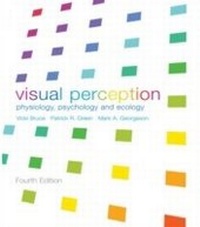
Visual Perception
Physiology, Psychology and Ecology
4th Edition
Published on 27. August 2014
496 pages
978-1-136-91707-3 (ISBN)
Description

This comprehensively updated and expanded revision of the successful second edition continues to provide detailed coverage of the ever-growing range of research topics in vision. In Part I, the treatment of visual physiology has been extensively revised with an updated account of retinal processing, a new section explaining the principles of spatial and temporal filtering which underlie discussions in later chapters, and an up-to-date account of the primate visual pathway.
Part II contains four largely new chapters which cover recent psychophysical evidence and computational model of early vision: edge detection, perceptual grouping, depth perception, and motion perception. The models discussed are extensively integrated with physiological evidence. All other chapters in Parts II, III, and IV have also been thoroughly updated.
Part II contains four largely new chapters which cover recent psychophysical evidence and computational model of early vision: edge detection, perceptual grouping, depth perception, and motion perception. The models discussed are extensively integrated with physiological evidence. All other chapters in Parts II, III, and IV have also been thoroughly updated.
Reviews / Votes
'An excellent, thorough revision which turns a useful book into an indispensible one. I would strongly recommend it as a main text for undergraduate vision courses in psychology and biology and for postgraduates starting research in vision science.' - Mike Harris, University of Birmingham, UK'The new text significantly strengthens the unique position that the book occupies in the market.' - George Mather, University of Sussex, UK
'This book presents a richly detailed account of current thinking on visual perception... New sections have been added to represent important, and sometimes fascinating, new developments.' - Gillian Rhodes, University of Canterbury, New Zealand
'Teachers of final-year psychology courses on vision have long had a problem with textbooks. This book goes a long way towards correcting this situation. Arguably it goes further than any competitor, and it does so with a clear and informed style, scoring close to full marks for both conceptual and literary clarity.' - Andrew T. Smith, Royal Holloway, University of London, UK
More details
Edition
4th edition
Language
English
Place of publication
London
United Kingdom
Publishing group
Taylor & Francis Ltd
Target group
College/higher education
Edition type
Revised edition
File size
62,12 MB
ISBN-13
978-1-136-91707-3 (9781136917073)
Copyright in bibliographic data and cover images is held by Nielsen Book Services Limited or by the publishers or by their respective licensors: all rights reserved.
Schweitzer Classification
Other editions
Additional editions
Vicki Bruce | Mark A. Georgeson | Patrick R. Green
Visual Perception
Physiology, Psychology and Ecology
Book
08/2003
4th Edition
Psychology Press Ltd
€85.00
Article exhausted; check different version
Vicki Bruce | Mark A. Georgeson | Patrick R. Green
Visual Perception
Physiology, Psychology and Ecology
Book
08/2003
4th Edition
Psychology Press Ltd
€89.38
Shipment within 3-4 weeks
Persons
Vicki Bruce, Mark A. Georgeson, Patrick R. Green
Content
Part I. The Physiological Basis of Visual Perception. Light and Eyes. The Neurophysiology of the Retina. Visual Pathways in the Brain. Part II. Processing Retinal Images. Approaches to the Psychology of Visual Perception. Images, Filters and Features: The Primal Sketch. Perceptual Organisation. Perceiving Depth. The Computation of Image Motion. Object Recognition. Connectionist Models of Visual Perception. Part III. Visual Information for the Control of Action. Introduction to the Ecological Approach to Visual Perception. Visual Guidance Of Animal Locomotion. Visual Guidance of Human Action. Theories of the Control of Action. Event Perception. Perception of the Social World. Part IV. Conclusions. Contrasting Theories of Visual Perception.
