

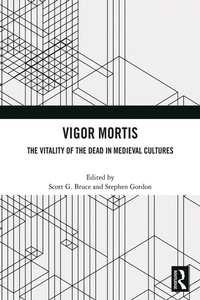
Vigor Mortis
The Vitality of the Dead in Medieval Societies
1st Edition
Published on 16. December 2024
166 pages
978-1-040-29986-9 (ISBN)
Description

This volume explores the enduring presence and participation of the dead in the lives of premodern people from the Carolingian period to the end of the Middle Ages.
Unlike modern states, which erect barriers to separate the dying and the deceased from their families, friends, and associates, premodern societies in western Europe fostered an on-going relationship between the living and the dead that was mutually beneficial to both parties. As these studies show, the dead had many means at their disposal to communicate their needs and disaffection, including ghostly visitations and unquiet corpses. For their part, medieval authors told stories about the fate of the dead and the geography of the afterlife to dissuade sinful behaviour and foster virtue in preparation for the Last Judgment. Premodern hauntings also serve as a useful metaphor for the uncertainty of archival research in recovering past voices and for the racial presumptions that inform our reconstruction of the western Middle Ages.
This book will appeal to scholars and students of history and literature, especially those interested in the concept of death in the medieval period. The chapters in this book were originally published in the Journal of Medieval History.
Unlike modern states, which erect barriers to separate the dying and the deceased from their families, friends, and associates, premodern societies in western Europe fostered an on-going relationship between the living and the dead that was mutually beneficial to both parties. As these studies show, the dead had many means at their disposal to communicate their needs and disaffection, including ghostly visitations and unquiet corpses. For their part, medieval authors told stories about the fate of the dead and the geography of the afterlife to dissuade sinful behaviour and foster virtue in preparation for the Last Judgment. Premodern hauntings also serve as a useful metaphor for the uncertainty of archival research in recovering past voices and for the racial presumptions that inform our reconstruction of the western Middle Ages.
This book will appeal to scholars and students of history and literature, especially those interested in the concept of death in the medieval period. The chapters in this book were originally published in the Journal of Medieval History.
More details
Edition
1. Auflage
Language
English
Place of publication
London
United Kingdom
Publishing group
Taylor & Francis Ltd
Target group
College/higher education
ISBN-13
978-1-040-29986-9 (9781040299869)
Copyright in bibliographic data and cover images is held by Nielsen Book Services Limited or by the publishers or by their respective licensors: all rights reserved.
Schweitzer Classification
Other editions
Additional editions
Book
approx. 07/2026
1st Edition
Routledge
€57.50
Not yet published
Book
12/2024
1st Edition
Routledge
€197.00
Shipment within 10-20 days
Persons
Scott G. Bruce is Professor of Medieval History at Fordham University. His research interests include monasticism, hagiography, and the reception of classical and patristic traditions in medieval Europe. He is the editor of The Penguin Book of the Undead (2016), The Penguin Book of Hell (2018), and The Penguin Book of Demons (2024).
Stephen Gordon is Lecturer in Medieval Literature at Cardiff University. He has taught previously at the University of Manchester and Royal Holloway. Stephen is an interdisciplinary scholar of the premodern supernatural with an especial interest in the literature and archaeology of the medieval walking dead.
Stephen Gordon is Lecturer in Medieval Literature at Cardiff University. He has taught previously at the University of Manchester and Royal Holloway. Stephen is an interdisciplinary scholar of the premodern supernatural with an especial interest in the literature and archaeology of the medieval walking dead.
Content
Preface. Introduction: The vitality of the dead in medieval cultures 1. The worm and the corpse: Carolingian visions of Gehenna's undead cemetery 2. 'Agite, agite et uenite!' Corrupted breath, corrupted speech and encounters with the restless dead in Geoffrey of Burton's Vita sancte Moduenne virginis 3. The necromancer and the abbot: summoning the dead in Cistercian exempla 4. The dead in dreams: medieval Icelandic conceptions of the unquiet dead 5. Talking with ghosts: Ranciere, Derrida and the archive 6. Landscapes of the dead in the late medieval imagination 7. Byland Revisited, or, Spectres of Inheritance 8. Bodies of Earth and Air: Corporeality and Spirituality in Pre-Modern British Narratives of the Undead 9. Of Saxons and spectres
