

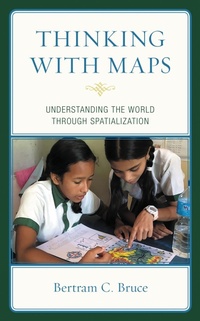
Thinking with Maps
Understanding the World through Spatialization
1st Edition
Published on 15. May 2021
208 pages
979-8-8818-7930-3 (ISBN)
Description

A 2022 Choice Reviews Outstanding Academic Title
Spatial reasoning, which promises connection across wide areas, is itself ironically often not connected to other areas of knowledge. Thinking with Maps: Understanding the World through Spatialization addresses this problem, developing its argument through historical analysis and cross-disciplinary examples involving maps. The idea of maps here includes traditional cartographic representations of physical environments, but more broadly encompasses the wide variety of ways that visualizations are used across all disciplines to enable understanding, to generate new knowledge, and to effect change.
The idea of thinking with maps is also used broadly. Maps become, not simply one among many items to learn about, but indispensable tools for thinking across every field of inquiry, in a way similar to that of textual and mathematical language. Effective use of maps becomes a way to make knowledge, much as writing or mathematical exploration not only displays ideas, but also creates them. The book shows that maps for thinking are not just a means to improve geographic knowledge, as valuable as that may be. Instead, they provide mechanisms for rejuvenating our engagement with the world, helping us to become more capable of facing our global challenges.
This book has a broader aim: It is fundamentally about general principles of how we learn and know. It calls for a renewed focus on democratic education in which both the means and ends are democratic. Education, just as the political realm, should follow Dewey's dictum that "democratic ends need democratic methods for their realization." Maps and mapping are invaluable in that endeavor.
Spatial reasoning, which promises connection across wide areas, is itself ironically often not connected to other areas of knowledge. Thinking with Maps: Understanding the World through Spatialization addresses this problem, developing its argument through historical analysis and cross-disciplinary examples involving maps. The idea of maps here includes traditional cartographic representations of physical environments, but more broadly encompasses the wide variety of ways that visualizations are used across all disciplines to enable understanding, to generate new knowledge, and to effect change.
The idea of thinking with maps is also used broadly. Maps become, not simply one among many items to learn about, but indispensable tools for thinking across every field of inquiry, in a way similar to that of textual and mathematical language. Effective use of maps becomes a way to make knowledge, much as writing or mathematical exploration not only displays ideas, but also creates them. The book shows that maps for thinking are not just a means to improve geographic knowledge, as valuable as that may be. Instead, they provide mechanisms for rejuvenating our engagement with the world, helping us to become more capable of facing our global challenges.
This book has a broader aim: It is fundamentally about general principles of how we learn and know. It calls for a renewed focus on democratic education in which both the means and ends are democratic. Education, just as the political realm, should follow Dewey's dictum that "democratic ends need democratic methods for their realization." Maps and mapping are invaluable in that endeavor.
More details
Other editions
Additional editions
Book
05/2021
Rowman & Littlefield Publishers
€49.50
Shipment within 10-20 days
Person
Bertram C. Bruce has a PhD in computer science and is professor emeritus in information science at the University of Illinois.He has worked on education in many countries, across grade levels, and in diverse areas of the curriculum. His work contributes to a tradition of democratic education, asking "How can we guide the educational enterprise by an ethical vision, not simply a technocratic one of transmitting isolated facts and skills?" His most recent book is Education's Ecosystems: Learning through Life.
Content
Foreword
Preface
Acknowledgments
Introduction
Chapter 1. Wayfinding
Chapter 2. Constructing
Chapter 3. Learning
Chapter 4. Expressing
Chapter 5. Solving
Chapter 6. Connecting
Chapter 7. Entering the Map
Chapter 8. What is a Map?
Conclusion: The Map Ahead
About the Author
Preface
Acknowledgments
Introduction
Chapter 1. Wayfinding
Chapter 2. Constructing
Chapter 3. Learning
Chapter 4. Expressing
Chapter 5. Solving
Chapter 6. Connecting
Chapter 7. Entering the Map
Chapter 8. What is a Map?
Conclusion: The Map Ahead
About the Author
