

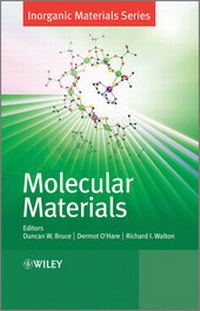
Molecular Materials
Description

Reviews / Votes
"The present book confirms that the view is correct, even if applications are difficult to forecast. However, the book does an excellent job of putting together several different classes of materials. Many common points emerge, and the book may facilitate the development of hybrids in which the qualities of the "parents" are enhanced." (Angewandte Chemie, 2011)More details
Other editions
Additional editions
Persons
Content
Preface.
List of Contributors.
1 Metal-Based Quadratic Nonlinear Optical Materials (Olivier Maury and Hubert Le Bozec).
1.1 Introduction.
1.2 Basic Concepts of Second-Order Nonlinear Optics.
1.2.1 Introduction to Nonlinear Molecular Materials.
1.2.2 Molecular Engineering of Quadratic NLO Chromophores.
1.2.3 Experimental Measurements of Second-Order NLO Activities.
1.3 Dipolar Metal Complexes.
1.3.1 Metal Complexes as Donor Groups.
1.3.2 Metal Complexes as Acceptor Groups.
1.3.3 Bimetallic Push-Pull Complexes.
1.3.4 Metal Complexes as p-Conjugated Bridges.
1.4 Octupolar Metal Complexes.
1.4.1 Metal as Peripheral Donor (or Acceptor) Substituent.
1.4.2 Metal as Template.
1.4.3 Conformational Studies Using Second-Order NLO Activity Measurements.
1.5 Switching Optical Nonlinearities of Metal Complexes.
1.5.1 Redox Switching of Quadratic Nonlinearities.
1.5.2 Acid/Base Switching of Quadratic Nonlinearities.
1.5.3 Photoswitching of Quadratic Nonlinearities.
1.6 Towards the Design of Pre-Organised Materials.
1.6.1 Supramolecular Octupolar Self-Ordering Within Metallodendrimers.
1.6.2 Engineering of NLO-Active Crystals.
1.7 Conclusions.
References.
2 Physical Properties of Metallomesogens (Koen Binnemans).
2.1 Introduction.
2.2 Overview of Mesophases.
2.3 Optical Properties.
2.3.1 Birefringence.
2.3.2 Light Absorption and Colour.
2.3.3 Luminescence.
2.3.4 Nonlinear Optical Properties.
2.4 Electrical Properties.
2.4.1 Electrical Conductivity.
2.4.2 Photoconductivity.
2.4.3 Electrochromism.
2.4.4 Ferroelectricity.
2.5 Magnetic Properties.
2.5.1 Magnetic Anisotropy and Alignment in External Magnetic Fields.
2.5.2 Spin-Crossover Phenomena.
2.5.3 Single Molecule Magnets.
2.6 Conclusions.
References.
3 Molecular Magnetic Materials (Neil Robertson and Gordon T. Yee).
3.1 Introduction.
3.1.1 History of Measurements.
3.2 Basic Concepts.
3.2.1 Magnetisation and Susceptibility.
3.2.2 The Curie and Curie-Weiss Laws.
3.2.3 Other Measurements.
3.2.4 Orbital Angular Momentum.
3.3 The Van Vleck Equation.
3.3.1 Application of the Van Vleck Formula to an Isolated, Spin-Only Metal Complex.
3.3.2 Deviations from the Curie Law: Zero-Field Splitting.
3.3.3 Exchange Coupling.
3.4 Dimensionality of Magnetic Systems.
3.4.1 Lattice Dimensionality vs Single Ion Anisotropy.
3.4.2 Mean or Molecular Field Approximation in Any Dimension and Any Value of S.
3.4.3 One-Dimensional Systems.
3.4.4 Two-Dimensional Magnetic Materials.
3.4.5 Three-Dimensional Magnetic Materials.
3.5 Switchable and Hybrid Systems and Future Perspectives.
3.5.1 Bistable and Switchable Magnetic Materials.
3.5.2 Multifunctional Magnetic Materials.
3.6 Conclusions.
References.
4 Molecular Inorganic Conductors and Superconductors (Lydie Valade and Hisashi Tanaka).
4.1 Introduction.
4.2 Families of Molecular Conductors and Superconductors.
4.2.1 From Molecules to Conductors and Superconductors.
4.2.2 Organic Metals and Superconductors.
4.2.3 Transition Metal Complex-Based Conducting Systems.
4.3 Systems Based on Metal Bis-Dithiolene Complexes.
4.3.1 Synthesis of Metal Bis-Dithiolene Complexes.
4.3.2 Synthesis of Conductors and Superconductors Based on Metal Bis-Dithiolene Complexes.
4.3.3 Superconductors Based on [M(dmit)2] Complexes.
4.3.4 Conductors Based on Neutral Metal Bis-Dithiolene Complexes.
4.4 Towards the Application of Molecular Inorganic Conductors and Superconductors.
4.4.1 Processing Methods.
4.4.2 Films and Nanowires of Molecular Inorganic Conductors.
4.5 Conclusions.
Acknowledgements.
References.
5 Molecular Nanomagnets (Richard E. P. Winpenny and Eric J. L. McInnes).
5.1 Introduction.
5.2 A Very Brief Introduction to Magnetochemistry.
5.3 Techniques.
5.3.1 Magnetometry.
5.3.2 AC Magnetometry.
5.3.3 Micro-SQUIDs.
5.3.4 Specific Heat.
5.3.5 Torque Magnetometry.
5.3.6 Electron Paramagnetic Resonance (EPR) Spectroscopy.
5.3.7 Inelastic Neutron Scattering (INS).
5.3.8 Nuclear Magnetic Resonance (NMR) Spectroscopy.
5.4 Single Molecule Magnets.
5.4.1 Physics of Single Molecule Magnets.
5.4.2 Chemistry of Single Molecule Magnets.
5.5 Emerging Trends.
5.5.1 Monometallic SMMs.
5.5.2 Molecular Spintronics.
5.5.3 Quantum Information Processing.
5.5.4 Antiferromagnetic (AF) Rings and Chains.
5.5.5 Magnetocaloric Effect.
5.5.6 High Symmetry Polyhedra and Spin Frustration.
5.5.7 Single Chain Magnets.
References.
Index.
