

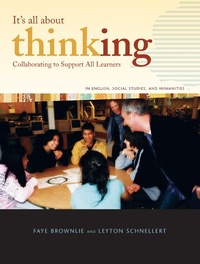
Collaborating to Support All Learners in English, Social Studies, and Humanities
Description

How can we help students develop the thinking skills they need to be successful learners? How does this relate to deep learning of important concepts? How can we engage and support diverse learners in inclusive classrooms where they develop understanding and thinking skills?
In this book, Faye and Leyton explore these questions and offer classroom examples to help busy teachers develop communities where all students learn. This book is written by two experienced educators who offer a welcoming and "can do" approach to the big ideas in education today. In this book, you will find:- insightful ways to teach diverse learners, e.g., literature and information circles, open-ended strategies, cooperative learning, inquiry curriculum design frameworks, e.g., universal design for learning (UDL) and backward design assessment for, of, and as learning
- lessons to help students develop deep learning and thinking skills in English, Social Studies, and Humanities
- excellent examples of theory and practice made accessible real school examples of collaboration - teachers working together to create better learning opportunities for their students
More details
Other editions
Additional editions
Persons
Faye Brownlie's (she/her/hers) goal is to build capacity with teachers, co-planning and co-teaching, providing seminars, workshops, and keynote presentations in Canada, the United States, Europe, and Asia. Passionate about including and supporting all learners, her work focuses on literacy, teaching for thinking, assessment, and inclusion. She has co-authored many books for teachers, including It's All About Thinking series for Portage & Main Press and most recently, a 2nd edition of Grand Conversations Thoughtful Responses. Faye believes, 'We know enough, collectively, to teach all our students to read, and more importantly, to create readers who not only can read but want to read."
Content
- Introduction xi
- Chapter 1 Meeting the Needs of All Learners 1
- Chapter 2 Working Together As a School 13
- Chapter 3 Assessment that Supports Learning 23
- Chapter 4 Frameworks and Approaches to Support Diverse Learners 41
- Chapter 5 Starting the Year with Significance 55
- Chapter 6 Inquiry and Thematic Teaching 77
- Chapter 7 Memoir Writing 99
- Chapter 8 Inquiry: Aboriginal Peoples of Canada 119
- Chapter 9 Inquiry and Oral Language 155
- Chapter 10 Engaging Critically with Text 177
- Chapter 11 Problem Solving in Geography 197
- Chapter 12 Online Literature Circles: Students and Teachers Learning Together 225
- Professional References 243
- Student Resources 249
- Chapter by Chapter Index 253
