

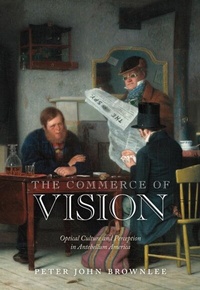
The Commerce of Vision
Optical Culture and Perception in Antebellum America
1st Edition
Published on 14. August 2018
264 pages
978-0-8122-9530-6 (ISBN)
Description

When Ralph Waldo Emerson wrote in 1837 that "Our Age is Ocular," he offered a succinct assessment of antebellum America's cultural, commercial, and physiological preoccupation with sight. In the early nineteenth century, the American city's visual culture was manifest in pamphlets, newspapers, painting exhibitions, and spectacular entertainments; businesses promoted their wares to consumers on the move with broadsides, posters, and signboards; and advances in ophthalmological sciences linked the mechanics of vision to the physiological functions of the human body. Within this crowded visual field, sight circulated as a metaphor, as a physiological process, and as a commercial commodity. Out of the intersection of these various discourses and practices emerged an entirely new understanding of vision.
The Commerce of Vision integrates cultural history, art history, and material culture studies to explore how vision was understood and experienced in the first half of the nineteenth century. Peter John Brownlee examines a wide selection of objects and practices that demonstrate the contemporary preoccupation with ocular culture and accurate vision: from the birth of ophthalmic surgery to the business of opticians, from the typography used by urban sign painters and job printers to the explosion of daguerreotypes and other visual forms, and from the novels of Edgar Allan Poe and Herman Melville to the genre paintings of Richard Caton Woodville and Francis Edmonds. In response to this expanding visual culture, antebellum Americans cultivated new perceptual practices, habits, and aptitudes. At the same time, however, new visual experiences became quickly integrated with the machinery of commodity production and highlighted the physical shortcomings of sight, as well as nascent ethical shortcomings of a surface-based culture. Through its theoretically acute and extensively researched analysis, The Commerce of Vision synthesizes the broad culturing of vision in antebellum America.
The Commerce of Vision integrates cultural history, art history, and material culture studies to explore how vision was understood and experienced in the first half of the nineteenth century. Peter John Brownlee examines a wide selection of objects and practices that demonstrate the contemporary preoccupation with ocular culture and accurate vision: from the birth of ophthalmic surgery to the business of opticians, from the typography used by urban sign painters and job printers to the explosion of daguerreotypes and other visual forms, and from the novels of Edgar Allan Poe and Herman Melville to the genre paintings of Richard Caton Woodville and Francis Edmonds. In response to this expanding visual culture, antebellum Americans cultivated new perceptual practices, habits, and aptitudes. At the same time, however, new visual experiences became quickly integrated with the machinery of commodity production and highlighted the physical shortcomings of sight, as well as nascent ethical shortcomings of a surface-based culture. Through its theoretically acute and extensively researched analysis, The Commerce of Vision synthesizes the broad culturing of vision in antebellum America.
Reviews / Votes
"[Brownlee's] ostensible quarry is an antebellum visual culture that developed around the intersecting concerns of ophthalmology and optometry, reform physiology, and a rapidly expanding market economy, but he sees vision as more than the mere sum of its parts. Brownlee's analysis reaches beyond the usual metaphors of nineteenth-century vision as possessing, knowing, or controlling, analyzing the 'economy of the eyes' as a shifting field that is at once physiological, commercial, political, and cultural, and almost always attended by doubt and ambiguity...The Commerce of Vision matches the undeniable richness and complexity of antebellum America's ocularity with deft, close readings that will bear repeated examination." (Panorama) "Brownlee has identified an important and rich topic, one that opens up other avenues for scholars to explore. In addition, his interdisciplinary approach provides an excellent model of how to bridge cultural and scientific history and understand vision at both a conceptual and physiological level. The Commerce of Vision is at once a major contribution to the history of visual culture in antebellum America and a call for continued work on this history, especially given its continuing relevance to our own digitally saturated world." (Literature & History) "[A]n elegantly written and extremely interesting study of a range of visual artefacts, including newspapers, paintings, photographs, caricatures, eye glasses, paper money and signboards, among others. Brownlee effectively weaves together a number of thematic threads to create a cohesive investigation of how people in antebellum America looked, learned to look differently and dealt with failures related to vision, both physiological and ideological." (Social History of Medicine) "The Commerce of Vision is an original, rich, and engaging study of an antebellum culture intrigued by questions of seeing and visual representation yet unsettled by the energies of rapidly expanding urban and market economies. Ranging over visual, material, and archival evidence-from paintings and daguerreotypes to broadsides, typeface, and newspapers, from ophthalmology and eyeglasses to paper currency and signboards-it will interest readers in visual and material culture studies, American studies, and the history of science." (Wendy Bellion, University of Delaware)More details
Series
Language
English
Place of publication
Pennsylvania
United States
Target group
College/higher education
Illustrations
8 color, 93 b/w illus.
File size
82,84 MB
ISBN-13
978-0-8122-9530-6 (9780812295306)
Copyright in bibliographic data and cover images is held by Nielsen Book Services Limited or by the publishers or by their respective licensors: all rights reserved.
Schweitzer Classification
Other editions
Additional editions
Book
10/2018
University of Pennsylvania Press
€51.50
Shipment within 10-20 days
Person
Peter John Brownlee is Curator at the Terra Foundation for American Art.
Content
Introduction. An Ocular Age: Vision in a World of Surfaces
PART I. THE PROBLEM OF VISION
Chapter 1. Ophthalmology, Popular Physiology, and the Market Revolution in Vision
Chapter 2. Vision, Eyewear, and the Art of Refraction
PART II. THE CHAOS OF PRINT
Chapter 3. Broadsides, Display Types, and the Physiology of the Moving Eye
Chapter 4. Signboards, Vision, and Commerce in the Antebellum City
PART III. PAINTING, PRINT, PERCEPTION
Chapter 5. The Optics of Newspaper Vision
Chapter 6. Paper Money, Spectral Illusions, and the Limits of Vision
Notes
Index
Acknowledgments
PART I. THE PROBLEM OF VISION
Chapter 1. Ophthalmology, Popular Physiology, and the Market Revolution in Vision
Chapter 2. Vision, Eyewear, and the Art of Refraction
PART II. THE CHAOS OF PRINT
Chapter 3. Broadsides, Display Types, and the Physiology of the Moving Eye
Chapter 4. Signboards, Vision, and Commerce in the Antebellum City
PART III. PAINTING, PRINT, PERCEPTION
Chapter 5. The Optics of Newspaper Vision
Chapter 6. Paper Money, Spectral Illusions, and the Limits of Vision
Notes
Index
Acknowledgments
