

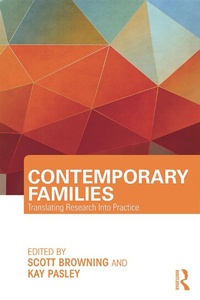
Contemporary Families
Translating Research Into Practice
Published on 5. June 2015
338 pages
978-1-134-69904-9 (ISBN)
Description

Written for researchers, practitioners, and students in advanced courses, this book furthers our understanding of the complexity of contemporary families. Seven types of families are the focus of this book, based on the research available and the challenges they present for mental health professionals. The family forms discussed are
* Adoption
* Foster care
* Interracial families
* Family members with special needs (with a focus on autism)
* Families with LGBTQ members
* Grandparent-headed Families
* Family members with chronic medical conditions
The volume establishes an innovative format that fits the new age of evidence-based practice. Each chapter is written by a collaborative team of authors consisting of researchers and practitioners. The former address the prevalence and characteristics of the family form and then present the research findings most relevant to clinical practice; the latter use this as the foundation for their portion of the chapter, in which they discuss strategies for good therapeutic intervention, representing a true integration of science and practice. Readers learn about relevant research findings regarding each family described, as well as gain explicit instruction and case material for which to augment therapeutic efforts with these populations.
* Adoption
* Foster care
* Interracial families
* Family members with special needs (with a focus on autism)
* Families with LGBTQ members
* Grandparent-headed Families
* Family members with chronic medical conditions
The volume establishes an innovative format that fits the new age of evidence-based practice. Each chapter is written by a collaborative team of authors consisting of researchers and practitioners. The former address the prevalence and characteristics of the family form and then present the research findings most relevant to clinical practice; the latter use this as the foundation for their portion of the chapter, in which they discuss strategies for good therapeutic intervention, representing a true integration of science and practice. Readers learn about relevant research findings regarding each family described, as well as gain explicit instruction and case material for which to augment therapeutic efforts with these populations.
Reviews / Votes
"Finally, a book on contemporary families that goes beyond the myth that families still look like Duvall proposed in 1950s. Additionally, the book is a serious attempt to integrate research and practice, excellently written by clinical and research scholars. Equally valuable for both groups, the book is a must read for beginning and advanced family science and therapy students and scholars." - Volker Thomas, PhD, Professor and Coordinator, Director of Couple and Family Therapy Program, The University of Iowa"Both novice and seasoned mental health workers will profit from this rich compendium of facts, opinions, and clinical wisdom. The clinical segments provide hands-on advice about how best to connect with different types of families and-even more important-how to avoid common pitfalls in working with them. Practitioners will find these suggestions applicable regardless of the particular "brand" of therapy they espouse. The editors have also made a concerted attempt-rare in the literature-to interleave research and clinical perspectives in a single volume. Thus, this book can serve as a primer, reminder, and reference tool for mental health workers whenever they are faced with members of these unique and fascinating populations." - Jay Efran, PhD, Professor Emeritus of Psychology, Temple University
"This volume takes on the critical task of bridging the deplorable disconnection between clinical practice and research. The editors, a leading family research scholar, and a noted authority on treatment of stepfamilies and of families on the spectrum, bring together seven researcher/therapist teams to focus on a number of diverse family forms. The resulting integration makes a unique and important contribution to both sides of the conversation and creates a long over-due and much-needed template for cross-discipline collaboration." - Patricia L. Papernow, EdD, author of Surviving and Thriving in Stepfamily Relationships and Becoming a Stepfamily; Psychologist; Clinical Instructor in Psychology at Harvard Medical School; Experts Council of the National Stepfamily Resource Center
"After a decade of reading political treatises bemoaning their separation, it is gratifying to see that the actual integration of research and practice has finally begun in earnest. The pairing of chapters on seven types of families is outstanding. This book illustrates a unique way for using research to inform any area of mental health practice." - Robert-Jay Green, PhD, Distinguished Professor Emeritus, Clinical Psychology PhD Program, California School of Professional Psychology, San
More details
Series
Language
English
Place of publication
London
United Kingdom
Publishing group
Taylor & Francis Ltd
Target group
Professional and scholarly
Product notice
Reflowable
Illustrations
1 s/w Tabelle, 5 s/w Zeichnungen
1 Tables, black and white; 5 Line drawings, black and white
File size
2,06 MB
ISBN-13
978-1-134-69904-9 (9781134699049)
Copyright in bibliographic data and cover images is held by Nielsen Book Services Limited or by the publishers or by their respective licensors: all rights reserved.
Schweitzer Classification
Other editions
Additional editions
Book
06/2015
1st Edition
Routledge
€232.40
Shipment within 15-20 days
Book
06/2015
1st Edition
Routledge
€77.10
Shipment within 15-20 days
Persons
Scott Browning is Professor of Professional Psychology at Chestnut Hill College in Philadelphia. He is a noted authority on psychological treatment with stepfamilies and families on the spectrum.
Kay Pasley is the Norejane Hendrickson Professor Emerita and was Chair of Family and Child Sciences at Florida State University. She is a former Editor of Family Relations , and a recipient of the 2012 Felix Berardo Mentoring Award and whose research addresses remarriage, stepfamilies, and fathering after divorce.
Kay Pasley is the Norejane Hendrickson Professor Emerita and was Chair of Family and Child Sciences at Florida State University. She is a former Editor of Family Relations , and a recipient of the 2012 Felix Berardo Mentoring Award and whose research addresses remarriage, stepfamilies, and fathering after divorce.
Content
1. Introduction Scott Browning and Kay Pasley 2. Adoptive Families Ellen Pinderhughes, Jessica A.K. Matthews, Xian Zang, and David Brodzinsky 3. Foster Families Jill D. Berrick, Lenore M. McWey, Andrew Benesh, and Armeda Stevenson Wojciak 4. Interracial Families Annamaria Csizmadia, Leigh Leslie, and Ronnit Nazarian 5. Families with a Special Needs Child Juliann J. Woods, Jennifer A. Brown, and Scott Browning 6. The GLBT Family Brad van Eeden-Moorefield, Kristen Benson, Erika L. Grafsky, Hoa N. Nguyen, and Joseph Micucci 7. The Grandparent Headed Family Tammy L. Henderson, Sandra J. Bailey, Marion Lindblad-Goldberg, and Edward A. Igle 8. Families with Chronic Medical Issues Joseph G. Grzywacz, Sally Eagleton, Amy Treat, Steve Simms, and Linda A. Hawkins 9. Collaboration of Science and Practice: A Realistic Goal Scott Browning and Kay Pasley
