


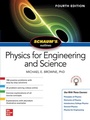
Schaum's Outline of Physics for Engineering and Science, Fourth Edition
1st Edition
Published on 22. October 2019
464 pages
978-1-260-45384-3 (ISBN)
Available for download
Description

Tough Test Questions? Missed Lectures? Not Enough Time?Fortunately, there s Schaum s. More than 40 million students have trusted Schaum s to help them succeed in the classroom and on exams. Schaum s is the key to faster learning and higher grades in every subject. Each Outline presents all the essential course information in an easy-to-follow, topic-by-topic format. You also get hundreds of examples, solved problems, and practice exercises to test your skills.Schaum s Outline of Physics for Engineering and Science, Fourth Edition is packed hundreds of examples, solved problems, and practice exercises to test your skills. This updated guide approaches the subject in a more concise, ordered manner than most standard texts, which are often filled with extraneous material.Schaum s Outline of Physics for Engineering and Science, Fourth Edition features: 788 fully-solved problems 25 problem-solving videos Succinct review of physics topics such as motion, energy, fluids, waves, heat, and magnetic fields Clear, concise explanations of all general physics concepts Content supplements the major leading textbooks in physics for engineering and science Content that is appropriate for Principles of Physics, Elements of Physics, Introductory College Physics, General Physics, Physics for Engineering coursesPLUS: Access to the revised Schaums.com website and new app, containing 25 problem-solving videos, and more.Schaum s reinforces the main concepts required in your course and offers hundreds of practice exercises to help you succeed. Use Schaum s to shorten your study time and get your best test scores!Schaum s Outlines Problem solved.
More details
Other editions
Additional editions
Book
09/2019
4th Edition
McGraw-Hill Education
€24.00
Shipment within 10-20 days
Content
- Cover
- Title Page
- Copyright Page
- Dedication
- Preface
- Contents
- CHAPTER 1 REVIEW OF MATHEMATICS
- 1.1 Symbols, Scientific Notation, and Significant Figures
- 1.2 Algebra
- 1.3 Geometry and Trigonometry
- 1.4 Vectors
- 1.5 Series and Approximations
- 1.6 Calculus
- CHAPTER 2 MEASUREMENT AND PHYSICS
- 2.1 Units
- 2.2 Unit Conversion
- 2.3 Order-of-Magnitude Estimates
- Supplementary Problems
- CHAPTER 3 MOTION IN ONE DIMENSION
- 3.1 Displacement and Velocity
- 3.2 Instantaneous Velocity and Acceleration
- 3.3 Constant Acceleration
- 3.4 Freely Falling Bodies
- 3.5 Summary of Key Equations
- Supplementary Problems
- CHAPTER 4 MOTION IN A PLANE
- 4.1 Position, Velocity, and Acceleration
- 4.2 Constant Acceleration
- 4.3 Projectiles
- 4.4 Uniform Circular Motion
- 4.5 Relative Motion
- 4.6 Summary of Key Equations
- Supplementary Problems
- CHAPTER 5 NEWTON'S LAWS OF MOTION
- 5.1 Newton's Third Law of Motion
- 5.2 Newton's First Law of Motion
- 5.3 Newton's Second Law of Motion
- 5.4 Applications of Newton's Laws
- 5.5 Summary of Key Equations
- Supplementary Problems
- CHAPTER 6 CIRCULAR MOTION
- 6.1 Centripetal Force
- 6.2 Summary of Key Equations
- Supplementary Problems
- CHAPTER 7 WORK AND ENERGY
- 7.1 Work
- 7.2 Kinetic Energy
- 7.3 Power
- 7.4 Summary of Key Equations
- Supplementary Problems
- CHAPTER 8 POTENTIAL ENERGY AND CONSERVATION OF ENERGY
- 8.1 Potential Energy
- 8.2 Energy Conservation and Friction
- 8.3 Potential Energy of a Spring
- 8.4 Machines
- 8.5 Summary of Key Equations
- Supplementary Problems
- CHAPTER 9 LINEAR MOMENTUM AND COLLISIONS
- 9.1 Linear Momentum
- 9.2 Impulse
- 9.3 Collisions in One Dimension
- 9.4 The Center of Mass
- 9.5 Rockets
- 9.6 Summary of Key Equations
- Supplementary Problems
- CHAPTER 10 ROTATIONAL MOTION
- 10.1 Angular Variables
- 10.2 Rotational Kinetic Energy
- 10.3 Moment of Inertia Calculations
- 10.4 Torque
- 10.5 Rolling
- 10.6 Rotational Work and Power
- 10.7 Summary of Key Equations
- Supplementary Problems
- CHAPTER 11 ANGULAR MOMENTUM
- 11.1 Angular Momentum and Torque
- 11.2 Precession
- Supplementary Problems
- CHAPTER 12 STATICS AND ELASTICITY
- 12.1 Rotational Equilibrium
- 12.2 Elasticity
- 12.3 Summary of Key Equations
- Supplementary Problems
- CHAPTER 13 OSCILLATIONS
- 13.1 Simple Harmonic Motion
- 13.2 Energy and SHM
- 13.3 SHM and Circular Motion
- 13.4 Pendulum
- 13.5 Damped Oscillations and Forced Oscillations
- 13.6 Summary of Key Equations
- Supplementary Problems
- CHAPTER 14 GRAVITY
- 14.1 The Law of Gravity
- 14.2 Gravitational Potential Energy
- 14.3 The Motion of Planets
- 14.4 Summary of Key Equations
- Supplementary Problems
- CHAPTER 15 FLUIDS
- 15.1 Pressure in a Fluid
- 15.2 Buoyancy
- 15.3 Fluid Flow
- 15.4 Bernoulli's Equation
- 15.5 Summary of Key Equations
- Supplementary Problems
- CHAPTER 16 WAVES AND SOUNDS
- 16.1 Transverse Mechanical Waves
- 16.2 Speed and Energy Transfer for String Waves
- 16.3 Superposition of Waves
- 16.4 Standing Waves
- 16.5 Sound Waves
- 16.6 Standing Sound Waves
- 16.7 Beats
- 16.8 The Doppler Effect
- 16.9 Summary of Key Equations
- Supplementary Problems
- CHAPTER 17 TEMPERATURE, HEAT, AND HEAT TRANSFER
- 17.1 Temperature
- 17.2 Thermal Expansion
- 17.3 Heat and Thermal Energy
- 17.4 Heat Capacity and Latent Heat
- 17.5 Heat Transfer
- 17.6 Summary of Key Equations
- Supplementary Problems
- CHAPTER 18 THE KINETIC THEORY OF GASES
- 18.1 The Ideal Gas Law
- 18.2 Molecular Basis of Pressure and Temperature
- 18.3 The Maxwell-Boltzmann Distribution
- 18.4 Molar Specific Heat and Adiabatic Processes
- 18.5 Summary of Key Equations
- Supplementary Problems
- CHAPTER 19 THE FIRST AND SECOND LAWS OF THERMODYNAMICS
- 19.1 The First Law of Thermodynamics
- 19.2 The Second Law of Thermodynamics
- 19.3 The Carnot Engine
- 19.4 The Gasoline Engine
- 19.5 Refrigerators and Heat Pumps
- 19.6 Entropy
- 19.7 Summary of Key Equations
- Supplementary Problems
- CHAPTER 20 ELECTRIC FIELDS
- 20.1 Properties of Electric Charge
- 20.2 The Electric Field
- 20.3 Motion of a Charged Particle in a Uniform Electric Field
- 20.4 Electric Field of a Continuous Charge Distribution
- 20.5 Summary of Key Equations
- Supplementary Problems
- CHAPTER 21 GAUSS' LAW
- 21.1 Electric Flux and Gauss' Law
- 21.2 Applications of Gauss' Law
- 21.3 Summary of Key Equations
- Supplementary Problems
- CHAPTER 22 ELECTRIC POTENTIAL
- 22.1 Electric Potential and Potential Energy
- 22.2 Electric Potential of a Point Charge
- 22.3 Finding the Field from the Potential
- 22.4 Potential of Continuous Charge Distributions
- 22.5 Potential of a Charged Conductor
- 22.6 Summary of Key Equations
- Supplementary Problems
- CHAPTER 23 CAPACITANCE
- 23.1 Calculation of Capacitance
- 23.2 Combinations of Capacitors
- 23.3 Energy Storage in Capacitors
- 23.4 Dielectrics
- 23.5 Summary of Key Equations
- Supplementary Problems
- CHAPTER 24 CURRENT AND RESISTANCE
- 24.1 Electric Current
- 24.2 Resistance, Resistivity, and Ohm's Law
- 24.3 Electric Power and Joule Heating
- 24.4 Summary of Key Equations
- Supplementary Problems
- CHAPTER 25 DIRECT CURRENT CIRCUITS
- 25.1 Resistors in Series and Parallel
- 25.2 Multiloop Circuits
- 25.3 RC Circuits
- 25.4 Summary of Key Equations
- Supplementary Problems
- CHAPTER 26 MAGNETIC FIELDS
- 26.1 The Magnetic Field
- 26.2 Motion of a Charged Particle in a Magnetic Field
- 26.3 Magnetic Force on a Current-Carrying Wire
- 26.4 Torque on a Current Loop
- 26.5 Summary of Key Equations
- Supplementary Problems
- CHAPTER 27 SOURCES OF THE MAGNETIC FIELD
- 27.1 Magnetic Fields due to Currents
- 27.2 Ampere's Law
- 27.3 Summary of Key Equations
- Supplementary Problems
- CHAPTER 28 ELECTROMAGNETIC INDUCTION AND INDUCTANCE
- 28.1 Faraday's Law
- 28.2 Motional EMF
- 28.3 Inductance
- 28.4 Energy Storage in a Magnetic Field
- 28.5 Magnetic Materials
- 28.6 RLC Circuits
- 28.7 Summary of Key Equations
- Supplementary Problems
- CHAPTER 29 ALTERNATING CURRENT CIRCUITS
- 29.1 Transformers
- 29.2 Single Elements in ac Circuits
- 29.3 The Series RLC Circuit and Phasors
- 29.4 Power in ac Circuits
- 29.5 Resonance in ac Circuits
- 29.6 Summary of Key Equations
- Supplementary Problems
- CHAPTER 30 ELECTROMAGNETIC WAVES
- 30.1 Maxwell's Equations and the Wave Equation
- 30.2 Energy and Radiation Pressure
- 30.3 Polarization
- 30.4 Reflection and Refraction of Light
- 30.5 Total Internal Reflection
- 30.6 Summary of Key Equations
- Supplementary Problems
- CHAPTER 31 MIRRORS AND LENSES
- 31.1 Plane Mirrors
- 31.2 Spherical Mirrors
- 31.3 Thin Lenses
- 31.4 Optical Instruments
- 31.5 Summary of Key Equations
- Supplementary Problems
- CHAPTER 32 INTERFERENCE
- 32.1 Double Slit Interference
- 32.2 Multiple Slit Interference and Phasors
- 32.3 Interference in Thin Films
- 32.4 The Michelson Interferometer
- 32.5 Summary of Key Equations
- Supplementary Problems
- CHAPTER 33 DIFFRACTION
- 33.1 Single Slit Diffraction
- 33.2 Resolution and Diffraction
- 33.3 The Diffraction Grating
- 33.4 Summary of Key Equations
- Supplementary Problems
- CHAPTER 34 SPECIAL RELATIVITY
- 34.1 The Basic Postulates
- 34.2 Simultaneity
- 34.3 The Lorentz Transformation Equations
- 34.4 Time Dilation
- 34.5 Length Contraction
- 34.6 Relativistic Velocity Transformation
- 34.7 Relativistic Momentum and Force
- 34.8 Relativistic Energy
- 34.9 The Doppler Effect for Light
- 34.10 Summary of Key Equations
- Supplementary Problems
- CHAPTER 35 ATOMS AND PHOTONS
- 35.1 Atoms and Photons
- 35.2 The Photoelectric Effect
- 35.3 The Compton Effect
- 35.4 Atomic Spectra and Bohr's Model of the Atom
- 35.5 Summary of Key Equations
- Supplementary Problems
- CHAPTER 36 QUANTUM MECHANICS
- 36.1 de Broglie Waves
- 36.2 Electron Diffraction
- 36.3 The Schrödinger Equation
- 36.4 A Particle in a Box
- 36.5 A Particle in a Finite Well and Tunneling
- 36.6 The Heisenberg Uncertainty Principle
- 36.7 Spin Angular Momentum
- 36.8 The Quantum Theory of Hydrogen
- 36.9 The Pauli Exclusion Principle
- 36.10 The Periodic Table
- 36.11 Summary of Key Equations
- Supplementary Problems
- CHAPTER 37 NUCLEAR PHYSICS
- 37.1 Properties of the Nucleus
- 37.2 Nuclear Stability and Binding Energy
- 37.3 Radioactivity
- 37.4 Radioactive Decay Processes
- 37.5 Nuclear Reactions
- 37.6 Fission
- 37.7 Nuclear Fusion
- 37.8 Summary of Key Equations
- Supplementary Problems
- APPENDIX
- INDEX

