

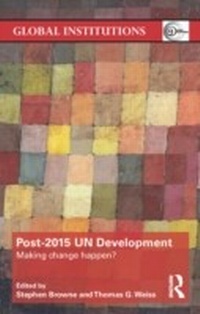
Post-2015 UN Development
Making Change Happen?
1st Edition
Published on 1. August 2014
296 pages
978-1-135-07361-9 (ISBN)
Description

In 2000, at the United Nations Millennium Summit, world leaders agreed to the Millennium Declaration. The Declaration included development targets to be reached by 2015, which were to become known as the Millennium Development Goals (MDGs). Progress has been made towards the achievement of the MDGs, but poverty remains widespread.
With the terminal year approaching, the international community has begun the process of determining the goals which might follow the MDGs. While the UN is driving the process, there has been very little introspection on its own organizational capacity to help countries to meet the goals and is being increasingly sidelined by other more effective development organizations and initiatives.
Based on extensive original research that has critically examined the role and functions of the organizations of the UN development system, this book seeks to capture in a single volume a comprehensive review of the UN's performance and prospects for development. The contributors each offer extensive experience and familiarity-as practitioners and researchers-with the UN and development; and the book will contribute to the urgently needed debate on the reform of the UN development system at a critical juncture.
The main rationale for this book, and its timing, is the unusual opportunity provided by the 2015 threshold to re-think the UN development system and to empower it to support a new development agenda and will be of interest to students, scholars of International Organizations and development studies.
With the terminal year approaching, the international community has begun the process of determining the goals which might follow the MDGs. While the UN is driving the process, there has been very little introspection on its own organizational capacity to help countries to meet the goals and is being increasingly sidelined by other more effective development organizations and initiatives.
Based on extensive original research that has critically examined the role and functions of the organizations of the UN development system, this book seeks to capture in a single volume a comprehensive review of the UN's performance and prospects for development. The contributors each offer extensive experience and familiarity-as practitioners and researchers-with the UN and development; and the book will contribute to the urgently needed debate on the reform of the UN development system at a critical juncture.
The main rationale for this book, and its timing, is the unusual opportunity provided by the 2015 threshold to re-think the UN development system and to empower it to support a new development agenda and will be of interest to students, scholars of International Organizations and development studies.
Reviews / Votes
"There is no better compilation of insights about the UN's lack of cohesion, growing turf battles, declining capacity, clumsy implementation, and cooptation by bilateral and private interests of the family of organizations that calls itself-somewhat awkwardly-the UN development system." Mark Malloch-Brown, former UN deputy-secretary-general and UNDP administrator"The book provides a frank, detailed and informative description of the weaknesses and strong points of the UN development system. It is without doubt one of the best books written on the subject in recent years and is highly recommendable to all those who are interested in the world body as well as to those who are interested in sustainable development." Helmut Volger, Pass Blue
More details
Series
Language
English
Place of publication
London
United Kingdom
Publishing group
Taylor & Francis Ltd
Target group
College/higher education
Illustrations
10 s/w Tabellen, 16 s/w Zeichnungen
10 Tables, black and white; 16 Line drawings, black and white
File size
3,36 MB
ISBN-13
978-1-135-07361-9 (9781135073619)
Copyright in bibliographic data and cover images is held by Nielsen Book Services Limited or by the publishers or by their respective licensors: all rights reserved.
Schweitzer Classification
Other editions
Additional editions
Book
07/2014
1st Edition
Routledge
€206.40
Shipment within 15-20 days
Book
07/2014
1st Edition
Routledge
€71.30
Shipment within 15-20 days
Persons
Stephen Browne is Co-Director of the Future of the UN Development System (FUNDS) Project and Senior Fellow at the Ralph Bunche Institute for International Studies at The CUNY Graduate Center. He worked for more than 30 years in different organizations of the UN development system, sharing his time almost equally between agency headquarters and country assignments. He has written books and articles on aid and development throughout his career, his most recent being?The United Nations Development Programme and System (2011), The International Trade Centre (2011), and The United Nations Industrial Development Organization (2012).
Thomas G. Weiss is Presidential Professor of Political Science and Director of the Ralph Bunche Institute for International Studies at The City University of New York's Graduate Center. He is Past President of the ISA (2009-10). His most recent single-authored books include Global Governance: Why? What? Whither? (2013); Humanitarian Business (2013); What's Wrong with the United Nations and How to Fix It (2012); and Humanitarian Intervention: Ideas in Action (2012). He is co-editor of the Routledge "Global Institutions Series" and co-director of the Wartime History and the Future United Nations Project and of the Future UN Development System Project.
Thomas G. Weiss is Presidential Professor of Political Science and Director of the Ralph Bunche Institute for International Studies at The City University of New York's Graduate Center. He is Past President of the ISA (2009-10). His most recent single-authored books include Global Governance: Why? What? Whither? (2013); Humanitarian Business (2013); What's Wrong with the United Nations and How to Fix It (2012); and Humanitarian Intervention: Ideas in Action (2012). He is co-editor of the Routledge "Global Institutions Series" and co-director of the Wartime History and the Future United Nations Project and of the Future UN Development System Project.
Content
Introduction: The UN we want for the world we want, Stephen Browne and Thomas G. Weiss, Part I: The essence of contemporary UN multilateralism, 1. UN roles and principles governing multilateral assistance, Bjorn Skogmo 2. Evolution of the UN development system, Craig N. Murphy, 3. Drivers of change for the UN's future role, Richard O'Brien Part II: Grappling with the present and future: results, funding, management, 4. Funding the UN system, Silke Weinlich 5. Evaluating the UN development system, Robert Picciotto 6. Making the UN more accountable and transparent, Richard Golding Part III: The requirements of war-torn states 7. Aligning UN development efforts and peacebuilding, W. Andy Knight 8. The economics of peace: is the UN system up to the challenge? Graciana del Castillo 9. Can peacebuilding drive the UN change agenda?, Michael von der Schulenburg Part IV: Toward a reformed UN development system 10. The UN and the post-2015 development agenda, David Hulme and Rorden Wilkinson 11. "We the Peoples" in the UN development system, Roberto Bissio 12. Revisiting UN development: the prospects for reform, Cecile Molinier and Stephen Browne Conclusion: Post-2015, making change happen?, Stephen Browne and Thomas G. Weiss
