

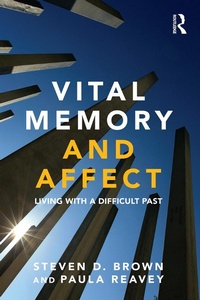
Vital Memory and Affect
Living with a difficult past
Published on 12. June 2015
258 pages
978-1-317-49949-7 (ISBN)
Description

Vital Memory and Affect takes as its subject the autobiographical memories of 'vulnerable' groups, including survivors of child sexual abuse, adopted children and their families, forensic mental health service users, and elderly persons in care home settings. In particular the focus is on a particular class of memory within this group: recollected episodes that are difficult and painful, sometimes contested, but always with enormous significance for a current and past sense of self. These 'vital memories', integral and irreversible, can come to appear as a defining feature of a person's life.
In Vital Memory and Affect, authors Steve Brown and Paula Reavey explore the highly productive way in which individuals make sense of a difficult past, situated as they are within a highly specific cultural and social landscape. Via an exploration of their vital memories, the book combines insights from social and cognitive psychology to open up the possibility of a new approach to memory, one that pays full attention to the contextual conditions of all acts of remembering.
This path-breaking study brings together a unique set of empirical material and maps out an agenda for research into memory and affect that will be important reading for students and scholars of social psychology, memory studies, cultural studies, philosophy, and other related fields.
In Vital Memory and Affect, authors Steve Brown and Paula Reavey explore the highly productive way in which individuals make sense of a difficult past, situated as they are within a highly specific cultural and social landscape. Via an exploration of their vital memories, the book combines insights from social and cognitive psychology to open up the possibility of a new approach to memory, one that pays full attention to the contextual conditions of all acts of remembering.
This path-breaking study brings together a unique set of empirical material and maps out an agenda for research into memory and affect that will be important reading for students and scholars of social psychology, memory studies, cultural studies, philosophy, and other related fields.
Reviews / Votes
'I was invited to review a book that discussses implications ofr memory in the context of vulnerable populations... What I found was a compassionate and creative approach to the art of defining oneself through the powerul tools of self-narrative... As a memory researcher, this book led me to new and interesting territory... To me, the book seems best suited for practitioners who are looking for a new framework within which to think about how personal memories may undermine the vulnerable people they work with and how memory might be used therapeutically. The book is filled with transcriptions of simple social interactions and, in that way, it feels like a clinical workbook of sorts... If a new perspective emerges that provides a better structure for managing the vital memories that Brown and Reavey refer to, I am all for it. This book may well spark a concerted effort toward that goal... The basic message--that it is possible even for vulnerable people to take control and define themselves through self-narrative--is a powerful one.'-Nancy Franklin, Department of Psychology, Stony Brook Univeristy, PsycCRITIQUES
'Brown and Reavey show how personal and institutional practices of remembering interact in specific, highly-charged settings. In powerful, moving reports of empirical studies, they reveal the richness and diversity of ordinary people's subtle strategies for managing memories of difficult experiences. This compelling book will challenge and reward scientists, practitioners, and policy-makers interested in the mechanisms and techniques driving our complex ecologies of remembering.'
- John Sutton, Department of Cognitive Science, Macquarie University, Australia
'Brown and Reavey calmly yet devastatingly disassemble long standing key assumptions and models in the interdisciplinary study of memory. They render the complex accomplishments of remembering intelligible and familiar; a truly liberating work.'
- Andrew Hoskins, Editor-in-Chief, Memory Studies
"The supreme appeal of Brown and Reavey's conceptual and empirical work lies in how they afford ways for psychology to study memory beyond the life-space of the person, to ask how person and environment, body and ecology, life and cosmos, topologically fold and extend to shape and actualize possible worlds. And so the authors serve a compelling account why vital memories challenge received methodological and ontological certainties in psychology, and therefore matter for academic and clinical psychologists alike." - Matthew J. Allen, British Journal of Psychology 'Brown and Reavey show how personal and institutional practices of remembering interact in specific, highly-charged settings. In powerful, moving reports of empirical studies, they reveal the richness and diversity of ordinary people's subtle strategies for managing memories of difficult experiences. This compelling book will challenge and reward scientists, practitioners, and policy-makers interested in the mechanisms and techniques driving our complex ecologies of remembering.'
- John Sutton, Department of Cognitive Science, Macquarie University, Australia
'Brown and Reavey calmly yet devastatingly disassemble long standing key assumptions and models in the interdisciplinary study of memory. They render the complex accomplishments of remembering intelligible and familiar; a truly liberating work.'
- Andrew Hoskins, Editor-in-Chief, Memory Studies
More details
Language
English
Place of publication
London
United Kingdom
Publishing group
Taylor & Francis Ltd
Target group
College/higher education
Professional and scholarly
Illustrations
22 s/w Abbildungen, 13 s/w Photographien bzw. Rasterbilder, 9 s/w Zeichnungen
9 Line drawings, black and white; 13 Halftones, black and white; 22 Illustrations, black and white
File size
2,15 MB
ISBN-13
978-1-317-49949-7 (9781317499497)
Copyright in bibliographic data and cover images is held by Nielsen Book Services Limited or by the publishers or by their respective licensors: all rights reserved.
Schweitzer Classification
Other editions
Additional editions
Book
06/2015
1st Edition
Routledge
€206.50
Shipment within 15-20 days
Book
06/2015
1st Edition
Routledge
€78.60
Shipment within 15-20 days
Persons
Steven D. Brown is Professor of Organisational and Social Psychology, University of Leicester, UK.
Paula Reavey is Professor of Psychology, London South Bank University, UK.
Paula Reavey is Professor of Psychology, London South Bank University, UK.
Content
1. Preface 2. The seven virtues of vital memory 3. The expanded view of memory 4. Memory and life space: affect, forgetting and ethics 5. Feeling an ambivalent past: Survivors of child sexual abuse 6. Managing the memories of others: Adoptive parents and their children 7. Remembering with, through and for others: Surviving the 2005 London Bombings 8. Forgetting who you were: The forensic psychiatric unit 9. Recollection in later life: The reminiscence museum 10. Ordinary people living with a difficult past
