

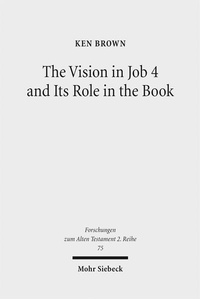
The Vision in Job 4 and Its Role in the Book
Reframing the Development of the Joban Dialogues. Studies of the Sofja Kovalevskaja Research Group on Early Jewish Monotheism. Vol. IV
1st Edition
Published on 21. April 2015
350 pages
978-3-16-153631-1 (ISBN)
Description

Am Anfang des Hiobdialogs wird Hiobs Freund Eliphas eine beunruhigende Vision (Hi 4,12-21) zugeschrieben, welche die Theologie der Freunde herausfordert. Vor allem ihre besondere körperliche Darstellungsform und die Folgerung, dass
jeder
jederzeit sterben kann, spiegeln Hiobs charakteristischen Stil wider und bilden die Basis seiner Vorwürfe gegen die göttliche Gerechtigkeit. Ken Brown zeigt, dass die Vision ursprünglich Hiob zugeschrieben wurde und erst später in die erste Eliphasrede integriert worden ist. Diese Veränderung wurde absichtlich vorgenommen und steht in Zusammenhang mit ähnlichen Umstellungen im dritten Redegang (Hi 22-27). Gegen die klare Tendenz in der jüngsten englischsprachigen Forschung, sich auf die Endgestalt des Hiobbuches zu konzentrieren, legt Brown dar, dass Hiobs Redaktion und Rezeption eng verbunden sind und nur in gegenseitiger Wahrnehmung das Verständnis des Hiobbuches fördern.
Diese Arbeit wurde mit dem Manfred Lautenschlaeger Award for Theological Promise 2016 ausgezeichnet.
Diese Arbeit wurde mit dem Manfred Lautenschlaeger Award for Theological Promise 2016 ausgezeichnet.
More details
Other editions
Additional editions
Ken Brown
The Vision in Job 4 and Its Role in the Book
Reframing the Development of the Joban Dialogues. Studies of the Sofja Kovalevskaja Research Group on Early Jewish Monotheism. Vol. IV
Book
04/2015
1st Edition
Mohr Siebeck
€109.00
Article exhausted; check different version
Person
Content
- Cover
- Preface
- Table of Contents
- Introduction
- A. History of Research on the Role of the Vision in the Book
- I. The Vision as a Central Element in Eliphaz's Argument
- II. The Vision as Ambiguous or Subversive
- III. The Vision as a Late Addition
- IV. Is it Job's Vision?
- B. Need for Further Research
- C. Assumptions and Approach
- I. The Composition and Unity of Job
- II. "Intertextuality" and the Book of Job
- D. Chapter Summary
- Chapter 1: An Uncanny Vision Subversive Imagery in 4:12-21
- A. Images of Revelation and Judgment in 4:12-16
- I. Juxtaposed Imagery of Revelation and Judgment
- II. The Role of the "Spirit" and the Purpose of the Vision
- B. Untrustworthy Servants and the Human Condition in 4:17-21
- I. A Subversive Vision
- II. Indiscriminate Destruction in 4:19-21
- C. Conclusions
- Chapter 2: "Have You Stood in the Council of God?" The Vision in the First Two Speech Cycles
- A. The Style of the Vision and the Dispute between Job and His Friends
- I. Formal Characteristics of the Vision within the Dialogues
- II. The Vocabulary of the Vision within the Dialogues
- III. Corporeal Language in the Vision and the Dialogues
- IV. Theophany and Its Effects in the Vision and the Dialogues
- V. The Language of 4:17-21 in the Dialogues
- B. The Friends' Responses to the Vision
- I. Allusions to the Vision in Eliphaz's First Speech
- II. The Vision in Eliphaz's Second Speech
- III. The Vision in the Other Speeches of the Friends
- C. Job's Allusions to and Reuse of the Vision
- I. The Vision in Job 6-7
- II. The Vision in Job 9-10
- III. The Vision in the Later Speeches of Job
- D. Conclusions
- Chapter 3: "How Small a Whisper We Hear of Him" The Vision in the Development of the Book
- A. The Vision in Job 3-5
- I. Is the Vision a Quotation of Job?
- II. The Vision is the Original Conclusion to Job 3
- III. Job 4-5 as a Response to the Vision
- IV. Was The Vision Accidentally Displaced?
- B. The Vision in the Third Speech Cycle and the Elihu Speeches
- I. The Vision in the Third Speech of Eliphaz
- II. The Vision in the Elihu Speeches
- III. The Vision in Job 25
- IV. The Vision in Job 26
- V. The Vision in the Final Speeches of Job
- C. The Vision in the Development of the Dialogues
- I. Is the Third Speech Cycle the Original End of the Dialogue?
- II. Is the Third Speech Cycle a Secondary Addition?
- III. Has the Third Speech Cycle Been Accidentally Disrupted?
- IV. Intentional Displacement and the Reframing of the Vision
- D. Conclusions
- Chapter 4:"If It Is Not He, Then Who?" The Meaning of the Vision in the Original Dialogue
- A. The Vision and Job's Dispute with God
- I. Reading the Vision with Job's Eyes
- II. The Vision as the Motivation for Job's Complaint
- III. Job's Responses to the Vision Reconsidered
- B. Revelation and Tradition in the Arguments of the Friends
- I. Eliphaz's Responses to the Vision and Use of Tradition
- II. Revelation and Tradition in the Speeches of Bildad and Zophar
- III. The Epistemology of the Friends and Job's Critique
- C. Conclusions
- Chapter 5: "Now My Eye Sees You" The Vision, the Final Form, and the Early Reception of Job
- A. The Vision in the Rest of the Book
- I. Elihu's Response to the Vision
- II. The Vision and the Divine Speeches
- III. Job's Final Response
- IV. The Prose Tale and the Vision
- B. The Earliest Reception and the Final Form of Job
- I. The Vision and Job in the Earliest Reception History
- II. The Purposes and Effects of the Vision's Reattribution
- Conclusions
- Bibliography
- Indices
