

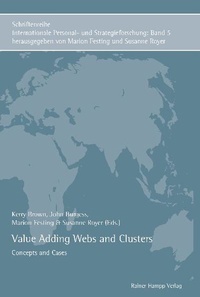
Value Adding Webs and Clusters
Concepts and Cases
1st Edition
Published on 19. November 2010
190 pages
978-3-86618-591-3 (ISBN)
Description

This book series on research in international human resource management and strategy is designed to stimulate discussions on current developments in these disciplines. The scope of this series reflects the importance of the fields of strat-egy and human resource management in the international environment of a globalised world. Both fields have the potential to contribute essentially to the description and explanation of competitive advantage realisation, performance issues and to achieving other corporate goals and objectives. Therefore, these areas need attention in research as well as in practice. This series will focus on the latest research results in this field. This volume consists of concepts and cases from research in the field of industry clusters by different authors. The aim of this book is to undertake an in-depth exploration of the topic of industry clustering from both management and policy perspectives. The book examines clustering from the standpoint of the single firm in the cluster and, in so doing, derives a novel formulation of clusters as comprising single firms with surround-ing concomitant chains of relationships with suppliers, other similar firms and, institutions of government and its agencies. Because of the resources that then can be attributed to firms within the cluster, the resultant conceptualisation of industry clusters is called value adding webs. It is contended that these then develop as a series of overlapping value adding webs forming an industry clus-ter. The concept is elaborated and applied to different cluster cases in this book.
More details
Other editions
Additional editions
Book
10/2010
1st Edition
Edition Rainer Hampp
€24.80
Article exhausted; check different version
Persons
Professor Kerry Brown is Mulpha Chair in Tourism Asset Management and professor at the School of Tourism and Hospitality Management at Southern Cross University, Gold Coast, Australia. / Professor John Burgess is professor of International Human Resource Management at Newcastle Business School, University of Newcastle, Australia. / Prof. Dr. Marion Festing is professor of Human Resource Management and Intercultural Leadership at ESCP Europe, Campus Berlin, Germany. / Prof. Dr. Susanne Royer is professor of Strategic and International Management at the University of Flensburg, Germany as well as adjunct professor at the Queensland University of Technology, Brisbane, Australia.
Content
1 - Table of Contents [Seite 6]
2 - PART I [Seite 15]
3 - CHAPTER 1: SINGLE FIRMS, PUBLIC POLICY AND INDUSTRY CLUSTERS: SOME REFLECTIONS ON THE FIELD [Seite 10]
4 - CHAPTER 2: CONCEPTUALISING CLUSTERS AS OVERLAPPING VALUE ADDING WEBS [Seite 16]
5 - CHAPTER 3: CLUSTER DEVELOPMENT AS AN INSTRUMENT OF REGIONAL BUSINESS DEVELOPMENT POLICY: CONCEPTS AND DANISH REALITY [Seite 48]
6 - CHAPTER 4: PROXIMITY AND KNOWLEDGE SHARING IN CLUSTERED FIRMS [Seite 67]
7 - PART II [Seite 90]
8 - CHAPTER 5: THE HUNTER VALLEY WINE CLUSTER, AUSTRALIA AND THE APPLE TOURISM CLUSTER, HARDANGER, NORWAY [Seite 91]
9 - CHAPTER 6: CASE STUDIES ON MECHANICAL WATCH CLUSTERS [Seite 131]
10 - CHAPTER 7: LESSONS FROM CONCEPTS AND CASES IN THE FIELD OF INDUSTRY CLUSTERS [Seite 177]
11 - BIOGRAPHICAL NOTES [Seite 189]
2 - PART I [Seite 15]
3 - CHAPTER 1: SINGLE FIRMS, PUBLIC POLICY AND INDUSTRY CLUSTERS: SOME REFLECTIONS ON THE FIELD [Seite 10]
4 - CHAPTER 2: CONCEPTUALISING CLUSTERS AS OVERLAPPING VALUE ADDING WEBS [Seite 16]
5 - CHAPTER 3: CLUSTER DEVELOPMENT AS AN INSTRUMENT OF REGIONAL BUSINESS DEVELOPMENT POLICY: CONCEPTS AND DANISH REALITY [Seite 48]
6 - CHAPTER 4: PROXIMITY AND KNOWLEDGE SHARING IN CLUSTERED FIRMS [Seite 67]
7 - PART II [Seite 90]
8 - CHAPTER 5: THE HUNTER VALLEY WINE CLUSTER, AUSTRALIA AND THE APPLE TOURISM CLUSTER, HARDANGER, NORWAY [Seite 91]
9 - CHAPTER 6: CASE STUDIES ON MECHANICAL WATCH CLUSTERS [Seite 131]
10 - CHAPTER 7: LESSONS FROM CONCEPTS AND CASES IN THE FIELD OF INDUSTRY CLUSTERS [Seite 177]
11 - BIOGRAPHICAL NOTES [Seite 189]
CHAPTER 5: THE HUNTER VALLEY WINE CLUSTER, AUSTRALIA AND THE APPLE TOURISM CLUSTER, HARDANGER, NORWAY (S. 86-87)
Lindy Henderson and John Burgess (The Hunter Valley Wine Cluster); Sidsel Grimstad (Apple Tourism Cluster: Hardanger, Norway)
5.1 The Hunter Valley Wine Cluster
Wine production is an obvious industry to study as an example of an industry cluster. Wine production is regional and there are usually strong links between producers and strong links to both upstream and downstream activities. Apart from “new world” producers, most wine districts have a long history and a distinct product that is linked to regional identity. In this chapter we discuss the Hunter Valley wine cluster situated in Australia, 150 kilometres north of Sydney. In terms of new world production it has a history of over 100 years and it is firmly inter linked to service provision for national and international tourists.
The chapter will review the history of wine making in the region and then outline its characteristics. It will then apply the concept of the value added web (Brown et al, 2007) to highlight the key actors, the sources of competitive advantage and the key relationships within the cluster. As with other chapters on industry clusters the approach taken here is that of a single cluster case study. We assess the cluster as a whole rather than examine the details of each individual firm in the cluster. In this case study there are over 150 horizontal actors in the cluster. The methodology involved secondary analysis, documentary analysis and interviews with key informants in the cluster (those linked to producer associations and technical colleges).
5.1.1 The Australian Wine Industry and the Hunter
Wine grapes were among the first crops planted by Europeans when they came to Australia in the eighteenth century and wine has been produced ever since. Wineries were established in the Hunter Valley and early wine pioneers included Wyndham and Lindeman, both well known names in the Australian wine industry. Until the 1960s, domestic demand was small and was mostly for fortified wines, while exports were inconsequential.
A re-orientation of public tastes, to some extent as a response to skilled promotion and advertising, but also reflecting the influx of European immigrants in the years after 1945, boosted the wine growing industry in the Hunter Valley as it did elsewhere in Australia (Halliday 1979; Beeston 2002). Beginning in the 1970s, a few individuals who were industry leaders and ambitious for the industry as a whole collaborated to raise awareness of the potential of the Australian wine industry, to promote it and lobby government for support, especially in regard to exports. Growth and change have been rapid in all Australian wine growing regions in the last twenty years to the extent that 73% of wineries in Australia have been established since 1980.
At the same time rationalisation and mergers have resulted in the concentration of ownership in the top four companies (60% of national crush), with Foster’s Group and Hardy Wine Company accounting for 42% of all branded wine sales. The big 4 also dominate export sales (approx. 70%) which are now valued at nearly A$3b annually (AWBC 2007). Most wineries in Australia (71 per cent) are small in scale, crushing less than 100 tonnes annually. In contrast to the large-scale production in Victoria and South Australia, the Hunter produces one per cent of the wine grapes grown in Australia (www.winebiz.com.au/statistics accessed 2/10/07; Marsh and Shaw, 2000).
Lindy Henderson and John Burgess (The Hunter Valley Wine Cluster); Sidsel Grimstad (Apple Tourism Cluster: Hardanger, Norway)
5.1 The Hunter Valley Wine Cluster
Wine production is an obvious industry to study as an example of an industry cluster. Wine production is regional and there are usually strong links between producers and strong links to both upstream and downstream activities. Apart from “new world” producers, most wine districts have a long history and a distinct product that is linked to regional identity. In this chapter we discuss the Hunter Valley wine cluster situated in Australia, 150 kilometres north of Sydney. In terms of new world production it has a history of over 100 years and it is firmly inter linked to service provision for national and international tourists.
The chapter will review the history of wine making in the region and then outline its characteristics. It will then apply the concept of the value added web (Brown et al, 2007) to highlight the key actors, the sources of competitive advantage and the key relationships within the cluster. As with other chapters on industry clusters the approach taken here is that of a single cluster case study. We assess the cluster as a whole rather than examine the details of each individual firm in the cluster. In this case study there are over 150 horizontal actors in the cluster. The methodology involved secondary analysis, documentary analysis and interviews with key informants in the cluster (those linked to producer associations and technical colleges).
5.1.1 The Australian Wine Industry and the Hunter
Wine grapes were among the first crops planted by Europeans when they came to Australia in the eighteenth century and wine has been produced ever since. Wineries were established in the Hunter Valley and early wine pioneers included Wyndham and Lindeman, both well known names in the Australian wine industry. Until the 1960s, domestic demand was small and was mostly for fortified wines, while exports were inconsequential.
A re-orientation of public tastes, to some extent as a response to skilled promotion and advertising, but also reflecting the influx of European immigrants in the years after 1945, boosted the wine growing industry in the Hunter Valley as it did elsewhere in Australia (Halliday 1979; Beeston 2002). Beginning in the 1970s, a few individuals who were industry leaders and ambitious for the industry as a whole collaborated to raise awareness of the potential of the Australian wine industry, to promote it and lobby government for support, especially in regard to exports. Growth and change have been rapid in all Australian wine growing regions in the last twenty years to the extent that 73% of wineries in Australia have been established since 1980.
At the same time rationalisation and mergers have resulted in the concentration of ownership in the top four companies (60% of national crush), with Foster’s Group and Hardy Wine Company accounting for 42% of all branded wine sales. The big 4 also dominate export sales (approx. 70%) which are now valued at nearly A$3b annually (AWBC 2007). Most wineries in Australia (71 per cent) are small in scale, crushing less than 100 tonnes annually. In contrast to the large-scale production in Victoria and South Australia, the Hunter produces one per cent of the wine grapes grown in Australia (www.winebiz.com.au/statistics accessed 2/10/07; Marsh and Shaw, 2000).
