

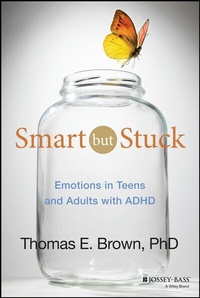
Smart But Stuck
Description

Smart but Stuck offers 15 true and compelling stories about intelligent, capable teens and adults who have gotten "stuck" at school, work, and/or in social relationships because of their ADHD. Dr. Brown highlights the often unrecognized role that emotions play in this complex disorder. He explains why even very bright people with ADHD get stuck because they can focus well on some tasks that interest them, but often can't focus adequately on other important tasks and relationships.
- The first book to explain and illustrate the crucial role of emotions in the daily functioning of those living with ADHD
- Brown, Associate Director of the Yale Clinic for Attention & Related Disorders, is an internationally known authority on ADHD
Drawing on the latest research findings, the book describes strategies and treatments for getting "unstuck" to move on to a more rewarding and productive life.
More details
Other editions
Additional editions
Person
THOMAS E. BROWN, PhD, is a Clinical Psychologist, Assistant Clinical Professor of Psychiatry at Yale University School of Medicine, and Associate Director of the Yale Clinic for Attention and Related Disorders. He is the author of several books including the award-winning Attention Deficit Disorder: The Unfocused Mind in Children and Adults (Yale University Press, 2005), which has been published in seven languages. Visit him at www.drthomasebrown.com.
Content
The Author ix
Acknowledgments xi
Introduction 1
1 ADHD and the emotional brain 7
A new understanding of ADHD and emotions; why emotions can be so troubling in the lives of those with ADHD; how the ADHD brain processes emotions differently; the influences of temperament and experiences on emotions and motivations.
2 Eric 43
"I'm in a great university where I want to do well, but I just can't get myself motivated to do the work. I did really well in high school; now my grade shave tanked. I've been spending too much time hanging out with my girlfriend and smoking weed. I've tried some ADHD medicines, but they make me too jittery."
-20-year-old university student
3 Karen 65
"My parents always taught me that I have an obligation to behave and achieve in ways that would not bring shame on my family. When I failed out of college, they helped me prepare to try again. I wanted very much to do it, but on that critical day when I was supposed to start the last two courses I needed to get readmitted, I was too afraid to walk in the classroom door."
-22-year-old university student
4 Martin 81
"I'm in Mensa, but I earned no credits in my first two years at college-I was too baked to get myself to class. Now I'm doing well in a few courses where the professors are really interesting, but I can't get started on writing papers and often skip class. With my miserable academic record, what's the use in my trying to graduate?"
-23-year-old university student
5 Sarah 103
"I've been married twenty-five years, have three great kids, and had a decent career as a journalist, but I just got fired because I couldn't prioritize and keep up with my work. Since menopause I've had trouble keeping track of things and getting work done. I've always had some trouble with these things, but it's recently been getting worse."
-50-year-old homemaker and mother
6 Mike 119
"My dad always said that I'm smart but just lazy; maybe he's right. I got put on academic probation, and now I have to drop out. I'm always spacing out and can't get myself started on anything until the last minute. I tried my friend's ADHD medicine and it helped alot, but my dad doesn't want me getting evaluated for ADHD because he says the meds are like steroids."
-21-year-old university student
7 Lisa 137
"Other kids don't seem to get my jokes and aren't interested in who I am. I try to make friends, but no one ever calls me back when I call them. I try to talk with my parents about it, but my dad doesn't understand kids and my mom's always yelling at me. ADHD meds help me get schoolwork done, but they don't help with social stuff."
-15-year-old high school student
8 Steve 155
"My wife divorced me three months ago, and then a month later I got fired from my job-both because of my ADHD! Meds help some, but not enough. I get stuck doing some things and don't get around to doing what's really important. I procrastinate, and everything takes me way too long. I'm good at programming computers, but not at programming myself."
-32-year-old computer programmer
9 Sue 169
"Until I got into middle school, I always got really good grades and never got into trouble. Now everybody thinks I'm hopeless just because I dress Goth and don't do much homework. My parents and teachers all look down on me just because of the friends I hang out with. They don't really know me or my friends!"
-14-year-old high school student
10 Matt 185
"When I was in high school, I had friends. When I got to college, I didn'tknow anyone and was too shy to make friends. I just kept to myself and almost never left my room except to go to class or get meals. I got pretty depressed, and after a while my sleep got messed up. I've stopped going to some of my classes."
-18-year-old college student
11 Lois 203
"I teach special education, so I've taught a lot of kids with ADHD, but never realized I have it. I have trouble organizing my stuff and finishing paperwork on time, and sometimes I'm forgetful. I got through college and I've been teaching for ten years, but over the past year I've had a harder time, and those ADHD problems are getting worse-especially since difficulties at home began."
-37-year-old school teacher
12 James 219
"If I don't finish four papers this month, I'm going to be put on probation at school. I
just can't get myself to finish. I've had this problem for a long time, but now it's worse than ever before. I've done the research for most of my papers, but I can't get myself past the first paragraph in any one of them. I'm stuck!"
-20-year-old college student
13 Getting Unstuck 235
How do the emotions of these teens and adults affect their education, work, family interactions, and social relationships? What treatments are useful for helping people with ADHD get unstuck from these difficulties? What can family members, friends, teachers, clinicians, and counselors do to help?
Questions for Discussion 243
Notes and Additional Reading 251
Index 267
introduction
All information processing is emotional . . . emotion is the energy level that drives, organizes, amplifies and attenuates cognitive activity.
—Kenneth Dodge, neuroscientist
Although the scientific understanding of ADHD has changed dramatically over the past decade, most people affected by this disorder—and many who diagnose and treat them—have not yet had the opportunity to gain a clear, up-to-date understanding of this complex condition. As you'll read in the chapters that follow, ADHD is not a simple problem of misbehavior, lack of willpower, or inability to focus attention. In this collection of true stories about extremely bright teenagers and adults, you'll find multiple examples of the ways that ADHD can cause even very intelligent individuals to experience chronic frustration and failure, which gets them “stuck” in their schooling or work and many other aspects of daily life. Fortunately, in most cases it's possible for a person with ADHD to get unstuck, and in these pages you'll find numerous examples showing how effective treatment has helped those suffering from ADHD to get back on track.
NOTE: Throughout this book, the term ADHD is used to refer to the disorder currently understood as Attention Deficit/Hyperactivity Disorder (ADHD) and/or Attention Deficit Disorder (ADD).Clinical and neuroscience research has revealed that ADHD is essentially a complex set of dynamically interacting impairments of the brain's management system, otherwise known as its “executive functions.” These functions involve a number of critical operations of the brain, including the abilities to
- Get organized and get started on tasks
- Focus on tasks and shift focus from one task to another when needed
- Regulate sleep and alertness, sustain effort, and process information efficiently
- Manage frustration and modulate emotions
- Utilize working memory and access recall
- Monitor and self-regulate action
Everyone has trouble with these functions from time to time, but people with ADHD have much more difficulty with them than do their same-age peers. (I offer more detailed descriptions of these various executive functions in Chapter 1.)
the missing link: emotions
Despite progress made in ADHD research, one element has been lacking in most current descriptions of the disorder: the critical role played by emotions in every one of the executive functions. This book describes that missing piece. In 1996, neuroscientist Joseph LeDoux published The Emotional Brain, a book highlighting evidence of the central importance of emotion in the brain's cognitive functioning. He emphasized that emotions—mostly unconscious emotions—are powerful and critically important motivators of human thought and actions.1 This understanding of the essential role of emotion in all aspects of human behavior has not yet been integrated into current thinking about ADHD.
We must recognize the critical role of emotions, both positive and negative, in initiating and prioritizing tasks, sustaining or shifting interest and effort, holding thoughts in active memory, and choosing to engage in or avoid a task or situation.
To fully understand the role of emotions in ADHD, we must not only recognize that those with the disorder often have a hard time managing how they express their emotions but also acknowledge the critical role that emotions, both positive and negative, play in the executive functions: initiating and prioritizing tasks, sustaining or shifting interest and effort, holding thoughts in active memory, choosing to engage in or avoid a task or situation. As was observed by neuroscientist Kenneth Dodge, “All information processing is emotional . . . emotion is the energy level that drives, organizes, amplifies and attenuates cognitive activity.”2
Emotions—sometimes conscious, more often unconscious—serve to motivate cognitive activity that shapes a person's experience and action. For those with ADHD, chronic problems with recognizing and responding to various emotions tend to be a primary factor in their difficulties with managing daily life.
The stories in this book highlight the role that various emotions, positive and negative, played in the struggles of some of my patients with ADHD. Some readers of these stories might think, “Oh, this is a person with ADHD and several other disorders—anxiety, depression, or OCD. Their emotional struggles are just part of those additional disorders, not ADHD.” My response is that ADHD is not one silo of cognitive problems with another silo of emotional difficulties beside it. Problems with responding to and managing emotions are intimately, dynamically, and inextricably involved in ADHD.
Problems with responding to and managing emotions are intimately, dynamically, and inextricably involved in ADHD.
learning from patients and research
I am a clinical psychologist. For more than thirty-five years, I have spent most of my working hours talking with and listening to children, adolescents, and adults, most seeking help for problems related to ADHD. Many also have had additional difficulties with other problems involving emotions, learning, or behavior. My primary source of learning about ADHD has been the countless conversations with these patients—young and old alike—who shared with me ongoing stories of their struggles to recognize and overcome their attention impairments and to extricate themselves from feeling stuck in patterns of demoralizing frustration and failure. The stories in this book are based on my notes from conversations with some of these patients. All have been modified to protect the privacy of those involved, but the essential details of all are true.
Recently expanding research in neuroscience, psychology, and psychiatry has helped explain many puzzling facts reported by patients with ADHD, such as how they can focus and work energetically on a few favored activities, but simply can't get started or sustain enough effort for other activities that they know are important and want to do. In these pages, true stories of patients are intermingled with accessible explanations of research that will help you better understand each patient's struggles and the fuller nature of the relationship between ADHD and emotions.
One of my special interests over the years has been adolescents and adults who are especially bright. They have taught me that being smart is no protection from attention impairments. Not only is it possible for people with a high IQ to suffer from ADHD, but it's likely that they'll suffer longer without adequate support or treatment because the people in their lives assume, quite mistakenly, that anyone who is really smart can't suffer from ADHD.
Not only is it possible for people with a high IQ to suffer from ADHD, but it's likely that they'll suffer longer without adequate support or treatment because the people in their lives assume, quite mistakenly, that anyone who is really smart can't suffer from ADHD.
The patients I write about in this book are all extremely bright. They scored within the top 9 percent of the population on IQ tests, but they were stuck. They sought treatment because they were unable to get themselves out of chronically unproductive, self-defeating patterns of emotions, thought, and action. They felt trapped in their daily dealings with their education, their job, their relationships with others, or a combination of these. Their stories illustrate the persistent difficulties those with ADHD have in managing themselves and their emotions. Some are stories of amazing successes and impressive accomplishments; others are tales of ongoing frustration and tragic disappointment. Most are a mixed bag. Yet each story illuminates the complex role that emotions play in ADHD.
what you'll find in this book
Chapter 1 describes this new understanding of ADHD, drawing on the latest research findings by clinicians, researchers, and neuroscientists. Chapters Two through Twelve offer stories of real teenagers and adults with ADHD, highlighting their particular struggles with the disorder, with their emotions, and with related problems in their family or various other contexts. The final chapter summarizes some of the ways that emotions affect the life experiences of those with ADHD and what can be offered to appropriately support and treat those affected.
The stories that follow illustrate the limitations of diagnostic “pigeonholes.” The individuals you'll read about in these pages can't be neatly categorized under one or several diagnoses. Each person is a unique and complex combination of interacting strengths and difficulties in each of the shifting contexts in which he or she lives. There is great diversity among people with ADHD as well as in the varied settings in which they encounter daily life.
In telling stories of these adolescents and adults, I have also shared some of my own reactions and challenges as I tried to provide the help they sought from me. Many of the stories are success stories. I share the resources and strategies that contributed to these successes. Several stories also illustrate the significant obstacles and struggles that some people with ADHD may experience.
Stories in this book also illustrate what we currently know about how ADHD changes—sometimes for the better, sometimes for the worse—as a person progresses into the...
