

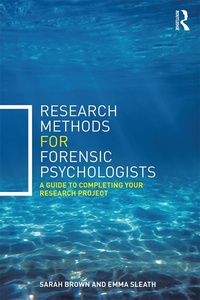
Research Methods for Forensic Psychologists
A guide to completing your research project
Published on 26. June 2015
302 pages
978-1-317-90901-9 (ISBN)
Description

Research Methods for Forensic Psychologists is an accessible and comprehensive textbook that introduces students to the research process in forensic psychology. Adopting a problem-based learning approach, this book offers a 'how-to' guide to the whole research process and empowers readers to develop their own programme of research, from initial vague ideas, to developing a research question, to carrying out a methodologically rigorous research project, to disseminating the findings.
The text is centred on five case studies, sufficiently different in nature to address the most common research methodologies. Each case study is linked with a specific research question that will be used to illustrate the research process throughout the rest of the book. Topics covered in the book include:
Design and Planning, including a literature search, a discussion of different sorts of data, practical and feasibility issues, research ethics and developing a research proposal.
Conducting research, including the submission of ethics proposals and responding to feedback, collecting data and dealing with the problems and challenges of analysing data.
Dissemination of findings, an overview of the different types of papers, with examples listed and other methods of disseminating findings discussed, such as conference presentations and the use of social media.
Throughout, issues of common difficulty or confusion are highlighted and activities are provided for readers to consider and apply the information discussed further. Additional reading sections and summaries are also provided at the end of each chapter. This book is essential reading for advanced students in Forensic Psychology, as well as trainees and practitioners within relevant forensic psychology organisations.
The text is centred on five case studies, sufficiently different in nature to address the most common research methodologies. Each case study is linked with a specific research question that will be used to illustrate the research process throughout the rest of the book. Topics covered in the book include:
Design and Planning, including a literature search, a discussion of different sorts of data, practical and feasibility issues, research ethics and developing a research proposal.
Conducting research, including the submission of ethics proposals and responding to feedback, collecting data and dealing with the problems and challenges of analysing data.
Dissemination of findings, an overview of the different types of papers, with examples listed and other methods of disseminating findings discussed, such as conference presentations and the use of social media.
Throughout, issues of common difficulty or confusion are highlighted and activities are provided for readers to consider and apply the information discussed further. Additional reading sections and summaries are also provided at the end of each chapter. This book is essential reading for advanced students in Forensic Psychology, as well as trainees and practitioners within relevant forensic psychology organisations.
Reviews / Votes
'This book is a landmark text that is set to become a fundamental read for forensic students and researchers. Sarah Brown and Emma Sleath have done a fantastic job of putting together a text that explains the process of conducting forensic psychology research from start to finish. This is the first UK textbook to specifically grapple with the "real-world" problems experienced by forensic researchers which mainstream texts are unable to address. I only wish such a text had been available when I was conducting my own PhD!' - Theresa A. Gannon, Professor of Forensic Psychology, CORE-FP, University of Kent, UK'Comprehensive, accessible, detailed and practical - a gem of a book for anyone researching in a forensic setting. From formulating your research question to disseminating your findings, everything you need to know to plan, conduct and present your research is right here. A "must-have" for all students and budding researchers in criminal justice.' - Jo Clarke, PhD, Programme Director, MSc in Applied Forensic Psychology, University of York, UK
'I am delighted to endorse this book. I have been involved in delivering postgraduate forensic psychology training for almost 20 years and this is THE book that we have been waiting for. It is clear and concise and focuses on all the main issues that plague any early researcher in the forensic field. I will be putting this on my required reading for our postgraduates and would recommend that postgraduate students, early researchers and all other course directors buy a copy too.' - Liz Gilchrist, Professor of Forensic Psychology, Glasgow Caledonian University, UK
More details
Language
English
Place of publication
London
United Kingdom
Publishing group
Taylor & Francis Ltd
Target group
College/higher education
Product notice
Reflowable
Illustrations
2 s/w Abbildungen, 4 s/w Tabellen, 2 s/w Zeichnungen
4 Tables, black and white; 2 Line drawings, black and white; 2 Illustrations, black and white
File size
2,18 MB
ISBN-13
978-1-317-90901-9 (9781317909019)
Copyright in bibliographic data and cover images is held by Nielsen Book Services Limited or by the publishers or by their respective licensors: all rights reserved.
Schweitzer Classification
Other editions
Additional editions
Sarah Brown | Emma Sleath
Research Methods for Forensic Psychologists
A guide to completing your research project
Book
07/2015
1st Edition
Routledge
€90.00
Shipment within 15-20 days
Sarah Brown | Emma Sleath
Research Methods for Forensic Psychologists
A guide to completing your research project
Book
06/2015
1st Edition
Routledge
€252.40
Shipment within 15-20 days
Persons
Sarah Brown is a professor, chartered psychologist, Associate Fellow of the British Psychological Society, a forensic psychologist, and Fellow of the Higher Education Academy. She has developed and led forensic psychology master's courses and taught both quantitative and qualitative research methods. Professor Brown has over fifteen years of experience in supervising numerous undergraduates and teaching postgraduate and doctoral research projects in forensic psychology using a range of research methods and types of data analyses. She has published peer-reviewed literature reviews and empirical papers from many of these projects with master's and doctoral students, and many of these studies have been presented at national and international conferences.
Emma Sleath is a senior lecturer in psychology, registered HCPC forensic psychologist and Fellow of the Higher Education Academy. Dr. Sleath has taught postgraduate forensic psychology courses for over ten years, and she has a range of experience in both quantitative and qualitative research methods. Her research interests focus on police practice in relation to victims of crime, and she has published numerous peer-reviewed journal articles in this area.
Emma Sleath is a senior lecturer in psychology, registered HCPC forensic psychologist and Fellow of the Higher Education Academy. Dr. Sleath has taught postgraduate forensic psychology courses for over ten years, and she has a range of experience in both quantitative and qualitative research methods. Her research interests focus on police practice in relation to victims of crime, and she has published numerous peer-reviewed journal articles in this area.
Content
1. Introduction Section 1: Designing and planning 2. Searching the literature 3. Methods 4. Types of data 5. From research question to research design 6. Practical and feasibility issues in research 7. Ethics in forensic psychology research 8. Research proposal Section 2: Conducting research 9. Gaining ethical approval 10. Setting up and implementing your study 11. Collecting data 12. Data analysis Section 3: Dissemination of your research findings 13. Purpose of dissemination 14. Literature review papers 15. Empirical papers 16. Conference presentations.
