

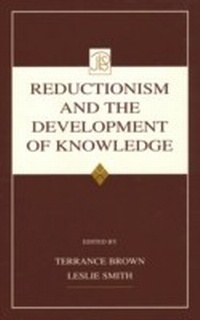
Reductionism and the Development of Knowledge
1st Edition
Published on 30. January 2003
248 pages
978-1-135-63988-4 (ISBN)
Description

Among the many conceits of modern thought is the idea that philosophy, tainted as it is by subjective evaluation, is a shaky guide for human affairs. People, it is argued, are better off if they base their conduct either on know-how with its pragmatic criterion of truth (i.e., possibility) or on science with its universal criterion of rational necessity.
Since Helmholtz, there has been increasing concern in the life sciences about the role of reductionism in the construction of knowledge. Is psychophysics really possible? Are biological phenomena just the deducible results of chemical phenomena? And if life can be reduced to molecular mechanisms only, where do these miraculous molecules come from, and how do they work? On a psychological level, people wonder whether psychological phenomena result simply from genetically hardwired structures in the brain or whether, even if not genetically determined, they can be identified with the biochemical processes of that organ. In sociology, identical questions arise.
If physical or chemical reduction is not practicable, should we think in terms of other forms of reduction, say, the reduction of psychological to sociological phenomena or in terms of what Piaget has called the "reduction of the lower to the higher" (e.g., teleology)? All in all, then, reductionism in both naive and sophisticated forms permeates all of human thought and may, at least in certain cases, be necessary to it. If so, what exactly are those cases?
The papers collected in this volume are all derived from the 29th Annual Symposium of the Jean Piaget Society. The intent of the volume is to examine the issue of reductionism on the theoretical level in several sciences, including biology, psychology, and sociology. A complementary intent is to examine it from the point of view of the practical effects of reductionistic doctrine on daily life.
Since Helmholtz, there has been increasing concern in the life sciences about the role of reductionism in the construction of knowledge. Is psychophysics really possible? Are biological phenomena just the deducible results of chemical phenomena? And if life can be reduced to molecular mechanisms only, where do these miraculous molecules come from, and how do they work? On a psychological level, people wonder whether psychological phenomena result simply from genetically hardwired structures in the brain or whether, even if not genetically determined, they can be identified with the biochemical processes of that organ. In sociology, identical questions arise.
If physical or chemical reduction is not practicable, should we think in terms of other forms of reduction, say, the reduction of psychological to sociological phenomena or in terms of what Piaget has called the "reduction of the lower to the higher" (e.g., teleology)? All in all, then, reductionism in both naive and sophisticated forms permeates all of human thought and may, at least in certain cases, be necessary to it. If so, what exactly are those cases?
The papers collected in this volume are all derived from the 29th Annual Symposium of the Jean Piaget Society. The intent of the volume is to examine the issue of reductionism on the theoretical level in several sciences, including biology, psychology, and sociology. A complementary intent is to examine it from the point of view of the practical effects of reductionistic doctrine on daily life.
More details
Series
Language
English
Place of publication
London
United Kingdom
Publishing group
Taylor & Francis Ltd
Target group
Professional and scholarly
Product notice
Reflowable
File size
1,32 MB
ISBN-13
978-1-135-63988-4 (9781135639884)
Copyright in bibliographic data and cover images is held by Nielsen Book Services Limited or by the publishers or by their respective licensors: all rights reserved.
Schweitzer Classification
Other editions
Additional editions
Terrance Brown | Leslie Smith
Reductionism and the Development of Knowledge
Book
07/2013
1st Edition
Psychology Press Ltd
€89.32
Shipment within 15-20 days
Terrance Brown | Leslie Smith
Reductionism and the Development of Knowledge
Book
11/2002
Psychology Press
€215.41
Shipment within 10-20 days
Content
Contents: Preface. T. Brown, Reductionism and the Circle of the Sciences. Part I: Ways of Understanding.W.F. Overton, Understanding, Explanation, and Reductionism: Finding a Cure for Cartesian Anxiety. W.C. Wimsatt, Evolution, Entrenchment, and Innateness. J.O.F. Vega, G. Hernandez, J.J. Rivaud, Reductionism in Mathematics. Part II: Representation.M.H. Bickhard, The Biological Emergence of Representation. T. Nunes, The Role of Systems of Signs in Reasoning. L. Morgado, The Role of Representation in Piagetian Theory: Changes Over Time. C. Lightfoot, Breathing Lessons: Self as Genre and Aesthetic. Part III: Looking Toward the Future.L. Smith, From Epistemology to Psychology in the Development of Knowledge.
