

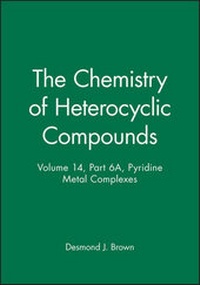
Pyridine Metal Complexes, Part 6A
Published on 13. October 2009
2248 pages
978-0-470-23972-8 (ISBN)
Description

The Chemistry of Heterocyclic Compounds, since its inception, has been recognized as a cornerstone of heterocyclic chemistry. Each volume attempts to discuss all aspects - properties, synthesis, reactions, physiological and industrial significance - of a specific ring system. To keep the series up-to-date, supplementary volumes covering the recent literature on each individual ring system have been published. Many ring systems (such as pyridines and oxazoles) are treated in distinct books, each consisting of separate volumes or parts dealing with different individual topics. With all authors are recognized authorities, the Chemistry of Heterocyclic Chemistry is considered worldwide as the indispensable resource for organic, bioorganic, and medicinal chemists.
More details
Other editions
Additional editions
Software
01/2008
Wiley
€564.32
No shipping information available

Person
Piotr Tomasik, The Hugon Kollataj Academy of Agriculture, Cracow, Poland.
Zbigniew Ratajewicz, Technical University, Lublin, Poland.
George R. Newkome, Louisiana State University, Baton Rouge, Louisiana.
Lucjan Strekowski, Department of Chemistry, Georgia State University, Atlanta, Georgia.
Content
- PYRIDINE-METAL COMPLEXES
- Contents
- GUIDE TO USING THE BOOK
- CHAPTER 1. ESSENTIALS OF COORDINATION CHEMISTRY
- 1.1. Formation of the Complexes
- 1.2. Systematics of the Complexes
- 1.3. Systematics of the Ligands
- 1.4. Stability of Complexes
- 1.4.1. Properties of the Central Atom
- 1.4.2. Properties of the Ligands
- 1.5. Complexes and Complex Compounds
- 1.6. Isomerism in the Complex Compounds
- 1.7. Pyridine and Its Derivatives as the Ligands
- References
- CHAPTER 2. s-PYRIDINE COORDINATION COMPOUNDS WITH NONTRANSITION METALS
- 2.1. Coordination Compounds with the Metals of Nontransition Group I
- 2.1.1. Introduction
- 2.1.2. Preparation Methods
- 2.1.3. Properties
- 2.1.4. Applications
- 2.2. Coordination Compounds with the Metals of Nontransition Group II
- 2.2.1. Introduction
- 2.2.2. Preparation Methods
- 2.2.3. Properties
- 2.2.4. Applications
- 2.3. Coordination Compounds with the Metals of Nontransition Group III
- 2.3.1. Introduction
- 2.3.2. Preparation Methods
- 2.3.3. Properties
- 2.3.4. Applications
- 2.4. Coordination Compounds with the Metals of Nontransition Group IV
- 2.4.1. Introduction
- 2.4.2. Preparation Methods
- 2.4.3. Properties
- 2.4.4. Applications
- 2.5. Coordination Compounds with the Metals of Nontransition Group V
- 2.5.1. Introduction
- 2.5.2. Preparation Methods
- 2.5.3. Properties
- 2.5.4. Applications
- 2.6. Coordination Compounds with the Metals of Nontransition Group VI
- 2.6.1. Introduction
- 2.6.2. Preparation Methods
- 2.6.3. Properties
- 2.6.4. Applications
- References
- CHAPTER 3. s-PYRIDINE COORDINATION COMPOUNDS WITH TRANSITION METALS
- 3.1. Coordination Compounds with the Metals of Transition Group I
- 3.1.1. Zero-Valent Copper and Cuprous Coordination Compounds
- 3.1.2. Cupric Coordination Compounds
- 3.1.3. Silver Coordination Compounds
- 3.2.1. Zinc Coordination Compounds
- 3.2.2. Cadmium Coordination Compounds
- 3.2.3. Mercurous and Mercuric Coordination Compounds
- 3.3. Coordination Compounds with the Metals of Transition Group III
- 3.3.1. Preparation Methods
- 3.3.2. Properties
- 3.3.3. Applications
- 3.4. Coordination Compounds with the Metals of Transition Group IV
- 3.4.1. Preparation Methods
- 3.4.2. Properties
- 3.4.3. Applications
- 3.5. Coordination Compounds with the Metals of Transition Group V
- 3.5.1. Preparation Methods
- 3.5.2. Properties
- 3.5.3. Applications
- 3.6. Coordination Compounds with the Metals of Transition Group VI
- 3.6.1. Chromium Coordination Compounds
- 3.6.2. Molybdenum Coordination Compounds
- 3.6.3. Tungsten Coordination Compounds
- 3.7. Coordination Compounds with the Metals of Transition Group VII
- 3.7.1. Manganese Coordination Compounds
- 3.7.2. Technetium and Rhenium Coordination Compounds
- 3.8. Coordination Compounds with the Metals of Transition Group VIII
- 3.8.1. Iron Coordination Compounds
- 3.8.2. Cobalt Coordination Compounds
- 3.8.3. Nickel Coordination Compounds
- 3.8.4. Ruthenium Coordination Compounds
- 3.8.5. Rhodium Coordination Compounds
- 3.8.6. Palladium Coordination Compounds
- 3.8.7. Osmium Coordination Compounds
- 3.8.8. Iridium Coordination Compounds
- 3.8.9. Platinum Coordination Compounds
- References
- CHAPTER 4. COORDINATION COMPOUNDS OF METALS WITH PYRIDINE 1-OXIDES
- 4.1. Introduction
- 4.2. Coordination Compounds with the Metals of Nontransition Group I
- 4.2.1. Introduction
- 4.2.2. Preparation Methods
- 4.2.3. Applications
- 4.3. Coordination Compounds with the Metals of Nontransition Group II
- 4.3.1. Introduction
- 4.3.2. Preparation Methods
- 4.3.3. Applications
- 4.4. Coordination Compounds with the Metals of Nontransition Group III
- 4.4.1. Introduction
- 4.4.2. Preparation Methods
- 4.4.3. Applications
- 4.5. Coordination Compounds with the Metals of Nontransition Group IV
- 4.5.1. Introduction
- 4.5.2. Preparation Methods
- 4.5.3. Applications
- 4.6. Coordination Compounds with the Metals of Nontransition Groups V and VI
- 4.6.1. Introduction
- 4.6.2. Preparation Methods
- 4.6.3. Applications
- 4.7. Coordination Compounds with the Metals of Transition Group I
- 4.7.1. Introduction
- 4.7.2. Preparation Methods
- 4.7.3. Applications
- 4.8. Coordination Compounds with the Metals of Transition Group II
- 4.8.1. Introduction
- 4.8.2. Preparation Methods
- 4.8.3. Applications
- 4.9. Coordination Compounds with the Metals of Transition Group III
- 4.9.1. Introduction
- 4.9.2. Preparation Methods
- 4.9.3. Applications
- 4.10. Coordination Compounds with the Metals of Transition Group IV
- 4.10.1.Introduction
- 4.10.2. Preparation Methods
- 4.10.3. Applications
- 4.11. Coordination Compounds with the Metals of Transition Group V
- 4.11.1.Introduction
- 4.11.2.Preparation Methods
- 4.11.3. Applications
- 4.12. Coordination Compounds with the Metals of Transition Group VI
- 4.12.1.Introduction
- 4.12.2.Preparation Methods
- 4.12.3. Applications
- 4.13. Coordination Compounds with the Metals of Transition Group VII
- 4.13.1. Introduction
- 4.13.2. Preparation Methods
- 4.13.3. Applications
- 4.14. Coordination Compounds with the Metals of Transition Group VIII
- 4.14.1.Introduction
- 4.14.2. Preparation Methods
- 4.14.3. Applications
- References
- CHAPTER 5. p-COORDINATION COMPOUNDS OF PYRIDINES WITH METALS
- 5.1. Preparation Methods
- 5.2. Properties
- References
- CHAPTER 6. PYRIDINE INTERCALATION COMPOUNDS
- 6.1. Introduction
- 6.2. Preparation Methods
- 6.3. Properties
- 6.4. Applications
- References
- CHAPTER 7. CLATHRATES
- 7.1. Introduction
- 7.2. Preparation Methods
- 7.3. Properties
- 7.4. Applications
- References
