

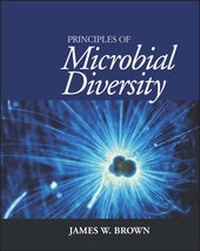
Principles of Microbial Diversity
Description

Every speck of dust, drop of water, and grain of soil and each part of every plant and animal contain their own worlds of microbes.
Designed as a key text for upper-level undergraduates majoring in microbiology, genetics, or biology, Principles of Microbial Diversity provides a solid curriculum for students to explore the enormous range of biological diversity in the microbial world. Within these richly illustrated pages, author and professor James W. Brown provides a practical guide to microbial diversity from a phylogenetic perspective in which students learn to construct and interpret evolutionary trees from DNA sequences. He then offers a survey of the "tree of life" that establishes the necessary basic knowledge about the microbial world. Finally, the author draws the student's attention to the universe of microbial diversity with focused studies of the contributions that specific organisms make to the ecosystem.
Principles of Microbial Diversity fills an empty niche in microbiology textbooks by providing an engaging, cutting-edge view of the "microbial zoo" that exists around us, covering bacteria, archaea, eukaryotes, and viruses.
More details
Other editions
Additional editions
Person
James (Jim) W. Brown's lasting interest in microbiology was sparked by a single lecture on microbial diversity in an undergraduate microbiology class at Ball State University and by the announcement in that class of the discovery of an entirely new kind of living thing, the "archaebacteria." He went on to earn his MS in Microbiology at Miami University and his PhD in the Molecular, Cellular, and Developmental Biology program at The Ohio State University. Jim developed and continues to teach senior-level undergraduate lecture and lab courses in microbial diversity at North Carolina State University (NCSU), which are the genesis of this textbook. He was awarded the NCSU Alumni Association Distinguished Undergraduate Professor award in 2014.
Content
Acknowledgments
Preface
About the Author
Section I Introduction to Microbial Diversity
1. What Is Microbial Diversity?
2. Context and Historical Baggage
3. Phylogenetic Information
4. Constructing a Phylogenetic Tree
5. Tree Construction Complexities
6. Alternatives to Small-Subunit rRNA Analysis
7. The Tree of Life
Section II The Microbial Zoo
8. Primitive Thermophilic Bacteria
9. Green Phototrophic Bacteria
10. Proteobacteria
11. Gram-Positive Bacteria
12. Spirochetes and Bacteroids
13. Deinococci, Chlamydiae, and Planctomycetes
14. Bacterial Phyla with Few or No Cultivated Species
15. Archaea
16. Eukaryotes
17. Viruses and Prions
Section III Microbial Populations
18. Identification of Uncultivated Organisms
19. Sequence-Based Microbial Surveys
20. Fluorescent In Situ Hybridization Surveys
21. Molecular Fingerprinting of Microbial Populations
22. Linking Phenotype and Phylotype
Section IV Conclusion: The Phylogenetic Perspective
23. Genomics, Comparative Genomics, and Metagenomics
24. Origins and Early Evolution
Index
1
What Is Microbial Diversity?
Facets of microbial diversity
What is diversity? How exactly are organisms either similar to or different from each other? This seems like an easy question in the macroscopic world, but what about microbes?
Morphological diversity
Microbes are often divided by shape into rods, cocci, and spirals. Although these are the most common cell shapes, bacterial and archaeal cells also come in a wide range of other shapes: filaments (branched or unbranched), irregular, pleomorphic (different shapes under different conditions or even in the same culture), star-shaped, stalked, and many, many others. Haloquadratum is a flat, square organism, just like a bathroom tile (Fig. 1.1).
Individual cells of whatever shape can be found in a variety of multicellular arrangements, from simple pairs and tetrads to multicellular filaments, sheets, rosettes, and true multicellular organisms. Many species form highly structured multispecies mats that resemble the tissues of animals and plants that carry out complex biochemical transformations (Fig. 1.2).
Figure 1.1 The tile-shaped halophilic archaeon Haloquadratum walsbyi. (Source: Wikimedia Commons.) doi:10.1128/9781555818517.ch1.f1.1
Figure 1.2 Section of a stratified microbial mat from Guerrero Negro, Baja California. (Copyright 2007, American Society for Microbiology. Photo by John R. Spear and Norman R. Pace.) doi:10.1128/9781555818517.ch1.f1.2
Most bacteria and archaea measure 1 to 5 µm, but they range from 0.1 µm in thickness to over a millimeter. At the low end, it is hard to understand how everything that is needed for life could fit into the cell. At the high end, they can be easily seen without a microscope (Fig. 1.3).
Structural diversity
Many bacteria have "typical" gram-positive (single membrane, thick cell wall) or gram-negative (double membrane, thin cell wall) cell envelopes. However, there is wide variation even within these two major types. Many gram-positive bacteria have an outer membrane, made of mycolic acids rather than glycerol-phosphate esters. Many gram-negative bacteria lack the lipopolysaccharide layer. Many archaea and bacteria (both gram positive and gram negative) have an orderly protein coat, the S-layer (Fig. 1.4). In bacteria, cell walls are composed of peptidoglycan, but there is a surprising range of chemical variations within this type of material. Archaea do not have peptidoglycan cell walls, although some archaeal cell walls contain a related material, pseudomurein.
Figure 1.3 The bacterium Epulopiscium fishelsoni (ca. 500 µm long) and four cells of the protist Paramecium (ca. 100 µm long). (Courtesy of Esther Angert.) doi:10.1128/9781555818517.ch1.f1.3
Microbes have a wide range of external structures: flagella, pili, fibrils, holdfasts, stalks, buds, capsules, sheaths, and so on. They also have a wide variety of internal structures such as spores, daughter cells, thylakoids, mesosomes, and the nucleoid. In reality, microbial cells are just as structurally organized, and diverse, as are eukaryotic cells.
Figure 1.4 A negative-stain electron micrograph of the S-layer of Pyrobaculum aerophilum. Scale bar, 200 nm. (Courtesy of Reinhard Rachel.) doi:10.1128/9781555818517.ch1.f1.4
Metabolic diversity
Macroscopic eukaryotes are not metabolically diverse; they are either chemoheterotrophic (e.g., animals) or photoautotrophic (e.g., plants). Bacteria and archaea have a much broader range of energy and carbon sources, which can be generally divided into four broad types, chemoheterotrophs, chemoautotrophs, photoheterotrophs, and photoautotrophs.
Chemoheterotrophs obtain both carbon and energy from organic compounds. Some organisms can use a wide range of organic compounds and can either oxidize or ferment them. Others can use only a very narrow range of organic compounds and process them in a specific way. Saprophytes and pathogenic microbes are examples of this group.
Chemoautotrophs obtain cell carbon by fixing CO2. Energy is obtained from inorganic chemical reactions such as the oxidation or reduction of sulfur or nitrogen compounds, iron, hydrogen, etc. These organisms do not need organic compounds for either energy or cell carbon. Sulfur-oxidizing bacteria and methane-producing archaea are examples of this group.
Photoheterotrophs obtain cell carbon from organic compounds, but energy is harvested from light. Halophilic archaea and most purple photosynthetic bacteria are examples of this group.
Photoautotrophs (photosynthetic) obtain cell carbon by fixing CO2. Energy is obtained from light. These organisms do not need organic compounds for either energy or cell carbon. Most cyanobacteria and some purple photosynthetic bacteria are examples of this group.
Ecological diversity
Microbes live in an amazing range of habitats, from laboratory distilled-water carboys, through freshwater and marine environments, to saturated brines like the Great Salt Lake or the Dead Sea. They grow at temperatures of -5°C to over 118°C; Pyrodictium cultures are sometimes incubated in autoclaves! Organisms are known to grow at pH 0 (0.5 M sulfuric acid) and at pH 11 (Drano). Very often, these extremes are combined: Acidianus grows in 0.1 M sulfuric acid at 80°C! Some bacteria live in the water droplets that make up the clouds, and others live in deep-underground aquifers or deep-sea sediments. Many microbes live in intimate symbiosis with other creatures, in complex communities, or as permanent intracellular "guests."
In fact, if you are on or around Earth and find liquid water, there is almost certainly something living in it (Fig. 1.5).
Figure 1.5 Moose Pool, Yellowstone National Park, pH ~2, 80°C. doi:10.1128/9781555818517.ch1.f1.5
Behavioral diversity
It may seem odd to consider the behavior of microscopic organisms, but they do have behavior. Motility and taxis are one form of behavior, both of which come in a variety of forms, from the phototactic Chlorobium bacteria that use gas vacuoles and symbiosis with motile bacteria to adjust their place in the water column (Fig. 1.6) to the chemotactic Rhizobium bacteria that sense and swim (via flagella) toward chemical signals sent by receptive plant roots. Magnetotactic bacteria have a built-in magnetic compass that allows them to use Earth's magnetic field for orientation.
Figure 1.6 Chlorobium symbiotic consortium. (Reprinted from Wanner G, Vogl K, Overmann J, J Bacteriol 190:3721-3730, 2008, with permission.) doi:10.1128/9781555818517.ch9.f9.10
All organisms have developmental cycles; at the very least they can switch between active-growth (i.e., log phase) to resting or slow-growth (i.e., stationary phase) stages. Other developmental cycles include sporulation; the production of swarmer cells, cysts, or akinetes; and even terminal differentiation and development into distinct germ and somatic cell types, such as heterocysts in filaments of cyanobacteria, "slugs" in myxobacteria, and the very complex life cycles of Streptomyces species (Fig. 1.7).
Figure 1.7 Overlay of phase-contrast and red and green fluorescent images of sporulating Streptomyces coelicolor grown on SFM agar plates for 3 days. Red fluorescence results from the DNA stain 7-AAD; chromosomes are stained unevenly because the image was made by using live cells. Green is the fluorescence of SsfA-GFP. SsfA, a protein that is upregulated during sporulation and localizes to sporulation septa, has been fused to the green fluorescent protein GFP. Images were taken with a Zeiss fluorescence microscope and further artistically rendered with Adobe Photoshop. (Courtesy of Nora Ausmees.) doi:10.1128/9781555818517.ch1.f1.7
Microbes also respond to their environments metabolically, by expressing the genes needed to compete for the resources available at the time. An example of this would be converting metabolism from oxidative to fermentative when oxygen is exhausted in a culture or from glucose to galactose use when the glucose is used up in a mixed-sugar medium.
In addition, microbes act communally. Organisms communicate by sending and receiving chemical signals or by direct contact. For example, Myxococcus (Fig. 1.8) swarming begins with a chemical signal propagated through the community, which brings the cells into proximity. Direct contact between cells then directs aggregation and formation of fruiting bodies. Microbes also form specific symbioses with other microbes or with macroscopic creatures. Complex communities of microbes associate into "mats" that process and recycle resources throughout the community.
Figure 1.8 A swarm of Myxococcus xanthus (left) invading a colony of E. coli (right). (Reprinted from Berleman JE, Scott J, Chumley T, Kirby JR, Proc Natl Acad Sci USA 105:17127-17132, 2008. Copyright 2008 National Academy of Sciences, USA.) doi:10.1128/9781555818517.ch1.f1.8
Evolutionary diversity
Underlying all of these different aspects of diversity is genetic diversity, perhaps more specifically...
