

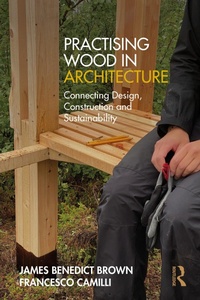
Practising Wood in Architecture
Connecting Design, Construction and Sustainability
Published on 17. April 2025
192 pages
978-1-040-31289-6 (ISBN)
Description

In the stark light of the climate emergency, using wood instead of concrete, steel, or masonry is increasingly seen as a way of reducing the environmental impact of architecture and construction. More and more new buildings are showcasing innovative ways to work with wood. Wood can help architects achieve ambitious sustainability targets, including the United Nations' Sustainable Development Goals.
How can architects, student architects, and those in the construction industry better understand the qualities, characteristics, and possibilities of building with wood? Practising Wood in Architecture explores the methods, philosophies, and possibilities of contemporary teaching practices in architecture. This book explores how architecture students are learning to build with wood and interrogates the consequences for architectural practice.
Based on original research conducted over two years, the book explores innovative projects that use wood in China, England, Finland, Germany, Mongolia, South Africa, and Switzerland. These case studies demonstrate the many advantages of wood, including its simplicity of use, its affordability, and its sustainability. The book focuses on ongoing initiatives that show the educational and professional impact of the use of wood in architecture and construction by students and professionals alike.
How can architects, student architects, and those in the construction industry better understand the qualities, characteristics, and possibilities of building with wood? Practising Wood in Architecture explores the methods, philosophies, and possibilities of contemporary teaching practices in architecture. This book explores how architecture students are learning to build with wood and interrogates the consequences for architectural practice.
Based on original research conducted over two years, the book explores innovative projects that use wood in China, England, Finland, Germany, Mongolia, South Africa, and Switzerland. These case studies demonstrate the many advantages of wood, including its simplicity of use, its affordability, and its sustainability. The book focuses on ongoing initiatives that show the educational and professional impact of the use of wood in architecture and construction by students and professionals alike.
More details
Language
English
Place of publication
London
United Kingdom
Publishing group
Taylor & Francis Ltd
Target group
College/higher education
Professional and scholarly
Illustrations
1 Tables, color; 2 Line drawings, color; 56 Halftones, color; 58 Illustrations, color
File size
166,30 MB
ISBN-13
978-1-040-31289-6 (9781040312896)
Copyright in bibliographic data and cover images is held by Nielsen Book Services Limited or by the publishers or by their respective licensors: all rights reserved.
Schweitzer Classification
Other editions
Additional editions
James Benedict Brown | Francesco Camilli
Practising Wood in Architecture
Connecting Design, Construction and Sustainability
Book
04/2025
1st Edition
Routledge
€47.50
Shipment within 10-20 days
James Benedict Brown | Francesco Camilli
Practising Wood in Architecture
Connecting Design, Construction and Sustainability
Book
04/2025
1st Edition
Routledge
€202.50
Shipment within 10-20 days
Persons
James Benedict Brown is Associate Professor of Architecture at Umea University, Sweden. James graduated from the University of Sheffield's School of Architecture in 2008 and in 2012 was awarded his PhD from Queen's University Belfast. His research interests are in critical pedagogy, architecture and wood, and design-build and live projects in architectural education, on which he has published extensively. He is the author of Mediated Space: The Architecture of News, Entertainment and Advertising (2018) and he is the co-editor of A Gendered Profession: The Question of Representation in Space Making (2016) with Harriet Harriss, Ruth Morrow, and James Soane. Forthcoming co-authored and co-edited books include Studio Properties: A Field Guide to Design Education (2025) and Architectural Thinking in a Climate Emergency (2025).
Francesco Camilli is an architect and researcher. Between 2023 and 2025 he was Postdoctoral Research Fellow at the Norwegian University of Science and Technology (NTNU) in Trondheim, Norway, where he researched how architecture and urban design practices can generate social engagement in the transition of cities towards climate neutrality. Between 2020 and 2022 he was a Research Fellow at the Umea School of Architecture, Umea University, Sweden. Francesco graduated in 2016 from the Faculty of Architecture of Sapienza University in Rome, Italy, where he also obtained his PhD in 2020 from the Department of Architecture and Design. His thesis investigated participatory practices in contemporary architectural design. He has been involved in several research projects and initiatives, ranging from theoretical approaches to the affective dimension of spaces to large-scale Horizon projects linked to the New European Bauhaus initiative, and has presented and published his work internationally.
Francesco Camilli is an architect and researcher. Between 2023 and 2025 he was Postdoctoral Research Fellow at the Norwegian University of Science and Technology (NTNU) in Trondheim, Norway, where he researched how architecture and urban design practices can generate social engagement in the transition of cities towards climate neutrality. Between 2020 and 2022 he was a Research Fellow at the Umea School of Architecture, Umea University, Sweden. Francesco graduated in 2016 from the Faculty of Architecture of Sapienza University in Rome, Italy, where he also obtained his PhD in 2020 from the Department of Architecture and Design. His thesis investigated participatory practices in contemporary architectural design. He has been involved in several research projects and initiatives, ranging from theoretical approaches to the affective dimension of spaces to large-scale Horizon projects linked to the New European Bauhaus initiative, and has presented and published his work internationally.
Content
1. Introduction 2. The Architect and the Forest Case Study 1: Studio in the Woods, UK 3. The Characteristics of Wood Case Study 2: Hooke Park, UK 4. Designing and Building With Wood Case Study 3: the Institute for Computational Design (ICD) and the Institute for Building Structures and Structural Design (ITKE), Germany Case Study 4: Laboratory for Timber Construction (IBOIS), Switzerland 5. Teaching With Wood Case Study 5: Wood Program in Architecture and Construction, Aalto University, Finland Case Study 6: Design+Build Studio, University of Nottingham, England 6. The Ecology of Wood Case Study 7: Gramazio Kohler Research Case Study 8: InSitu Project Case Study 9: Rural Urban Framework 7. The Politics of Wood 8. A Look Back at the Forest
