

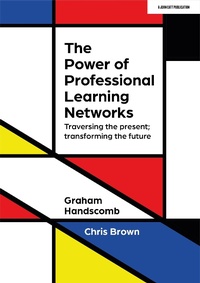
The Power of Professional Learning Networks: Traversing the present; transforming the future
Traversing the present; transforming the future
Published on 27. July 2022
240 pages
978-1-915361-42-4 (ISBN)
Description

Now, more than ever, it seems that the age of professional learning networks has well and truly arrived. The rise and proliferation of digital communication, coupled with the circumstances enforced during the pandemic experience, have led to a dynamic re-imagining of Professional Learning Networks (PLNs) - both in terms of what they are for and what they can achieve. Set against this context this book provides a stimulating insight into the current state of the art of professional learning networks and the transformative difference they are poised to make to our educational future. Drawing on a wealth of expertise, each chapter is written by leading thinkers and doers in the field, and covers a range of topics and emerging areas. These include: the professional learning vistas opened up through digital opportunities; how these networks have helped to enhance teachers' identity and sense of well-being: the new sense of practitioner ownership and partnership now at the heart of PLNs; new openings for professionalization; how PLNs have become vehicles for radically different forms of professional development and learning; and what this all means for school leadership.
More details
Edition
Digital original
Language
English
Place of publication
Saxmundham, Suffolk
United Kingdom
Target group
Primary & secondary/elementary & high school
College/higher education
Interest Age: From 18 to 100 years
File size
4,28 MB
ISBN-13
978-1-915361-42-4 (9781915361424)
Copyright in bibliographic data and cover images is held by Nielsen Book Services Limited or by the publishers or by their respective licensors: all rights reserved.
Schweitzer Classification
Other editions
Additional editions
Chris Brown | Graham Handscomb
The Power of Professional Learning Networks: Traversing the present; transforming the future
Traversing the present; transforming the future
Book
06/2022
John Catt Educational Ltd
€21.50
Shipment within 3-4 weeks
Persons
Graham Handscomb is Honorary Professor with University College London (UCL) and Visiting Professor at Bolton University. He was Professor of Education and Dean of The College of Teachers. He has an extensive career of senior leadership of local authorities and schools and twenty years' teaching experience. Graham has made a considerable contribution to the development of school-based practitioner enquiry and pioneered the concept of the Research Engaged School. He wrote the criteria to establish the national Research Mark Award for the National Foundation for Educational Research. Graham was a member of the National College for School Leadership Networked Learning Communities Assessment Panel. He led the creation of the National discipleship training programme for the United Reformed Church.
As an educational consultant he works with schools, Teaching Schools Alliances and Trusts throughout the UK and has also a range of international experience including developing teacher and leadership development programmes in the UAE and in Wuxi and Suzhou, Jiangsu, China. He is a fellow of numerous universities and organisations and was a senior member of Hughes Hall, University of Cambridge. Graham is editor of Professional Development Today and sits on the editorial boards of a number of journals, including Creative Teaching and Learning, and the Journal of Contemporary English Teaching and Learning in Non-English Speaking Countries.|Chris Brown is Professor in Education at Durham University's School of Education. His own interest in networks began with a chance encounter and a leftfield conversation at the age of five, which resulted in a life-changing difference: the idea that after school, there was a thing called 'university'. In addition to his lived experience in this area, Chris' research activity is also focused on driving forward understanding as to how networks can be used to improve people's life chances, as well as close the outcomes gaps that exist between the richest and poorest communities. This work has been recognized from its innovative nature. For example, in 2018 Chris received a Siftung Mercator Foundation Senior Fellowship, one of only six awarded annually. Other recent prizes received by Chris include the 2015 American Educational Research Association 'Emerging Scholar' award and the 2016 UCEA Jeffrey V. Bennett Outstanding International Research award. Chris was also recently awarded a significant research grant by the German Foundation Bosch 'Stiftung' to examine the effectiveness of area-based reforms: in themselves a specific form network-based approach to improving the outcomes of the most impoverished communities.
As an educational consultant he works with schools, Teaching Schools Alliances and Trusts throughout the UK and has also a range of international experience including developing teacher and leadership development programmes in the UAE and in Wuxi and Suzhou, Jiangsu, China. He is a fellow of numerous universities and organisations and was a senior member of Hughes Hall, University of Cambridge. Graham is editor of Professional Development Today and sits on the editorial boards of a number of journals, including Creative Teaching and Learning, and the Journal of Contemporary English Teaching and Learning in Non-English Speaking Countries.|Chris Brown is Professor in Education at Durham University's School of Education. His own interest in networks began with a chance encounter and a leftfield conversation at the age of five, which resulted in a life-changing difference: the idea that after school, there was a thing called 'university'. In addition to his lived experience in this area, Chris' research activity is also focused on driving forward understanding as to how networks can be used to improve people's life chances, as well as close the outcomes gaps that exist between the richest and poorest communities. This work has been recognized from its innovative nature. For example, in 2018 Chris received a Siftung Mercator Foundation Senior Fellowship, one of only six awarded annually. Other recent prizes received by Chris include the 2015 American Educational Research Association 'Emerging Scholar' award and the 2016 UCEA Jeffrey V. Bennett Outstanding International Research award. Chris was also recently awarded a significant research grant by the German Foundation Bosch 'Stiftung' to examine the effectiveness of area-based reforms: in themselves a specific form network-based approach to improving the outcomes of the most impoverished communities.
Content
- Cover
- Book Title
- Copyright
- Contents
- Acknowledgements
- About the contributors
- Networks make a difference
- Part one: Insights, structures and systems
- The role of networks in supporting school improvement
- Fostering collaboration across schools around the world: insights from TALIS
- Change, adaptation and transformation: peer review and collaborative improvement during the pandemic
- Networking small rural schools in the pandemic
- A new paradigm for professional development and performance management
- Reframing teacher development in uncertain times: new spaces, new collaborations, new purposes
- Big Education: collaboration for change
- Disrupters, innovators, changemakers: the global WomenEd network
- A digital asset: understanding your value and new possibilities in a pandemic/post-pandemic world
- Dynamic, urban professional learning networks
- Part two: Flourishing practice
- Creative collaboration: professional learning in and through the arts
- Discovering professional identities: a networked theatre in education approach to support early career teachers
- Covid-19 driven emergence of an informal network to support vulnerable students
- Scottish Island Schools Network: bringing the remote rural voice to networked professional development
- Global networking for sustainable futures: collegiality and intellectualism as network norms
- Creating a virtual staffroom: dynamic and organic CPD conversations with colleagues, at a distance
- Grassroots professional learning networks
- Teacher research groups: enhancing teacher professionalism during the pandemic
- Networking inside and out: using student voice to improve professional practice
- Professional learning in adult education: crucial roles and future actions of networks and networking
- Concluding reflection: What next for professional learning networks?
- Collaborative caldrons
- Index
- A
- B
- C
- D
- E
- G
- H
- I
- J
- K
- L
- M
- N
- O
- P
- Q
- R
- S
- T
- U
- V
- W
- Y
