

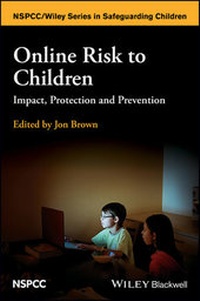
Online Risk to Children
Description

More details
Other editions
Additional editions
Person
Content
Foreword xi
Anne Longfield
About the Contributors xiii
Acknowledgements xvii
Introduction 1
Jon Brown
1 A Brief History of Child Safety Online: Child Abuse Images on the Internet 5
John Carr
Unintended, Unforeseen and Unwanted Consequences 5
Sexual Images of Children 6
The World Wide Web Explosion 7
Affordability, Accessibility and Anonymity - the Three As - Provide the Spur 8
The Number of Arrests and Police Operations Start to Climb 9
The Emergence of Hotlines 10
The Birth of the Internet Watch Foundation 12
Not a Very Promising Start 15
The Terrain Shifts and URL Blocking Emerges 16
Technology Comes to the Rescue of a Problem Technology Helped to Create 18
The Role of Search Engines 19
The Unanswered Questions about Technical Solutions 19
2 Children's and Young People's Lives Online 23
Sonia Livingstone
Trends in Children's Internet Use 24
Parental Responses and Responsibilities 25
Digital Skills as Mediators-Why is it Hard to Get This Right? 27
The Emerging Balance of Opportunities and Risks 28
Evidence-Based Implications for Policy and Practice 30
Conclusion 32
3 Cyberbullying and Peer-Oriented Online Abuse 37
Andy Phippen
Perspectives on Online Child Protection from Parents 39
Policy Responses and 'Prevention' Mechanisms 41
Growing up in the Online World 43
4 Offender Behaviour 55
Helen C. Whittle and Catherine Hamilton-Giachritsis
The Impact of the Online Environment 56
Offending Online 57
Comparison with Offline Offenders 65
Gaps in Our Knowledge 67
Conclusion 67
5 Treatment of Online Offenders: Current Best Practice and Next Steps 73
Sandy Jung
Online Sex Offenders: Characteristics and Comparisons with Contact Offenders 74
Typology of Online Offenders 77
Theories of Online Offending 79
Intervention Best Practices with Online Sex Offenders 81
Conclusion 90
6 The Impact of Online Sexual Abuse on Children and Young People 97
Elly Hanson
Overview of Online Sexual Abuse 98
The Impact of Child Sexual Abuse 102
Characteristics of CSA That Affect Impact 104
Social Contextual Factors That Affect Impact 104
Social and Psychological Processes Following Abuse 106
Complexities to Online Sexual Abuse 106
Salient Factors Underpinning Impact 111
Promoting Resilience, Reducing Impact, Fostering Recovery 116
Research Directions 117
Conclusion 117
7 Promising Therapeutic Approaches for Children, Young People and their Families Following Online Sexual Abuse 123
Elly Hanson
Effective and Promising Treatment Approaches for Problems in Childhood Arising from Sexual Abuse 124
Key Targets for Change in Therapy 127
Promising Methods of Fulfilling Key (Overlapping) Therapeutic Aims 130
Engagement and Building a Strong Therapeutic Relationship 131
Developing Positive Body Esteem and Sexuality 133
Reducing the Impact of Abuse Images Circulating and the Threat of This 133
Overcoming Shame and Self-Blame; Building Pride and Mastery 135
Facilitating Support from Families 136
Conclusion 137
8 Preventing Child Sexual Abuse Online 143
Stephen Smallbone and Richard Wortley
Organising Prevention Strategies 144
Prevention Strategies 146
Primary Prevention 146
Secondary Prevention 150
Tertiary Prevention 154
Conclusion 158
9 Promoting Child Protection Principles in Complex Abuse Investigation Involving Online Offending 163
Zoe Hilton
Definitions 164
Key Principles for Operational Activity 165
Incorporating Child Protection Principles into Operational Planning 166
Principles of Working 166
Capacity and Capability Building 170
Operational Examples 171
Annex 1 173
10 Staying Safe Online 177
Dido Harding
Technology Is Changing the Rules - or Is It? 177
Embracing Opportunities 178
Industry's Responsibility 180
Industry Action 181
The Future Challenge 186
11 UK Policy Responses and Their International Relevance 189
Claire Lilley
Definitions and Terminology 190
Legislation 190
Removal of Child Abuse Content 193
Multi-Agency Approaches 195
The Role of NGOs 197
Policing Response 198
Offenders 202
Victims 205
Recent Developments 206
Conclusion 210
12 The Role of Schools in Children's Online Safety 217
Martin Waller
Online Technologies and Education 218
The Blurring of Boundaries 219
E-Safety and Moral Panics 222
Integrating Online Technologies 223
Implications 227
Conclusion 228
Epilogue 231
Jon Brown
Index 235
1
A Brief History of Child Safety Online: Child Abuse Images on the Internet
John Carr
Foreign holidays used to be a rare treat enjoyed by better-off families, but otherwise, until the Internet arrived, the great majority of the world's children and young people spent pretty much their entire day-to-day lives exposed to and governed by the mores, sights, sounds and laws of one country, usually the one where they were born and lived. The opportunities open to children and young people, as well as any threats or dangers they might encounter on their pathway to adulthood, were generally well understood by their parents and their communities, because more or less everyone had lived through similar situations themselves. The Internet1 changed that. A great many parents and the social institutions charged with safeguarding children were overtaken by events, and it is still by no means clear when or even if a new equilibrium will be established.
UNINTENDED, UNFORESEEN AND UNWANTED CONSEQUENCES
None of the scientists and technologists involved in the early development of the Internet had any idea it would turn out the way it did. Thus in many ways what the world is now having to grapple with in relation to online child abuse images as well as several other areas of crime is an example of the doctrine of unintended, unforeseen and definitely unwanted consequences being played out on an epic scale.
Without computers there could be no Internet. It is therefore tempting to begin a discussion of the history of the Internet by looking first at the history of computing and tracing the journey from there. However, according to the Internet Society2 the real Internet story does not begin until the 1960s with the development of packet switching and later the ARPANET.
In February 2013, in a famous TED Talk,3 Internet pioneer Danny Hillis describes the Internet as it was in 1982: '. it was a very small community. We didn't all know each other but we all kinda trusted each other . . .'
For many years, almost by definition, every Internet user was a highly educated adult. There was a great deal of reciprocity involved in running the network - everybody had a more or less equal stake in its continuing success. Users would behave responsibly within a framework of commonly accepted if typically unstated norms.
During his TED Talk Hillis brandishes in his hands a slender volume that contained the names, email addresses and telephone numbers of everyone who had an Internet account in 1982. He suggested that today a similar volume, if it could be constructed at all, would be about 25 miles high.
In short the early developers of the Internet, although they had a good idea about its potential to do good in the world by facilitating rapid communications between researchers and later businesses, they had no idea that what they were building would end up being exploited on a large scale by criminals to make or distribute child abuse images or to engage in any other type of felonious activity. If they had there seems little doubt they would have built in more security protocols to inhibit such antisocial behaviour.
SEXUAL IMAGES OF CHILDREN
Today child abuse images are very heavily identified with the Internet, but nobody would ever seriously argue the Internet is truly a cause of children being abused or of images of that abuse being made and distributed. The Internet has certainly opened up pathways that, for practical purposes, never previously existed, but that is a different point albeit one of some importance.
The development of photography and printing techniques in the 19th century first allowed for the larger-scale production and distribution of pornography of every type, including some depicting child sex abuse. However, as far as we can tell, since time immemorial there seems always to have been a small but still numerous minority of people,4 mainly but by no means exclusively men, who have had an interest in children as objects of sexual desire or in depictions of children engaged in sexual acts.
In the UK in 1986, before the mass Internet emerged, one of the world's top paediatric specialists, Professor Oliver Brooke, was sent to prison after admitting dealing in and collecting child pornography. When police searched his office at St George's Hospital in London, they found more than 300 photographs of children in explicit sexual poses, 22 albums of cuttings from child pornography magazines and a dozen Danish magazines specialising in child pornography. Professor Brooke, who was later barred by the British General Medical Council from ever practising again as a doctor, was at the time considered to be one of the five top specialists in the world in his field.
Also in 1986 a British local government surveyor, Charles Norris, was sent to prison for sexually abusing young boys and making indecent images of children. Police discovered 5,500 colour slides, 3,500 photographs, 29 photograph albums, 100 videos and 200 books and magazines - mainly featuring young boys - at his home in Kent. Again, Brooke had no connection to the Internet.
Nevertheless, with a limited number of exceptions5 in modern times any sort of sexual interest in children and depictions of it have been the subject of severe societal disapproval based on an appreciation of the harm done to children by early sexual encounters with adults or by other forms of premature involvement with sex.
The law has intervened to underpin, reinforce and reflect these societal values. For example in all major jurisdictions around the world the possession, production and distribution of images of children engaged in sexual acts is now a criminal offence6 and the age at which it becomes lawful for someone to be depicted in a published sexual image is not necessarily the same as the age of consent to sex.7
In 1995, on the eve of the Internet explosion in the UK, the police in Greater Manchester recorded the seizure of only 12 child abuse images in the entire year. In 1995 UK police as a whole were said to have known of the existence of only 7,000 unique child abuse images. INTERPOL then had records of only 4,000 known unique images.
In 'People Like Us,' commissioned in 1996 and published in 1997, Sir William Utting described the production and distribution of child abuse images as being a 'cottage industry.' That was probably about the last moment a statement like that could have been made.
What Sir William meant was that, traditionally, people who wanted to get hold of child abuse materials had to find or know a person who already had some. Alternatively they would need to take considerable personal risks to locate a stranger who could and would oblige or risk asking someone to send them material through the post. With the Internet, a few mouse clicks could put them in touch with a supplier who could deliver in an instant and on a completely unprecedented scale.
THE WORLD WIDE WEB EXPLOSION
At the end of 1980s and at the beginning of the 1990s the Internet was still nothing like it is today. The World Wide Web and the web browsers that would provide easy access to it were just around the corner.
Web browsers did for the Internet what Windows has done for personal computing: made it accessible to the non-technical masses. As with Windows, browsers deployed a 'graphical user interface,' using intuitive icons. These enabled people who did not have a degree in computer science or perhaps a great deal of patience to carry out what would otherwise be quite complex operations potentially involving dozens of obscure, hard-to-remember keystrokes. All they had to do now was click on a little picture.
The first web browser famously was developed at CERN in Switzerland by Tim Berners Lee in 1989-1990. In 1993 the first publicly available web browser arrived. It was called 'Mosaic,' followed in 1994 by 'Netscape,' then in 1995 came Microsoft's 'Internet Explorer.' This was given away free and would go on to capture, at its height, over 95% of the entire web browser market.
Louis XV of France died in 1785, but not before uttering the immortal words 'Apres moi le deluge' (After me, the deluge). Four years later the French Revolution began. The arrival of the web browser was a revolutionary moment of a different kind. Web browsers opened up the Internet to the rough, rude and larger world that hitherto had been excluded from its gentle cloisters.
AFFORDABILITY, ACCESSIBILITY AND ANONYMITY - THE THREE As - PROVIDE THE SPUR
The arrival of the web coincided with a fall in hardware prices, a fall in telecommunications costs and an increase in connection speeds. Affordability and accessibility were here. The belief in anonymity would come soon and complete the circle.
As noted, Sir William Utting had observed that prior to the arrival of the Internet the production and dissemination of child abuse images were essentially local and small scale. If there were larger numbers of people who were interested in child abuse images they seemed to be unwilling to take the risks associated with obtaining them or were disinclined to go to the trouble. The Internet was cheap, easy to use from the comfort of one's own home and it was being widely reported in the press that it could be used anonymously. It opened doors many were to go through who very likely would not have done so otherwise, and it is clear many did because they thought they would be...
