

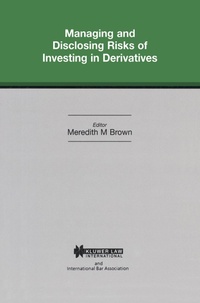
Managing and Disclosing Risks of Investing in Derivatives
Published on 1. August 1996
162 pages
978-90-411-7277-8 (ISBN)
Description

This is a practical handbook of key issues relating to investing in derivatives, both from the point of view of customers who purchase and use derivative products, and from the point of view of banks and other dealers. Among the topics discussed by leading regulators and practitioners in major markets - the United States, the United Kingdom and France - are risks from using and not using derivatives, the disclosures that dealers should make to customers, whether derivatives are securities, what disclosures should be made by users to their shareholders, suits by users against dealers, and what directors of users should know about derivatives. This handbook provides an excellent practical introduction to derivatives for company and securities lawyers, bankers and bank lawyers and corporate finance officers.
More details
Other editions
Additional editions
Meredith Brown
Managing and Disclosing Risks of Investing in Derivatives
Book
08/1996
1st Edition
Kluwer Law International
€94.70
Shipment within 10-20 days
Content
- Cover
- Half Title Page
- Title Page
- Copyright Page
- Table of Contents
- About the IBA, the Section on Business Law, Committee E (Banking) and Committee Q (Issues and Trading in Securities)
- About the Editor and Contributors
- Foreword
- The International Bar Association Series
- 1. The Topic and the Panelists
- 2. What is a Derivative?
- 3. The Volume of Derivatives Trading
- 4. "Normal" Use of Derivatives
- 5. Exotic Derivative Products
- 6. Risks from Not Using Derivatives
- 7. Disclosures by Dealers to Customers
- 8. What if the Customer is not Authorized to Deal in Derivatives?
- 9. Are Derivatives Securities?
- 10. Disclosures by End-users
- 11. Suits by End-users Against Dealers
- 12. Potential Liability of Directors of the End-user
- 13. Differences Among Regulators: Is there a Race to the Bottom?
- 14. Questions from the Floor
- a. OTC vs. Exchange-regulated Products
- b. Derivatives on a Single Security
- c. Overlapping Jurisdiction of Regulators in the U. S.
- 15. Morals
- Appendices 1. Case Study
- 1. "Normal" use of derivatives
- 2. The Treasurer's temptation
- 3. Regulatory developments
- 4. Where should derivatives be traded?
- Appendices 2. Iain Cullen: Discussion Paper - Questions &: Answers
- SECTION A: INTRODUCTION
- 1. DRAMATIS PERSONAE AND KEY DEFINITIONS
- 2. APPROACH
- 3. KEY ASSUMPTIONS
- 4. KEY FACTS IN THE CASE STUDY
- SECTION B: THE QUESTIONS
- QUESTION (a): Does the intended use make a difference?
- QUESTION (b): What disclosures should have been made by the Bank? Does it make any difference that Inter is a large company? Should the Bank have furnished Inter with a written disclosure?
- QUESTION (c): Are disclosures sufficient, or are there questions of suitability which cannot be addressed by disclosure?
- QUESTION (d): PART 1: What laws, if any, have been broken by the Bank?
- QUESTION (d): PART 2: Who is ultimately responsible for problems at the Bank? Are directors at the Bank themselves exposed to liability?
- QUESTION (e): PART 1: What exposure, if any, does Intergalactique face to its own shareholders, from the losses that resulted from the use of the derivative products?
- QUESTION (e): PART 2: Would Intergalactique have been protected from these risks by disclosures in its reports to shareholders? What kind of disclosures? What disclosure should Intergalactique already have been making as a result 'of its "normal" use of derivatives?
- QUESTION (f): PART 1: Would Intergalactique increase its exposure to its shareholders, if Intergalactique were to bring suit against the Bank?
- QUESTION (f): PART 2: What about exposure to the employees who are beneficiaries of the pension fund?
- QUESTION (g): Apart from the exposure of Intergalactique, are the directors of Intergalactique also responsible for the losses? Have they breached a duty of care or a supervisory duty?
- QUESTION (j): Does it matter if the Bank is offering investment advisory services to the pension fund? Custodial services? Other services?
- QUESTION (k): Does it make any difference if Pierre is a trustee of the pension fund?
- QUESTION (I): If the Intergalactique pension fund isn't managed by an investment adviser, does that increase the exposure of Intergalactique?
- Appendices 3. Andrea M. Corcoran: Derivatives Regulation: What's Next? Issues for International Regulators
- Introduction
- Chronology of Important Initiatives Related to Over-the Counter Derivative Transactions - Joint Statement
- GAO Report
- IOSCO Technical Committee Reports
- Derivatives Policy Group Voluntary Framework
- Windsor Declaration
- Burgenstock Regulators to Consider DPG Report
- Management Controls
- Enhanced Supervisory Reporting
- Measurement of Capital Exposure to Risk
- Counterparty relationships
- Coverage
- Related and Follow-Up Activities
- In the Area of Internal and Risk-Management Controls - Joint Audits
- MOU Provisions
- Risk-Assessment Rules
- Recent CFTC Settlement
- In the Area of Capital and Reporting
- In the Area of Sales Practices/Counterparty Relationships - OTC Generic Risk Disclosure
- New York Wholesale Transactions Code
- The National Association of Securities Dealers Suitability Interpretation
- Questions for Regulators
- Index
- Back Cover
