

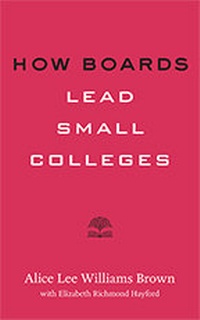
How Boards Lead Small Colleges
Published on 18. June 2019
216 pages
978-1-4214-2863-5 (ISBN)
Description

A college is only as strong as its board of trustees.
While the media frequently report on threats facing colleges and universities, no sector of higher education is in more danger than private colleges with small endowments and low enrollments. Numerous small private liberal arts colleges could benefit from careful consideration of characteristics and practices of successful trusteeship.
In How Boards Lead Small Colleges, Alice Lee Williams Brown and Elizabeth Richmond Hayford focus on small colleges-the kind that seldom attract the attention of researchers. Integrating case studies with theoretical analyses of college governance, they explain the basic responsibilities of boards while demonstrating how some develop practices that fulfill these responsibilities more effectively than others. The book emphasizes strategic planning and collaboration between the board and central administration-advice useful to those governing colleges and universities of all sizes and strengths.
For decades, the authors led consortia of small colleges and served on boards of multiple nonprofit organizations. Here, they interview trustees and presidents at dozens of small colleges across multiple states to identify the role governing boards play in building strong private colleges. Encouraging presidents to consider new approaches for working with their boards based on mutual dedication to strengthening institutions, Brown and Hayford also urge trustees to challenge new thinking from their presidents without interfering in internal operations. How Boards Lead Small Colleges is designed to appeal to anyone with a special interest in the future of small private colleges, which play a critical role in the world of higher education.
While the media frequently report on threats facing colleges and universities, no sector of higher education is in more danger than private colleges with small endowments and low enrollments. Numerous small private liberal arts colleges could benefit from careful consideration of characteristics and practices of successful trusteeship.
In How Boards Lead Small Colleges, Alice Lee Williams Brown and Elizabeth Richmond Hayford focus on small colleges-the kind that seldom attract the attention of researchers. Integrating case studies with theoretical analyses of college governance, they explain the basic responsibilities of boards while demonstrating how some develop practices that fulfill these responsibilities more effectively than others. The book emphasizes strategic planning and collaboration between the board and central administration-advice useful to those governing colleges and universities of all sizes and strengths.
For decades, the authors led consortia of small colleges and served on boards of multiple nonprofit organizations. Here, they interview trustees and presidents at dozens of small colleges across multiple states to identify the role governing boards play in building strong private colleges. Encouraging presidents to consider new approaches for working with their boards based on mutual dedication to strengthening institutions, Brown and Hayford also urge trustees to challenge new thinking from their presidents without interfering in internal operations. How Boards Lead Small Colleges is designed to appeal to anyone with a special interest in the future of small private colleges, which play a critical role in the world of higher education.
More details
Series
Language
English
Place of publication
Baltimore
United States
Target group
Professional and scholarly
File size
0,41 MB
ISBN-13
978-1-4214-2863-5 (9781421428635)
DOI
10.1353/book.66179
Copyright in bibliographic data and cover images is held by Nielsen Book Services Limited or by the publishers or by their respective licensors: all rights reserved.
Schweitzer Classification
Other editions
Additional editions
Alice Lee Williams Brown | Elizabeth Richmond Hayford
How Boards Lead Small Colleges
Book
06/2019
Johns Hopkins University Press
€30.00
Shipment within 10-20 days
Persons
Alice Lee Williams Brown, president emerita of the Appalachian College Association, is the author of Cautionary Tales: Strategy Lessons from Struggling Colleges. Elizabeth Richmond Hayford, the former president of the Associated Colleges of the Midwest, teaches in Northwestern University's Higher Education Administration and Policy Program.
Content
Acknowledgments
Frequently Used Acronyms
Introduction
Chapter One. Characteristics of Boards
Chapter Two: Selecting Trustees
Chapter Three: Training and Supporting Trustees
Chapter Four: Basic Responsibilities of Trustees
Chapter Five: Hiring and Supporting the President
Chapter Six: Evaluating and Possibly Terminating the President
Chapter Seven: Building Institutional Stability
Chapter Eight: Being Responsible to Those Outside the Boardroom
Chapter Nine: A Critical Element in Making a Small College Great
Conclusion: Steps to the Future
Notes
References
Index
Frequently Used Acronyms
Introduction
Chapter One. Characteristics of Boards
Chapter Two: Selecting Trustees
Chapter Three: Training and Supporting Trustees
Chapter Four: Basic Responsibilities of Trustees
Chapter Five: Hiring and Supporting the President
Chapter Six: Evaluating and Possibly Terminating the President
Chapter Seven: Building Institutional Stability
Chapter Eight: Being Responsible to Those Outside the Boardroom
Chapter Nine: A Critical Element in Making a Small College Great
Conclusion: Steps to the Future
Notes
References
Index
