

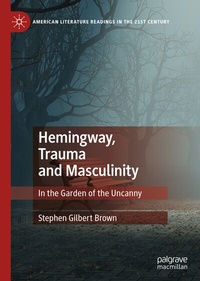
Hemingway, Trauma and Masculinity
Description

Hemingway, Trauma and Masculinity: In the Garden of the Uncanny is at once a model of literary interpretation and a psycho-critical reading of Hemingway's life and art. This book is a provocative and theoretically sophisticated inquiry into the traumatic origins of the creative impulse and the dynamics of identity formation in Hemingway. Building on a body of wound-theory scholarship, the book seeks to reconcile the tensions between opposing Hemingway camps, while moving beyond these rivalries into a broader analysis of the relationship between trauma, identity formation and art in Hemingway.
Reviews / Votes
"Stephen Gilbert Brown draws from his colossal knowledge of literature and psychology and blazes a new trail through Hemingway's life and work. Brown is particularly nimble when analyzing the less prominent works, the dark corners of Hemingway's career, which he mines to yield fascinating discoveries. Elegantly written and convincingly argued, Hemingway, Trauma, and Masculinity: In the Garden of the Uncanny becomes an indispensable text in future discussions of Hemingway and the trauma that underlies his work." (Mark Cirino, Associate Professor of English, University of Evansville, USA)More details
Other editions
Additional editions
Person
Stephen Gilbert Brown is Professor of English and Barrick Scholar of Modern Comparative Literature at University of Nevada, Las Vegas, USA, where he teaches courses in Hemingway, Joyce and Proust. He is the author of The Gardens of Desire: Marcel Proust and the Fugitive Sublime (2004); Socrates and Freire: Ancient Rhetoric/ Radical Praxis (2011) and the award-winning Words in the Wilderness (2000).
Content
Chapter 1: Introduction: Entering the Garden: The Genealogy of a Reading.- Chapter 2: Eden and its Discontents.- Chapter 3: The Mother of Invention: The Birth of the Twin.- Chapter 4: Sisters of the Forest.- Chapter 5: The Forest of Four Wounds: Hemingway and the Sawyer's Daughter.- Chapter 6: As One Animal of the Forest: " The Last Good Country " of Sibling Eros.- Chapter 7: The Father of the Forest: Identity Formation and Hemingway's Naturalist Calling.- Chapter 8: An Uncanny Genealogy: Agassiz, Roosevelt, and Pound.- Chapter 9: A Father's Fall from Grace.- Chapter 10: The Rise of the Old Brute.- Chapter 11: Tabula Fabulas: Re-Reading Hemingway's First Narratives.
