

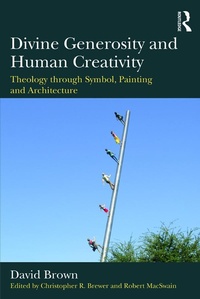
Divine Generosity and Human Creativity
Theology through Symbol, Painting and Architecture
Published on 22. February 2017
224 pages
978-1-317-14892-0 (ISBN)
Description

Partly in a desire to defend divine freedom and partly because it is seen as the only way of preserving a distinctive voice for theology, much contemporary theology has artificially restricted revelation and religious experience, effectively cutting off those who find God beyond the walls of the Church. Against this tendency, David Brown argues for divine generosity and a broader vision of reality that sees God deploying symbols (literary, visual and sacramental) as a means of mediating between the divine world and our own material existence. A sustained argument for divine interaction and more specifically the ways in which God speaks in the wider imaginative world, this volume calls for a careful listening exercise since symbols are richer and more open in their possibilities than their users often suppose. Not only is this true of the imagery of Scripture, even inanimate objects like buildings or hostile but creative artists can have important things to say to the believing Christian. An ideal introduction that also moves the conversation forward, this volume addresses foundations, the multivalent power of symbols, artists as theologians and meaning in religious architecture.
Reviews / Votes
'David Brown helps us regard art and imagination as truly and irreducibly constructive (though not beyond criticism), and as potentially part of genuine critique-even when ignored almost completely by much of academic theology. There is no one I would rather be reading, or have students of theology and the arts be taking into full consideration. In fact, I've never read a theologian more informed-and more "generous"-in insisting on the integral connection between theology, the arts, and imagination.' - Frank Burch Brown, Frederick Doyle Kershner Professor Emeritus of Religion and the Arts, Christian Theological Seminary, USA'In this important volume of essays David Brown works to widen the avenues of exchange between theology and the arts, getting the traffic between the two to move more freely in both directions and to carry heavier freight in the process. Brown's writing is irenic and erudite, drawing insights from an astonishing range of biblical, theological and art historical studies into new, mutually enriching dialogue.' - Jonathan A. Anderson, associate professor of art, Biola University, USA
'An excellent introduction to the work of David Brown, these essays offer great insight into the theoretical principles and criteria undergirding his writings on human creativity and the imagination. The central idea in Brown's work, which is the intrinsic, sacramental relationship of revelation and imagination, will prove to be a significant starting point for new theological developments in the years to come.' - Stephan van Erp, professor of fundamental theology, KU Leuven, Belgium
'This is a wonderfully liberating way of looking at religious art that reflects a truth often lost through a tradition of rehearsed dogma and doctrine. Anyone looking for a way in to such a rich and rewarding area of study should look no further.' - Stephen Miller in Reading Religion
'A Renaissance man in a time of ever-growing specialisation, Brown's work impresses in scope, research, energy and erudition... His knowledge is breath-taking.' - Gesa E. Thiessen in New Blackfriars
'... a powerful, very readable, and at times quietly subversive exercise in theological aesthetics.' - Graham Howes in Theology
'This collection of essays is accessible and well written, offering an introduction to Brown's thought while also allowing those familiar with his work to delve deeper into his ideas. As always, his work is theologically rigorous while being grounded in the practice of art and wider human experience.' - Sarah Schumacher in The Living Church 'David Brown helps us regard art and imagination as truly and irreducibly constructive (though not beyond criticism), and as potentially part of genuine critique-even when ignored almost completely by much of academic theology. There is no one I would rather be reading, or have students of theology and the arts be taking into full consideration. In fact, I've never read a theologian more informed-and more "generous"-in insisting on the integral connection between theology, the arts, and imagination.' - Frank Burch Brown, Frederick Doyle Kershner Professor Emeritus of Religion and the Arts, Christian Theological Seminary, USA
'In this important volume of essays David Brown works to widen the avenues of exchange between theology and the arts, getting the traffic between the two to move more freely in both directions and to carry heavier freight in the process. Brown's writing is irenic and erudite, drawing insights from an astonishing range of biblical, theological and art historical studies into new, mutually enriching dialogue.' - Jonathan A. Anderson, associate professor of art, Biola University, USA
'An excellent introduction to the work of David Brown, these essays offer great insight into the theoretical principles and criteria undergirding his writings on human creativity and the imagination. The central idea in Brown's work, which is the intrinsic, sacramental relationship of revelation and imagination, will prove to be a significant starting point for new theological developments in the years to come.' - Stephan van Erp, professor of fundamental theology, KU Leuven, Belgium
'This is a wonderfully liberating way of looking at religious art that reflects a truth often lost through a tradition of rehearsed dogma and doctrine. Anyone looking for a way in to such a rich and rewarding area of study should look no further.' - Stephen Miller in Reading Religion
'A Renaissance man in a time of ever-growing specialisation, Brown's work impresses in scope, research, energy and erudition... His knowledge is breath-taking.' - Gesa E. Thiessen in New Blackfriars
'... a powerful, very readable, and at times quietly subversive exercise in theological aesthetics.' - Graham Howes in Theology
'This collection of essays is accessible and well written, offering an introduction to Brown's thought while also allowing those familiar with his work to delve deeper into his ideas. As always, his work is theologically rigorous while being grounded in the practice of art and wider human experience.' - Sarah Schumacher in The Living Church"In this collection of essays by David Brown, he repeatedly and convincingly demonstrates that imagination, creativity, and the arts are essential to the practice and exploration of theology as a whole. Symbiotically connected, these arenas are richer when encountered together and when mutuality is acknowledged and amplified. Brown's essays get to the heart of some of the most difficult themes in theology and the arts with a satisfying swiftness." -Ayla Lepine, in Arts and Christianity
More details
Language
English
Place of publication
London
United Kingdom
Publishing group
Taylor & Francis Ltd
Target group
College/higher education
Product notice
Reflowable
File size
0,60 MB
ISBN-13
978-1-317-14892-0 (9781317148920)
Copyright in bibliographic data and cover images is held by Nielsen Book Services Limited or by the publishers or by their respective licensors: all rights reserved.
Schweitzer Classification
Other editions
Additional editions
David Brown | Christopher Brewer | Robert Macswain
Divine Generosity and Human Creativity
Theology through Symbol, Painting and Architecture
Book
02/2017
1st Edition
Routledge
€206.30
Shipment within 10-20 days
David Brown | Christopher Brewer | Robert Macswain
Divine Generosity and Human Creativity
Theology through Symbol, Painting and Architecture
Book
02/2017
1st Edition
Routledge
€74.30
Shipment within 10-20 days
Persons
David Brown retired from the University of St Andrews as Professor of Theology, Aesthetics and Culture in 2015, having previously held positions at Oxford and Durham. Five major volumes on relations between theology and the arts were published with OUP between 1999 and 2008, with a large edited volume on Durham Cathedral: History, Fabric and Culture (Yale, 2015) his most recent contribution. He was elected a Fellow of the British Academy in 2002 and of the Royal Society of Edinburgh in 2012.
Christopher R. Brewer (PhD, St And) is a Program Officer of the Templeton Religion Trust in Nassau, The Bahamas. He has edited or co-edited six volumes including Christian Theology and the Transformation of Natural Religion: From Incarnation to Sacramentality--Essays in Honour of David Brown.
Robert MacSwain is Associate Professor of Theology at the School of Theology of the University of the South in Sewanee, Tennessee, USA. The author of Solved by Sacrifice: Austin Farrer, Fideism, and the Evidence of Faith, he has edited or co-edited six other volumes, including Theology, Aesthetics, and Culture: Responses to the Work of David Brown.
Christopher R. Brewer (PhD, St And) is a Program Officer of the Templeton Religion Trust in Nassau, The Bahamas. He has edited or co-edited six volumes including Christian Theology and the Transformation of Natural Religion: From Incarnation to Sacramentality--Essays in Honour of David Brown.
Robert MacSwain is Associate Professor of Theology at the School of Theology of the University of the South in Sewanee, Tennessee, USA. The author of Solved by Sacrifice: Austin Farrer, Fideism, and the Evidence of Faith, he has edited or co-edited six other volumes, including Theology, Aesthetics, and Culture: Responses to the Work of David Brown.
Content
Editor's Introduction Christopher R. Brewer
Part I
Foundations
Introduction
In the Beginning Was the Image
Why Theology Needs the Arts
Learning from Pagans
Part II
The Power of Symbols
Introduction
Understanding Symbol
Baptism and Water as Cosmological Symbol
'The darkness and the light are both alike to thee': Finding God in Limited Light and Darkness
Part III
Artists as Theologians
Introduction
The Annunciation as True Fiction
Why the Ascension Matters
Artists on the Trinity
Part IV
Meaning in Religious Architecture
Introduction
Architecture and Theism
Interfaith Dialogue through Architecture
Tensions Between Politics and Religious Symbolism in Architecture
Worshipping with Art and Architecture
Part I
Foundations
Introduction
In the Beginning Was the Image
Why Theology Needs the Arts
Learning from Pagans
Part II
The Power of Symbols
Introduction
Understanding Symbol
Baptism and Water as Cosmological Symbol
'The darkness and the light are both alike to thee': Finding God in Limited Light and Darkness
Part III
Artists as Theologians
Introduction
The Annunciation as True Fiction
Why the Ascension Matters
Artists on the Trinity
Part IV
Meaning in Religious Architecture
Introduction
Architecture and Theism
Interfaith Dialogue through Architecture
Tensions Between Politics and Religious Symbolism in Architecture
Worshipping with Art and Architecture
