

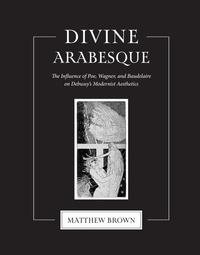
Divine Arabesque
Description

The arabesque, a crucial component of nineteenth-century aesthetics characterized by recurring patterns of interlocking geometric and floral ornamentation, was found in a wide range of forms of artistic expression and played a pivotal role in the music of Claude Debussy. Divine Arabesque explores the arabesque in Debussy's music and reveals its profound influence on his musical repertoire and on the works of other Symbolist artists and writers.
Taking as his starting point a discussion of the short manifesto Debussy published in "La Revue blanche" in 1901, author Matthew Brown embarks on a thorough and comprehensive analysis of Debussy's works across all phases of his career and genres-from his early songs and piano pieces to mature orchestral compositions and late works. Along the way, Brown unveils the intertextual connections between Debussy's compositions and the works of such Symbolist artists as Edgar Allan Poe, Richard Wagner, Charles Baudelaire, Stéphane Mellarmé, Vaslav Nijinsky, and others.
Featuring a rich collection of music examples and illustrations, Divine Arabesque sheds new light on the full range of Debussy's musical output and establishes his critical role in ushering in the age of Modernism.
More details
Other editions
Additional editions
Person
Matthew Brown is Professor of Music Theory at the Eastman School of Music. He is author of Debussy Redux: The Impact of His Music on Popular Culture (IUP, 2011), (with Th. Emil Homerin) Ariane & Bluebeard: From Fairy Tale to Comic Book Opera (IUP, 2022), and (with Robert W. Wason) Heinrich Schenker's Conception of Harmony.
Content
Acknowledgments
I: Preliminaries
Introduction: Debussy's Concept of the Musical Arabesque
1. Arabesques, Moresques, and Grotesques
II: Decoration and Counterpoint
2. Debussy's Première Arabesque and the Legacy of J. S. Bach
3. Exoticism, Escapism, and Ennui
4. Prélude à L'Après-midi d'un faune
III: Part and Whole
5. "A Premeditated Design"
6. La Mer and the Case of the Missing Fanfares
7. Bitten by the Tarantella: Debussy and Self-Generating Form
IV: Borrowing and Self-Generation
8. Pelléas et Mélisande, Arabesques, and Texts within Texts
9. Fake Beards and False Mustaches
10. Jeux: Poetry as Dance
V: Emotions and Images
11. "Les miroirs ternis"
12. Debussy's Cinematic Obsessions
13. Arabesques as Confessions
Conclusion: Coming Full Circle
Bibliography
Index
