

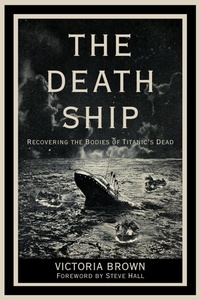
The Death Ship
Recovering the Bodies of Titanic's Dead
Published on 3. April 2025
224 pages
978-1-80399-804-6 (ISBN)
Description

Death is a topic we often avoid talking about, but in The Death Ship Victoria Brown faces it head on, taking a deep dive into the fate of Titanic's victims: how did they die? How did their bodies decompose? Were their bodies recovered and buried? What happened to the bodies that went down with the ship?
And what of Titanic's legacy? Here, Brown explores the proposed legislative changes, salvage proposals and surge of interest the wreck received shortly after the disaster, alongside the contemporary controversy surrounding the wreck as a shipwreck versus a gravesite.
The Death Ship is a fascinating, at times shocking, examination of the ill-fated souls who tragically lost their lives that day - a crucial but seldom told part of Titanic's enduring story. It also gives recognition to the people of Halifax in Nova Scotia, Canada, whose unwavering dedication ensured those who died were properly taken care of.
And what of Titanic's legacy? Here, Brown explores the proposed legislative changes, salvage proposals and surge of interest the wreck received shortly after the disaster, alongside the contemporary controversy surrounding the wreck as a shipwreck versus a gravesite.
The Death Ship is a fascinating, at times shocking, examination of the ill-fated souls who tragically lost their lives that day - a crucial but seldom told part of Titanic's enduring story. It also gives recognition to the people of Halifax in Nova Scotia, Canada, whose unwavering dedication ensured those who died were properly taken care of.
Reviews / Votes
'Victoria sheds an interesting light on the RMS Titanic tragedy, with her focus on death, decomposition, and recovery of the passengers and crew by the 'death ships'. A very insightful read.' -- Dee Ryan-Meister, Maritime Marine History Researcher/ Editor/ Titanic Society of Atlantic Canada President 'A fascinating, information-saturated, thorough research work dealing with a wide variety of topics that constitute the core subject of death on Titanic in a broad sense, both during the sinking and beyond, including the recovery of dead bodies and the mortal remains of the ship itself. This book really provides an extensive overview, sometimes dark, sometimes enlightening, and stimulates your thinking superbly. At the same time, and rather paradoxically, it makes you feel glad to be alive, as John B. 'Jack' Thayer once wrote.' -- Eugene Nesmeyanov, author of <i>The Titanic Expeditions: Diving to the Queen of the Deep 1985-2021</i> 'There are many facets that combine to tell the story of Titanic, from conception, construction to maiden voyage and tragedy, all well covered in the pages of history books. The last episode in Titanic's tale, however, is not widely discussed for obvious reasons. The Death Ship covers the final chapter of Titanic's tragedy, delving into the sometimes gruesome aspects of the reality of death as is associated with a tragedy at sea, and providing a well-organized reference to the out-coming legislation, recovery efforts and final arrangements of Titanic's fatalities; it deserves a place on the historian's book shelf.' -- Bruce Beveridge, author of <i>Titanic: The Ship Magnificent</i> 'In this book, Victoria Brown looks into how and why so many of those aboard Titanic lost their lives. ... examines in detail the fates of the 1,496 people who perished on that cold and moonless night ... how those lost died, how their bodies were recovered and where their remains were interred.' -- Steve Hall, <i>Titanic</i> historian and author (from the Foreword to <i>The Death Ship</i>)More details
Language
English
Place of publication
Stroud
United Kingdom
Illustrations
15 Illustrations, black and white
File size
7,31 MB
ISBN-13
978-1-80399-804-6 (9781803998046)
Copyright in bibliographic data and cover images is held by Nielsen Book Services Limited or by the publishers or by their respective licensors: all rights reserved.
Schweitzer Classification
Other editions
Additional editions
Book
04/2025
The History Press Ltd
€25.50
Shipment within 3-4 weeks
Persons
VICTORIA BROWN studied English Literature & Film Studies, reflecting her love of storytelling and history, especially the Victorian and Edwardian eras. While at Queen's University Belfast, she was the Editor of The Gown Independent Newspaper, the oldest student newspaper in the UK, and has always written stories and non-fiction. She has written about art and feminist history and presented talks for feminist horror film club Ghouls on Film. Growing up in Northern Ireland, she has always been fascinated by Titanic,/i>, and is a keen supporter of the Death Positive movement.
STEVE HALL is a historian, author, novelist and renowned Titanic researcher. He is one of the world's foremost authorities on her photographic record, having collected, studied and researched the ship for over three decades, and is a recognised authority on the technical aspects of the Olympic-class ships. He is a consultant for media centres, auction houses and museums around the world and is regularly invited to conduct talks with history students. He is a foundation member of the Titanic and Steamship Historical Society of Australia.
STEVE HALL is a historian, author, novelist and renowned Titanic researcher. He is one of the world's foremost authorities on her photographic record, having collected, studied and researched the ship for over three decades, and is a recognised authority on the technical aspects of the Olympic-class ships. He is a consultant for media centres, auction houses and museums around the world and is regularly invited to conduct talks with history students. He is a foundation member of the Titanic and Steamship Historical Society of Australia.
